

What is the weight per square meter of aluminum honeycomb wall panels?
What is the weight per square meter of aluminum honeycomb wall panels? It’s a question that surfaces—not once, but repeatedly—during early-stage design reviews, structural calculations, and even on-site coordination meetings. You’re not just asking for a number. You’re weighing trade-offs: How much load can the substrate bear? Will cranes or manual handling suffice? Does this panel allow for larger spans without intermediate framing? And quietly, beneath all that: *Will it still look seamless, stay flat, and pass fire tests?*
At Shenyang Shengshi Meilin Technology Co., Ltd., we hear this question in many accents—architects from Shanghai sketching curtain walls for high-rises, contractors in Dubai coordinating façade logistics under tight timelines, interior designers in Berlin specifying partition systems for open-plan offices. Their contexts differ, but the need is consistent: reliable, transparent, context-aware data—not generic brochures or rounded-up estimates.
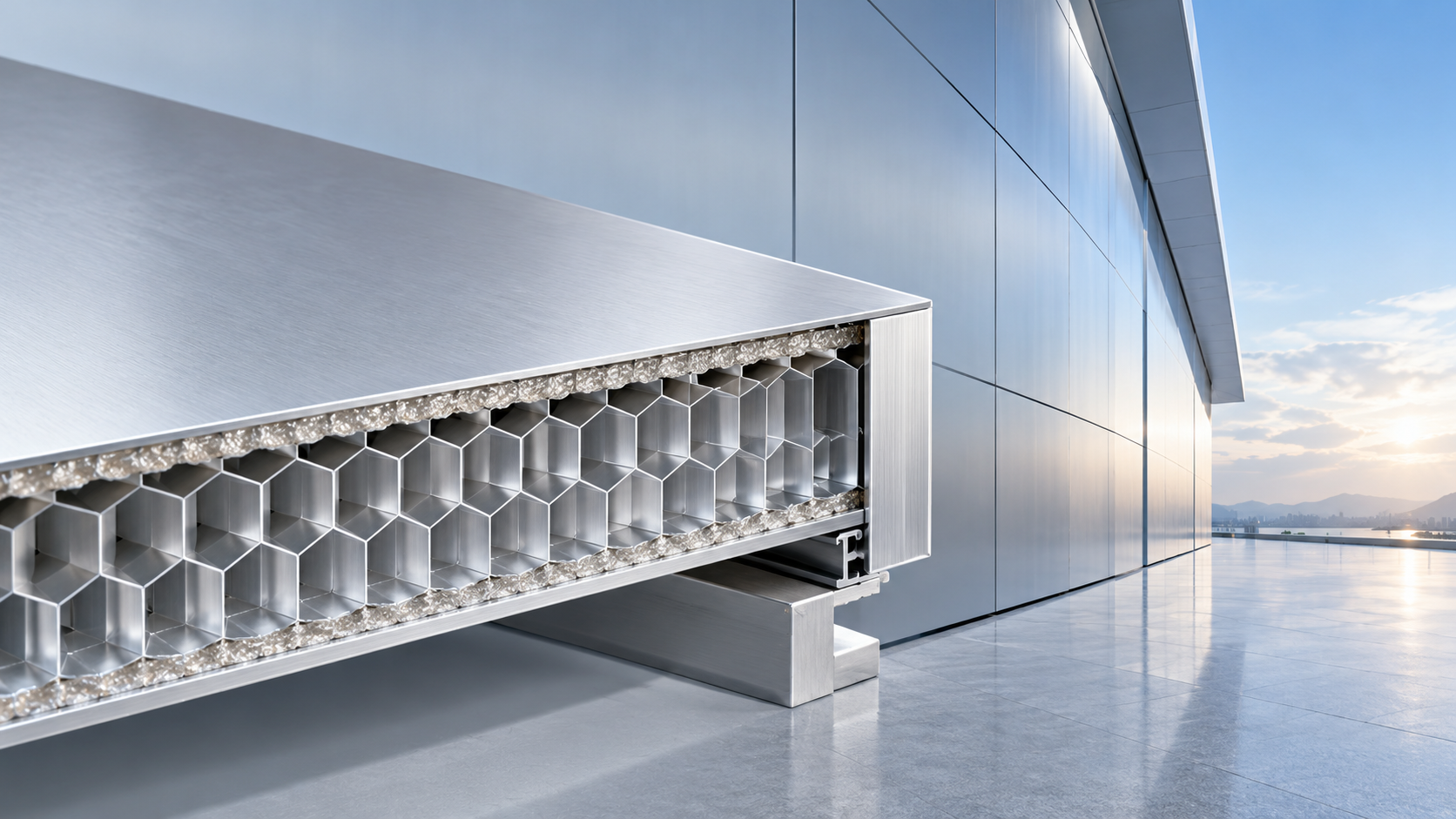
So let’s start with the core answer—but not as a single figure. Aluminum honeycomb wall panels don’t have *one* weight per square meter. They have a range—shaped by real engineering choices, not marketing convenience. For standard architectural-grade panels (3–6 mm total thickness, using 0.5–0.8 mm aluminum skins and 3–5 mm honeycomb core), the typical weight falls between 3.5 kg/m² and 6.5 kg/m². That’s lighter than most fiber cement boards (12–15 kg/m²), significantly lighter than solid aluminum plates (12–20+ kg/m²), and roughly comparable to premium composite panels—but with superior rigidity-to-weight ratio.
Why does that range exist? Because “aluminum honeycomb wall panel” isn’t a monolithic product—it’s a family. Think of it like choosing a bicycle: road, gravel, or e-bike—all share the same basic geometry, but frame material, tube thickness, and component specs change everything. Similarly, weight shifts based on three interlocking variables:
- Skin thickness and alloy grade: Most panels use 3003-H14 or 5052-H32 aluminum alloys. Thinner skins (0.4 mm) shave off ~0.8 kg/m² versus 0.8 mm—without sacrificing dent resistance if core density and bonding quality are maintained.
- Core cell size and foil thickness: A 3 mm core with 0.05 mm foil yields lower weight than a 5 mm core with 0.08 mm foil—even if total panel thickness is identical. Smaller cells improve flatness; thicker foil boosts impact resilience. We optimize both for specific applications—not just minimum weight.
- Surface treatment and backing layers: A raw mill-finish panel weighs less than one with PVDF coating (+0.15–0.3 kg/m²) or fire-rated mineral backing (+0.5–1.2 kg/m²). At Shengshi Meilin, we never quote weight without clarifying finish configuration—because that extra half-kilogram matters when you’re installing 2,000 m² across eight floors.
This precision isn’t theoretical. It comes from our R&D lab in Shenyang, where every batch undergoes dimensional stability testing, peel strength validation, and calibrated weight verification—not just per sample, but per production run. Our registered capital of 30 million yuan reflects more than scale; it funds metrology-grade scales, climate-controlled aging chambers, and cross-functional teams who treat weight not as a spec sheet footnote, but as a design parameter.
But here’s what experienced users often overlook: weight alone doesn’t tell the full story. A panel at 4.2 kg/m² may sag over time if its core bond degrades under thermal cycling. Another at 5.8 kg/m² might deliver flawless flatness for 15 years—if engineered with balanced skin tension and optimized adhesive shear distribution. That’s why we embed weight data within broader performance context: fire classification (our standard panels meet GB 8624–2012 Class B1 and EN 13501–1 Class B-s1,d0), thermal expansion coefficient (23 × 10⁻⁶/°C), and long-term deflection under wind load (tested at ±2.5 kPa).
Real-world implications follow naturally. In retrofit projects—where existing structures limit added dead load—a 3.9 kg/m² panel enables cladding upgrades without reinforcing slabs or columns. In modular construction, lighter panels reduce crane dependency and accelerate installation cycles. And in interiors, sub-4.5 kg/m² partitions allow ceiling-mounted track systems instead of floor-fixed studs—preserving spatial flow and reducing acoustic bridging.
We’ve also seen how misreading weight leads to unintended consequences. One project specified “lightweight aluminum honeycomb” without defining minimum rigidity—resulting in panels that passed weight checks but buckled near HVAC vents due to localized thermal stress. Another team opted for ultra-thin skins to hit a target weight, only to find edge chipping during transport. These aren’t failures of material—they’re gaps in specification dialogue. Which is why our technical support begins not with quoting numbers, but with asking: *Where will this panel live? What’s the longest unsupported span? What’s your tolerance for field adjustment?*
For those comparing options, here’s a practical filter: If your priority is pure weight reduction—and you’re willing to accept tighter tolerances on flatness or limited fire rating—look for panels with thinner skins and minimal backing. But if longevity, low-maintenance aesthetics, and code compliance are non-negotiable (especially in public buildings or high-humidity zones), a slightly higher weight—say, 5.2–6.0 kg/m²—is often the smarter investment. It buys you wider joint tolerances, better sound attenuation, and fewer callbacks for re-leveling.
And yes—environmental responsibility ties directly into weight. Lighter panels mean less fuel burned in transport. Our aluminum is sourced from smelters certified to ASI Performance Standard, and our bonding adhesives are formaldehyde-free and VOC-compliant. Weight efficiency, in this sense, isn’t just structural—it’s ecological.
So when someone asks, *What is the weight per square meter of aluminum honeycomb wall panels?*, the most honest answer starts with listening. Not just to the number they want, but to the unspoken constraints behind it: the crane’s reach, the engineer’s margin, the tenant’s expectation of quiet elegance, the site manager’s deadline. At Shengshi Meilin, we don’t sell panels—we help resolve tensions between ambition and feasibility. And sometimes, the right weight isn’t the lowest one. It’s the one that carries the whole story: strength, safety, sustainability, and silence in the joints.
If you’re evaluating panels for an upcoming project, we recommend requesting a certified weight report—not just for your selected configuration, but alongside third-party test summaries for fire, bending stiffness, and thermal cycling. Because in architecture, the most meaningful numbers aren’t always the ones printed largest on the datasheet.
RECOMMEND

Oct 26, 2026
How Do You Choose Fire-Resistant Composite Panels for Commercial Use?
Choose fire resistant composite panels for commercial interior projects. Learn how to verify fire documentation, compare options, and avoid costly specification mistakes.
Oct 26, 2026
Are Meilin Board Custom Panels Suitable for Luxury Hotel Lobbies?
Explore Meilin Board custom decorative panels for luxury hotel lobbies. Discover design considerations and essential fire, emissions, and maintenance checks before specifying your project.
Oct 26, 2026
Stone-Look Wall Panels vs. Natural Stone: Which Costs Less?
Compare stone look wall panels vs natural stone cost, from materials and installation to maintenance. Discover which option delivers better value for your next wall project.
Oct 25, 2026
How Strong Are Meilin Board Aluminum Honeycomb Panels?
Explore aluminum honeycomb panels structural strength with Meilin Board. Learn how thickness, core design, and fixings affect performance to choose panels confidently.