How Strong Are Meilin Board Aluminum Honeycomb Panels?
Meilin Board aluminum honeycomb panels can provide high rigidity and a favorable strength-to-weight ratio, but their real structural performance cannot be judged from the words “aluminum honeycomb” alone. Panel thickness, aluminum alloy and skin gauge, honeycomb core density, bonding quality, edge treatment, support spacing, and the type of load all affect the result.
For decorative walls, ceilings, façades, furniture components, and interior panels, their main advantage is usually stiffness with low weight rather than unlimited load-bearing capacity. A properly engineered panel can resist bending, vibration, impact, and dimensional movement effectively. However, it should not automatically be treated as a substitute for a structural slab, beam, or independently designed load-bearing system.
What makes an aluminum honeycomb panel strong?
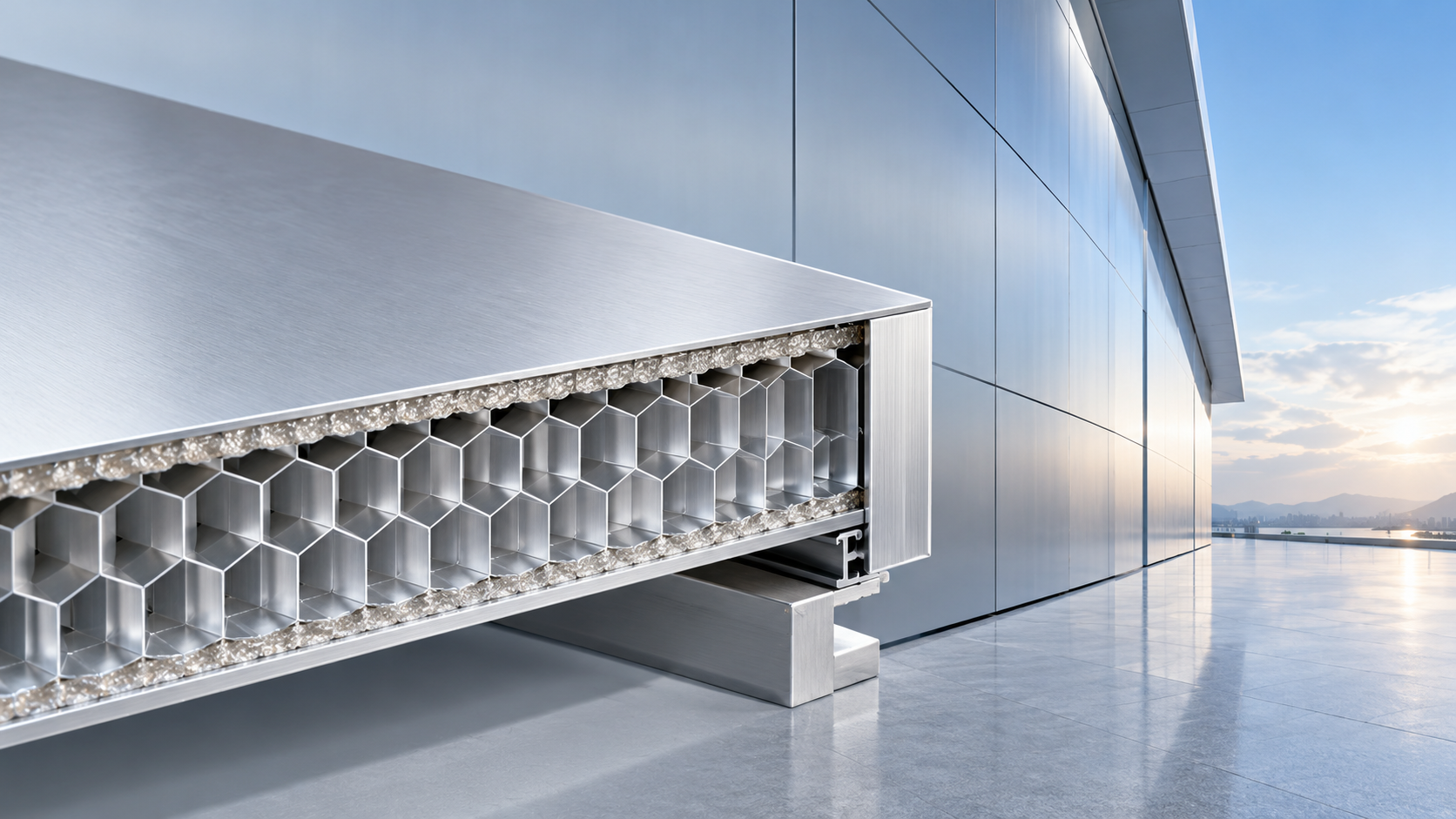
An aluminum honeycomb panel normally consists of two relatively thin aluminum skins bonded to a lightweight honeycomb core. This configuration works in a similar way to an I-beam: the outer skins carry much of the tensile and compressive stress created by bending, while the core keeps the skins separated and transfers shear between them.
That separation is important. Increasing the distance between the skins can raise bending stiffness without adding the same amount of material as a solid aluminum plate. The result is a panel that may be much lighter than a solid sheet with comparable resistance to deflection under certain loading conditions.
The core does not simply act as filler. Its cell size, foil thickness, density, orientation, and bonding to the skins influence shear resistance, local compression, vibration response, and the panel’s ability to maintain its geometry. If the core-to-skin bond is weak or inconsistent, the theoretical performance of the sandwich structure will not be achieved.
Is strength the same as stiffness?
No. This distinction is essential when evaluating aluminum honeycomb panels structural strength.
Stiffness describes how much a panel deflects under a load. A stiff panel bends less and may feel more solid during handling or use.
Strength describes the load at which a component yields, fractures, buckles, suffers core shear failure, loses its bond, or otherwise stops performing safely.
A panel may be stiff enough for a large wall or ceiling surface while still being unsuitable for a concentrated fixing point or heavy suspended load. Conversely, a panel may survive a high short-term load but show excessive deflection that makes it unsuitable for a visible architectural application.
For procurement and design decisions, both values matter. Deflection limits, ultimate failure loads, service loads, and safety factors should be considered separately rather than relying on a single “strength” number.
Which loads can Meilin Board panels resist?
The answer depends on how the panel is installed and where the force is applied. A panel used as a flat wall cladding element may mainly experience wind pressure, suction, handling forces, thermal movement, and vibration. A ceiling panel may also be affected by its own weight, access loads, suspended components, and local fixing forces. Furniture or interior components can experience repeated contact, impact, and concentrated loads around hinges, brackets, or fasteners.
Under a uniformly distributed load, the sandwich construction can perform efficiently because the skins work across the panel area. Under a concentrated load, the situation is more demanding. A small force may press through an outer skin, crush the core, deform a fixing, or create local debonding even when the overall panel remains strong in bending.
This is why a panel’s span and support layout are as important as its material composition. A thicker panel with suitable supports may be appropriate for a long span, while a thinner panel may be adequate for a short, well-supported area. The same product can therefore be suitable in one application and unsuitable in another without any change in its nominal material category.
How does panel construction affect performance?
Several construction variables should be reviewed before comparing suppliers or specifications.
- Face-sheet thickness: Thicker skins generally improve bending resistance, surface durability, and resistance to local indentation, although the benefit depends on the complete panel design.
- Core thickness: A deeper core can increase bending stiffness, but it does not eliminate the need to check core shear, edge compression, and connection behavior.
- Core density and cell geometry: These influence shear performance, weight, energy absorption, and resistance to local crushing.
- Aluminum alloy and temper: Different alloy conditions have different yield strength, ductility, corrosion behavior, and forming characteristics.
- Adhesive system: The adhesive must maintain adequate bond strength under expected temperature, humidity, vibration, and aging conditions.
- Manufacturing consistency: Variations in skin flatness, adhesive coverage, core alignment, and curing can affect the actual performance of a batch.
- Edges and reinforcements: Open honeycomb edges are vulnerable to damage and moisture ingress. Perimeter closures, inserts, or reinforced zones may be needed for reliable fixing.
A product data sheet that only lists overall panel thickness and weight is not enough for a demanding application. The purchaser should request the construction details that control the intended performance.
Are aluminum honeycomb panels resistant to impact?
They can offer good resistance to ordinary handling and service impacts, particularly when the face sheets have suitable thickness and hardness. The honeycomb core can help distribute energy across a wider area instead of allowing the entire panel to deform like a thin unsupported sheet.
Impact performance is not unlimited. A sharp or concentrated impact may dent the outer skin, crush the core, or damage the bond without producing an obvious crack on the visible surface. This type of concealed damage can reduce later stiffness and may become more serious under repeated loading.
For high-traffic interiors, transport-related handling, sports facilities, or locations exposed to deliberate impact, the specification should address impact energy, allowable denting, repairability, and inspection criteria. A general statement that the panel is “impact resistant” does not replace a defined test method or acceptance limit.
What are the limitations around fasteners and attachments?
Fastening is one of the most common sources of incorrect strength assumptions. A honeycomb core is efficient for distributing surface loads, but it may provide limited pull-out or thread engagement for a conventional screw. If a bracket, hinge, handrail, sign, light fitting, or other component is attached directly to a thin skin, the local connection may fail before the panel reaches its overall bending capacity.
Reliable solutions can include edge profiles, embedded inserts, solid infill blocks, bonded mounting plates, through-bolts with suitable load distribution, or a separate supporting frame. The appropriate solution depends on the load direction, cyclic loading, access for installation, corrosion environment, and maintenance requirements.
Connection design should also account for thermal expansion and differential movement between aluminum, steel, glass, concrete, and other adjacent materials. A strong panel can still develop distortion or fastener damage if the surrounding system prevents normal movement.
Can the panels be used outdoors or on façades?
Aluminum honeycomb panels can be considered for exterior applications when the complete system is designed for outdoor exposure. The relevant question is not only whether the aluminum is strong enough. Wind pressure and suction, support spacing, panel dimensions, edge restraint, drainage, sealants, corrosion compatibility, temperature variation, and installation tolerances all influence performance.
Exterior use also places greater demands on the bond line and perimeter details. Water should not be allowed to remain trapped in vulnerable parts of the assembly, and dissimilar metals may require isolation to reduce galvanic corrosion risk. Coating selection and surface preparation affect long-term appearance and protection but do not by themselves prove structural adequacy.
For façade work, project-specific calculations and the required local testing or approvals should be obtained. A decorative panel may be suitable as a rainscreen or finish element while still requiring an independent substructure to resist the primary wind load.
Does fire performance indicate structural strength?
No. Fire resistance, reaction to fire, stiffness, impact resistance, and mechanical load capacity are different performance categories.
An aluminum-faced panel may have favorable non-combustible or low-combustibility characteristics in some configurations, but the complete assembly can include adhesive, coatings, sealants, insulation, core materials, and supporting components that affect fire behavior. Aluminum also loses mechanical strength as temperature rises. Therefore, a fire classification should not be interpreted as evidence that the panel will retain its normal load capacity during a fire.
Projects with fire-safety requirements should evaluate the full assembly under the applicable building regulations and test procedures. The panel’s mechanical specification and its fire documentation should be reviewed as separate parts of the approval process.
How should buyers evaluate Meilin Board panel strength?
The most useful approach is to match the requested evidence to the actual application rather than asking for a general strength claim. A technical review should normally cover:
- Panel dimensions, total thickness, skin thickness, alloy information, and core construction;
- Allowable span and support conditions for the intended orientation;
- Flexural stiffness and strength, including the relevant test direction;
- Core shear and skin-to-core bond performance;
- Local load, indentation, and impact behavior where concentrated forces are expected;
- Connection details for fasteners, inserts, perimeter frames, and joints;
- Environmental durability under the expected temperature, humidity, and corrosion conditions;
- Batch consistency, inspection controls, and traceability of supplied material;
- Applicable fire, façade, or construction documentation required by the project location.
Test results should be read with their specimen dimensions, support arrangement, loading method, failure mode, and acceptance criteria. A result obtained from a small laboratory specimen cannot automatically be applied to a larger panel with different joints and support spacing.
What should be checked before approving a specification?
The first check is whether the panel is decorative, semi-structural, or part of a system that transfers a defined design load. These categories should not be mixed. A decorative wall panel may only need to remain flat, secure, and visually stable. A façade panel, ceiling system, or furniture component may require additional calculations for wind, vibration, impact, or repeated use.
The second check is the weakest part of the assembly. It may be the panel center, an edge, a corner, a joint, a fastener, an adhesive layer, or the supporting frame. Designing around the strongest material in the system can create a misleading sense of safety.
The third check is installation quality. Incorrect support spacing, excessive tightening, damaged edges, unsuitable sealants, poor substrate preparation, and unauthorized cutting can all reduce performance. Clear fabrication and installation instructions are therefore part of the technical value of the product, not an optional accessory.
Overall assessment
Meilin Board aluminum honeycomb panels can be strong and highly rigid for many architectural and furnishing applications, especially where low weight, flatness, and dimensional stability are important. Their structural efficiency comes from the interaction between the skins, core, adhesive, edges, and supports—not from the aluminum honeycomb core alone.
They are a sensible option when the design load, span, fixing method, environmental exposure, and required documentation are clearly defined. They should not be selected solely because a sample feels rigid or because a supplier uses a broad strength description. For a dependable decision, the panel specification and the installation system must be assessed together, with project-specific test evidence or engineering calculations where the consequences of failure are significant.
Next:No more content
RECOMMEND

Oct 25, 2026
How Strong Are Meilin Board Aluminum Honeycomb Panels?
Explore aluminum honeycomb panels structural strength with Meilin Board. Learn how thickness, core design, and fixings affect performance to choose panels confidently.
Oct 24, 2026
What Cutting Tolerances Can Buyers Expect from Meilin Board Panels?
Cut to size panel processing precision tolerance: discover what to specify for Meilin board panels, avoid costly fit issues, and order with confidence using our buyer’s guide.
Oct 23, 2026
Construction Materials for Coastal Interiors: Moisture and Corrosion Checks
Choose Construction Materials for coastal interiors with confidence. Explore moisture, corrosion, and compatibility checks to protect finishes and reduce costly repairs.

Oct 22, 2026
Choosing Home Furnishing Materials for Humid Homes: MDF, Plywood, or PVC?
Choosing Home Furnishing Materials for a humid home? Compare MDF, plywood, and PVC for moisture resistance, strength, and cost—and discover how to avoid costly cabinet damage.