

What Should Export Projects Expect From a Custom Panel OEM?
What Should Export Projects Expect From a Custom Panel OEM?
Export projects demand more than an attractive surface. A decorative panel that looks right in a showroom can still create serious problems once it reaches a construction site, furniture factory, retail fit-out, or residential development overseas. Dimensions may not match the approved shop drawings. Surface batches may vary. Packaging may not withstand long-distance handling. Required fire, emissions, or material documentation may be missing when the shipment is ready to move.
That is why choosing a custom decorative panel OEM for export projects is not simply a matter of comparing designs and unit prices. Contractors, distributors, interior brands, and furniture manufacturers need a supplier that can turn a design concept into a repeatable, traceable, and export-ready material program. The right OEM partner should help reduce uncertainty from sampling through final delivery, while respecting the different technical, aesthetic, and commercial expectations of each market.
In decorative materials, the most expensive issue is often not the panel itself. It is the disruption caused by a mismatch between the approved sample, the installed product, the local requirement, and the delivered documentation.
Customization Must Begin With the Application, Not the Finish
A common procurement mistake is to start with color, grain, gloss level, or texture and leave the panel structure for later. For export work, that sequence is risky. The same decorative appearance may be requested for wall cladding, cabinetry, retail displays, hotel furniture, door components, or ceiling elements, yet each application can place different demands on the board.
An OEM should ask how and where the panel will be used before recommending a construction. Is it intended for a dry interior space or an area exposed to intermittent moisture? Will it be cut on a CNC line, edge-banded, grooved, laminated, drilled, or installed as a large-format wall panel? Is face consistency more important than impact resistance? Does the project require fire-related performance that must be assessed for the full assembly rather than the decorative face alone?
These questions are not administrative details. They affect substrate selection, thickness tolerance, surface treatment, adhesive compatibility, machining behavior, edge treatment, and packing method. A decorative panel OEM that only confirms a finish code may be suitable for a simple repeat order. A project-oriented OEM should help define the material system behind that finish.
The approved sample should describe more than appearance
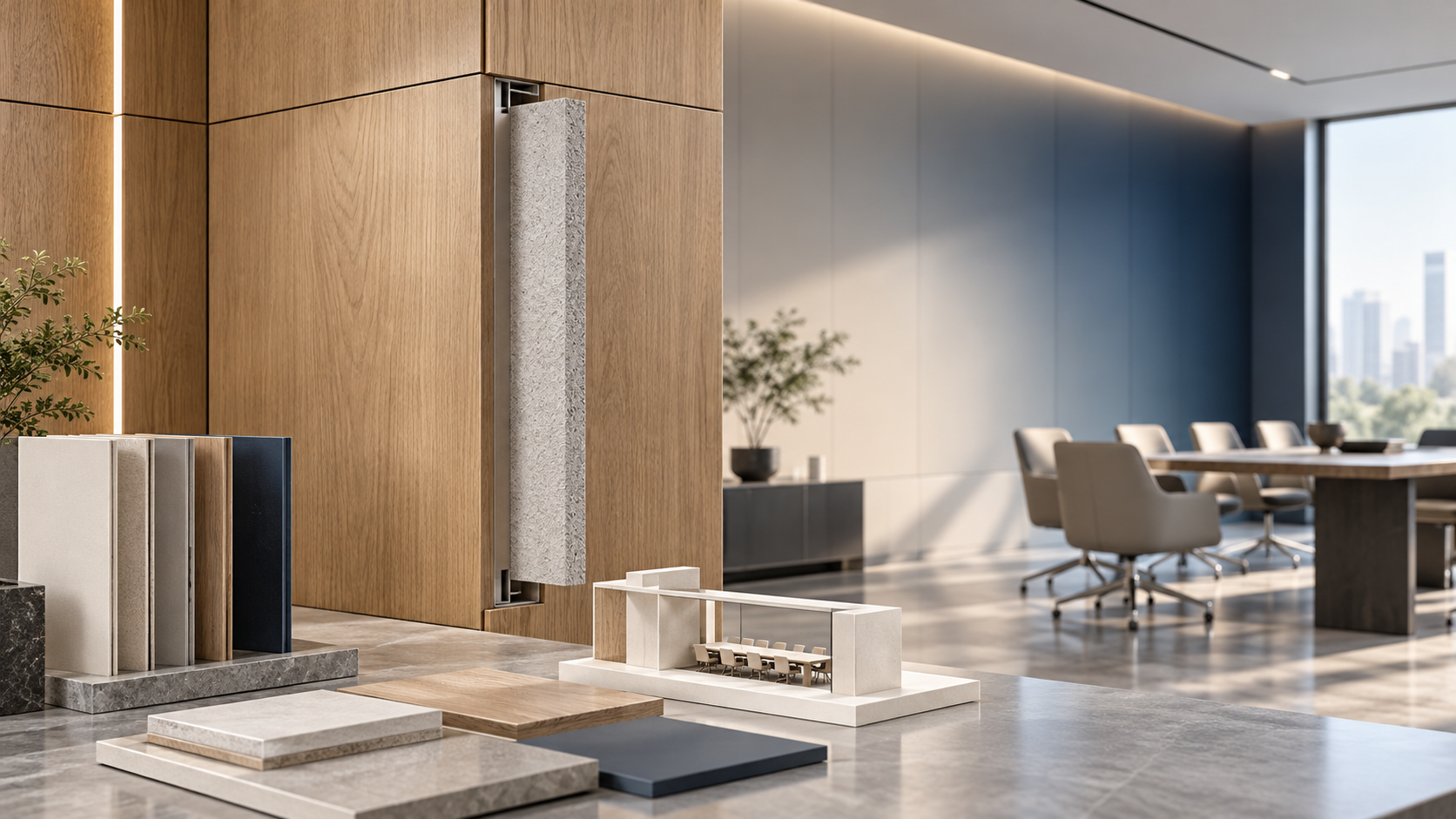
A physical sample remains essential, but export buyers should avoid treating it as a purely visual reference. A usable approval process normally records the agreed panel construction, nominal dimensions, face orientation where relevant, texture, gloss expectation, edge condition, and permitted variation. It should also clarify whether the sample represents a one-off development piece or the standard to be reproduced across production lots.
Woodgrain and stone-look surfaces deserve particular care. Repeat patterns, tonal shifts, texture direction, and the visual relationship between adjacent panels can all affect the installed result. For a feature wall or a high-visibility hospitality interior, buyers may need to specify how panels are sequenced. For furniture components, the priority may instead be consistency across doors, drawer fronts, and matching accessories.
Compliance Is a Project Requirement, Not a Generic Promise
“Compliant material” is an incomplete description unless the destination, use, and applicable requirement are known. Export markets do not all ask the same questions, and requirements can differ between a commercial fit-out, a residential product, a public building, and a furniture item. Fire performance, formaldehyde or other emissions expectations, restricted substances, labeling, and documentation may all need to be reviewed against the project’s actual destination and application.
A responsible OEM should not imply that one test report or one material statement automatically covers every market and every installation. Fire-related performance, for example, may depend on the panel composition, thickness, facing, adhesive, mounting system, and end use. A report for one configuration should not be assumed to validate a different assembly. The same caution applies to low-emission claims: buyers need to confirm what has been tested, what product configuration the evidence covers, and whether the project specification asks for a particular method or documentation format.
The practical expectation is clear communication. Before production, the OEM should identify what information is already available, what must be provided by the buyer or project consultant, and what requires separate verification. This approach may feel slower at the beginning, but it is far safer than discovering a documentation gap after goods are packed.
Repeatability Is the Real Test of OEM Capability
Many suppliers can create an appealing prototype. Fewer can reproduce it reliably over multiple production lots, particularly when a project involves several sizes, matching components, or phased deliveries. Export buyers should therefore look beyond the first sample and ask how the OEM controls variation between batches.
This does not mean expecting decorative materials to be visually identical in every circumstance. Some variation is inherent in certain finishes and substrates. It means defining which variation is acceptable and establishing a workable reference for production. A competent factory should be able to discuss color control, face inspection, dimensional checking, surface defects, protective film or interleaf use, and how nonconforming material is isolated before packing.
For large programs, buyers should also consider continuity. Will the same finish remain available for later phases? Are matching edge materials, decorative moldings, sealing materials, or related furnishing components needed? If a replacement order is required months after the first shipment, what reference will be used to maintain reasonable alignment with the original supply? These are commercial and technical questions at the same time.
Export Packaging Is Part of Product Quality
Panels may travel through several loading points, ports, warehouses, and inland transport stages before installation. A finished surface can be damaged by abrasion, edge impact, moisture exposure, compression, or poor stacking long before it reaches the site. Packaging should therefore be designed around the material and the route, not treated as a final warehouse task.
The buyer and OEM should agree on practical details: panel orientation, stack height, corner protection, pallet construction, moisture protection where appropriate, package labels, batch identification, and whether mixed sizes can be packed together. For projects that require site-by-site allocation, clear outer marking can save significant time during receiving. For delicate decorative surfaces, buyers should ask how face-to-face contact is prevented and whether protective layers are suitable for the expected storage period.
Container planning also deserves early attention. The usable loading arrangement depends on panel size, package dimensions, weight distribution, and the need to prevent movement in transit. An OEM does not need to control every logistics decision to add value here, but it should provide accurate packing information early enough for the freight plan to be realistic.
Communication Should Reduce Ambiguity, Not Add More Documents
Export projects often involve a developer, architect, contractor, distributor, installer, and procurement team in different locations. Information can easily become fragmented. The most useful OEM is not necessarily the one sending the most emails; it is the one that keeps decisions visible and converts discussion into controlled specifications.
A clear project file may include the approved finish reference, panel construction, dimensions, order quantities, packing instructions, labeling requirements, production milestones, inspection expectations, and document list. Where there are open points, they should be recorded as open points rather than quietly assumed. This discipline is especially valuable when purchase orders are placed before all interior details have been finalized.
Lead time should be discussed in the same way. A reliable schedule is not just a date quoted at inquiry stage. It depends on sample approval, raw-material availability, customization complexity, production capacity, quality checks, packaging, and shipping arrangements. Buyers should distinguish between a preliminary estimate and a confirmed production plan.
Material Development Can Add Value When It Stays Grounded in Use
For projects with demanding visual or safety objectives, a manufacturer with broader materials knowledge can be more useful than a supplier focused on one panel category alone. Shenyang Shengshi Meilin Technology Co., Ltd., a high-tech enterprise based in Shenyang, Liaoning Province, works in the research, development, and application of new material technologies. Its offerings extend from materials and fireproof sealing materials to furniture and home furnishing solutions.
That wider perspective matters because decorative panels rarely exist in isolation. A wall system may involve interfaces, joints, sealing considerations, furniture elements, and different surface materials within the same space. An OEM with an understanding of these connections can have more informed conversations about compatibility, design intent, and practical use conditions. It should not replace the project’s architect, fire consultant, or local compliance specialist, but it can contribute to earlier and more useful technical coordination.
Shengshi Meilin’s stated emphasis on innovation, quality, and service reflects the priorities that export buyers should expect from any serious manufacturing partner: responsible material development, attention to safe and environmentally conscious solutions, and a willingness to work through details rather than sell a generic board as a universal answer.
Questions Worth Settling Before the Order Is Released
Before a custom order moves into production, the buyer should be able to answer a few basic questions without relying on assumptions:
- What exact panel construction and finish have been approved?
- Which dimensions, tolerances, machining operations, and edge requirements apply?
- What project-specific performance or documentation requirements have been identified for the destination?
- How will batch, finish, and package identification be managed?
- What inspection point or sample approval is required before shipment?
- How will panels be protected, loaded, stored, and handled after arrival?
If these questions cannot be answered clearly, a lower quoted price may simply be hiding work that has not yet been defined. That work will still need to be done, often under greater time pressure after production has started.
A Better Standard for Choosing an OEM Partner
The best custom decorative panel OEM for export projects is not automatically the factory with the widest catalogue or the fastest initial quotation. It is the partner that can connect design intent with material performance, controlled manufacturing, appropriate documentation, and shipment-ready protection. It knows where certainty is possible, where variation must be managed, and where a project team needs to verify local requirements instead of making assumptions.
For buyers, the next step is usually not requesting more product photos. It is preparing a concise technical brief: destination, application, drawings or dimensions, target finish, expected order phasing, relevant project requirements, and preferred packing method. With that foundation, an OEM can provide a proposal that is more accurate, more transparent, and far more useful when the panels finally reach the site.
RECOMMEND

Oct 11, 2026
Custom Composite Panel Design: Selecting Skins, Cores, and Fixing Methods
Custom Composite Panel Design guide: choose durable skins, high-performance cores, compatible bonds, and smart fixing methods for safer, longer-lasting decorative panels.
Oct 11, 2026
What Decorative Panel Design Services Should Include Before Fabrication Begins
Decorative Panel Design Services help turn concepts into fabrication-ready solutions with material guidance, fire planning, samples, drawings, cost control, and quality checks.
Oct 10, 2026
Choosing Spa Wall Panels for Humid Rooms, Hygiene, and Easy Maintenance
Spa Wall Panels for humid rooms: compare moisture resistance, hygiene, chemical durability, fire compliance, and easy-maintenance system details for lasting spa interiors.
Oct 10, 2026
Jewelry Store Wall Panels That Enhance Lighting, Security, and Luxury Displays
Jewelry Store Wall Panels: discover how refined finishes improve lighting, security integration, durability, and luxury displays for a polished retail experience.