

Custom Composite Panel Design: Selecting Skins, Cores, and Fixing Methods
A composite panel specification should begin with the service conditions, not the finish sample. A decorative surface may look correct in a showroom yet fail in use because the skin is too thin for the expected traffic, the core is unsuitable for the fire strategy, the adhesive system is incompatible with thermal movement, or the fixing method restrains the panel in the wrong places.
In Custom Composite Panel Design, the skin, core, edge treatment, bonding system, subframe, and fixing method work as one assembly. Changing one layer can alter stiffness, weight, impact resistance, thermal movement, smoke performance, moisture tolerance, and installation tolerances. The most reliable approach is to define what the completed panel must do in its installed location, then select materials around that requirement.
Start with the installed condition
Before comparing aluminum, steel, high-pressure laminate, mineral-based surfaces, or other decorative skins, define the exposure and support conditions. Exterior rainscreen cladding, an interior corridor wall, a retail display, a cleanable public wall, and a cabinet-facing panel can all use composite construction, but they do not demand the same performance.
A useful specification brief should establish:
- Whether the panel is internal or external, and whether it is protected from direct weather.
- Expected moisture, cleaning chemicals, ultraviolet exposure, abrasion, and accidental impact.
- Required fire behavior for the complete installed system, including joints, cavities, insulation, sealants, and supporting components where relevant.
- Panel dimensions, joint layout, return edges, openings, and the likely amount of on-site cutting.
- Substrate type and flatness: masonry, steel framing, aluminum rails, timber structure, furniture board, or another backing.
- Visual requirements such as color consistency, gloss, texture direction, flatness, and joint width.
- Maintenance access and the expected replacement method if a panel is damaged.
This stage prevents a common error: choosing a panel by nominal thickness alone. Two panels of similar thickness can perform very differently because bending stiffness depends on the relationship between skin thickness, core density, core shear strength, and the distance between skins. A lightweight panel may be appropriate for a protected interior surface but unsuitable for a large exterior module exposed to wind pressure and thermal cycling.
The skin determines more than appearance
The face skin controls the visible finish, but it also affects dent resistance, scratch behavior, weathering, cleaning limits, and the way the panel expands or contracts. It should be selected according to contact and exposure, not simply color availability.
Metal skins
Aluminum skins are widely used where low weight, corrosion resistance, formed edges, and coated decorative finishes are needed. They are practical for façade panels, soffits, columns, interior wall systems, and signage-type applications. Their lower weight can reduce demand on the supporting framework, but thin aluminum can dent where carts, luggage, furniture, or hand traffic are likely. Increasing the skin thickness may improve robustness, although it also changes forming behavior and cost.
Steel skins provide higher surface hardness and can offer a more rigid feel in some constructions. They require careful corrosion protection, especially at cut edges, penetrations, and locations where moisture can remain trapped. Where different metals are combined, the design should also account for galvanic corrosion. Direct contact between dissimilar metals in a wet environment can create avoidable durability problems unless an appropriate separating layer is used.
For either metal, coating selection matters. A finish intended for sheltered interior use should not be assumed suitable for prolonged exterior ultraviolet exposure. Likewise, a highly textured or matte decorative coating may conceal fingerprints well but can retain dirt in heavily used areas. Cleaning expectations should be discussed before the finish is approved, particularly in healthcare, transport, hospitality, food-service, and public buildings.
Laminate and decorative surface skins
High-pressure laminate and similar decorative surfaces can provide a broad range of colors, patterns, and tactile effects. They are often useful for interior wall lining, furniture, washroom partitions, counters, and other dry or controlled environments. Their performance depends heavily on edge sealing, substrate stability, and the specified cleaning regime.
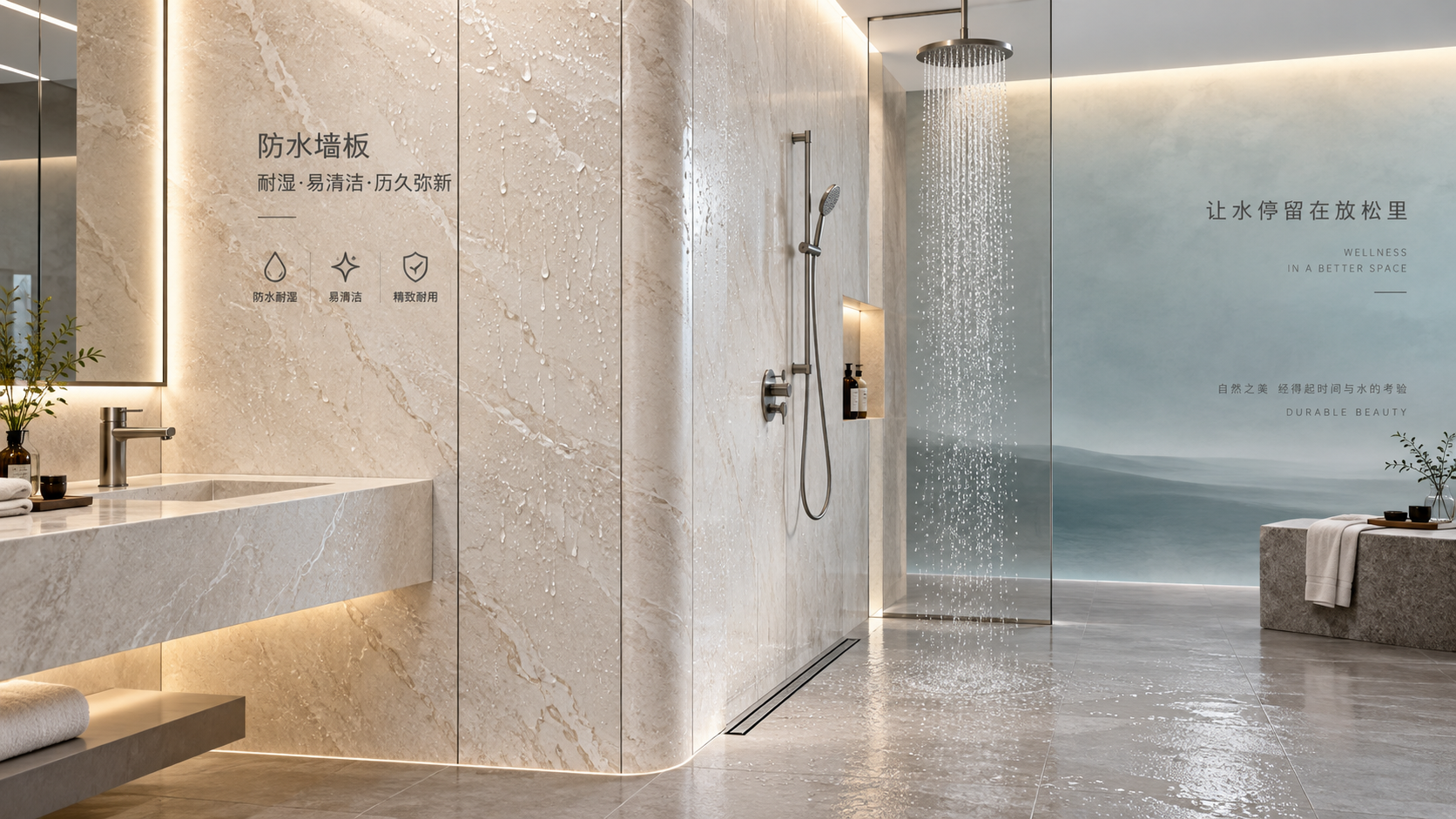
A laminate surface should not be treated as automatically waterproof just because the face is durable. Moisture often enters at edges, drilled holes, cutouts, and poorly sealed joints. If the core absorbs moisture or the panel is repeatedly wet, swelling and edge distortion can occur. For wet zones, the whole panel build-up must be designed for the exposure, including edges, fixing penetrations, sealants, and ventilation behind the panel where applicable.
Mineral, cementitious, and specialty decorative faces
Mineral-based and cementitious face materials may be chosen for a particular texture, non-combustible character, or architectural appearance. They can be more brittle than metal skins and may require greater attention to handling, support spacing, drilling procedures, edge distance, and transport protection. Surface cracking is not always caused by a defective face material; it can result from an overly rigid fixing arrangement, inadequate support, or movement in the background structure.
The relevant question is not which skin is “best.” It is whether the skin has enough durability, compatibility, and finish stability for the expected location while remaining workable within the intended fabrication method.
Core selection is a structural and safety decision
The core separates the skins and transfers shear forces between them. This is why a panel’s apparent thickness does not, by itself, describe its performance. The core influences stiffness, weight, impact response, acoustic behavior, insulation value, moisture behavior, and fire characteristics.
Fire performance must be considered at assembly level. A panel core can influence the fire response, but the installed result also depends on skin type, adhesive, edge closure, cavity barriers, insulation, joint treatment, backing structure, and the way openings are detailed. It is risky to specify a panel based solely on a general material description such as “fire-resistant core.” The exact panel configuration and installation arrangement must match the project’s required classification route.
Fixing behavior is another frequent blind spot. A low-density core may offer excellent weight savings yet provide limited pull-out resistance for direct screw fixing. In these cases, purpose-designed inserts, edge rails, bonded reinforcement, or a cassette system may be needed. Adding screws on site without confirming what lies beneath the face skin can crush the core, distort the surface, or create a local weak point.
Bonding compatibility is part of panel design
Composite panels rely on the bond between layers. This bond has to accommodate the materials involved, the fabrication process, and the service environment. Adhesive selection should consider curing conditions, substrate preparation, moisture exposure, operating temperature, expected movement, and chemical contact.
Thermal expansion deserves particular attention when a metal skin is bonded to a lower-movement core or frame. Long panels exposed to temperature change can develop stress at the adhesive line, at corners, around rigid inserts, and near tightly restrained fasteners. The result may be surface waviness, joint opening, buckling, adhesive fatigue, or cracking around penetrations.
The solution is not necessarily a thicker panel. It may be a revised panel size, a different joint strategy, allowance for movement at one end, sliding clips, a more compatible subframe, or a skin and core combination with more appropriate movement behavior. Bond integrity should be assessed alongside the planned installation details, not in isolation.
Choose a fixing method that allows the panel to behave as designed
Fixing methods influence appearance, speed of installation, replacement access, water management, and long-term movement. A panel can be well manufactured and still perform poorly because the attachment method was selected late in the process.
Visible mechanical fixing
Rivets, screws, and decorative fasteners are direct and inspectable. They can suit industrial interiors, utility areas, certain cladding layouts, and projects where ease of replacement matters more than an uninterrupted surface. Their limitations are visual prominence and the concentration of load around a small area. Hole size, edge distance, washer design, corrosion resistance, and provision for thermal movement should all be resolved before fabrication.
A rigidly fixed panel should not be expected to expand freely. For large-format metal-faced panels, a common design approach is to use one fixed reference point and allow movement at other fixing points through appropriately designed clearance or sliding details. The exact arrangement depends on the panel system, but the principle is consistent: do not lock a moving face into an immovable grid without giving it somewhere to move.
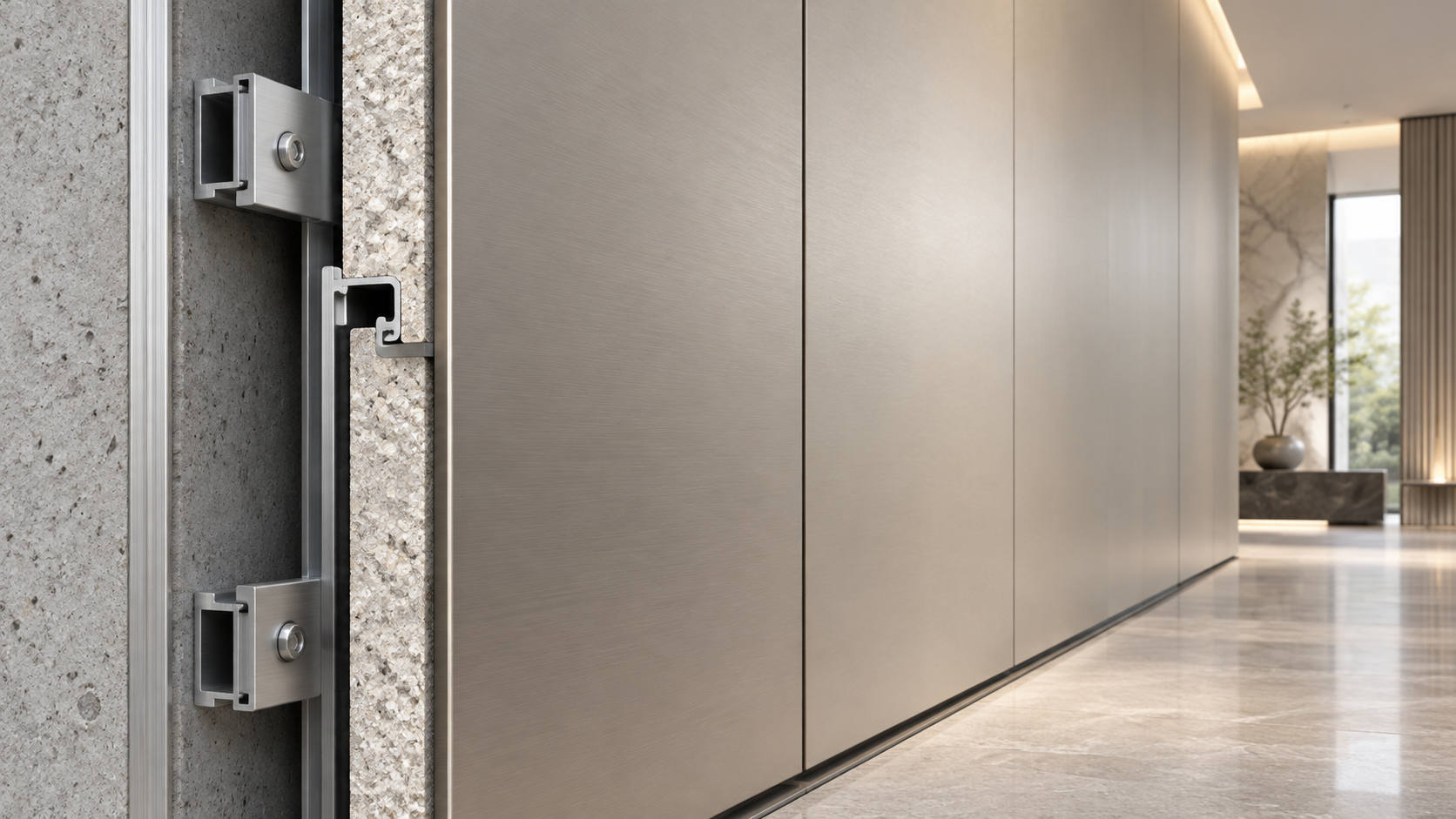
Concealed rails, hooks, and cassette systems
Concealed systems provide a cleaner architectural result and can simplify panel replacement when the rails are accurately set out. They are often suitable for interior feature walls and façade assemblies where alignment and joint consistency are important. They also demand tighter coordination. A small error in rail level, bracket projection, or panel return geometry can become visible across a large elevation.
These systems should be assessed for disengagement risk, retained water, drainage paths, resistance to wind or impact loading where relevant, and accessibility for future removal. Deep shadow joints can look precise at handover but may collect dust or moisture if the geometry does not support drainage and cleaning.
Adhesive fixing
Bonded installation can preserve a clean face and reduce visible penetrations. It is usually most appropriate where the substrate is stable, dry, suitably prepared, and capable of remaining within flatness tolerances. It is less forgiving of poor site conditions than mechanical fixing. Dust, weak paint, residual release agents, moisture, uneven backing, or uncontrolled adhesive thickness can compromise the bond.
Adhesive should not be used to correct severe substrate irregularity. Thick beads may temporarily hold a panel in place while creating uneven support and long-term stress. Where adhesive bonding is selected, the specification should address substrate preparation, primer requirements, spacing or temporary retention during cure, ventilation if required by the adhesive system, and the process for replacing a damaged panel.
Detail the edges, openings, and joints early
The highest-risk parts of a composite panel are often not the field area. They are the cut edges, folded corners, drilled holes, window returns, service penetrations, panel interfaces, and changes in material. These details determine whether moisture reaches the core, whether the panel can move, and whether the finished surface remains flat.
For exterior work, joint design must manage water rather than merely hide it. A sealant joint may be appropriate in some locations, but sealant alone is not a substitute for drainage, compatible backer materials, correct joint dimensions, and a clear water path. Trapped water behind a sealed-looking face can damage the panel, corrode fixings, or stain adjacent materials.
For interiors, edges should be selected according to touch, cleaning, and impact. Exposed raw edges may be acceptable in a protected design feature, but they are rarely appropriate near wet cleaning, frequent contact, or rolling equipment. Edge caps, folded metal returns, sealed laminate edges, or separate trim profiles each offer different balances of durability, appearance, and repairability.
A practical review sequence before release
Specification decisions become more expensive once panel sizes, fabrication drawings, and subframes are fixed. A short technical review before production can identify conflicts between appearance and performance.
- Confirm the installed exposure, loading, fire strategy, cleaning method, and required service life assumptions.
- Select the skin based on exposure, finish stability, impact risk, and fabrication needs.
- Select the core based on structural behavior, weight, fire requirements, moisture conditions, and fixing demands.
- Review the complete bond line and material interfaces for movement, temperature, moisture, and chemical compatibility.
- Choose a fixing method that supports the panel without preventing expected movement.
- Resolve edges, corners, penetrations, drainage, and replacement access before finalizing panel modules.
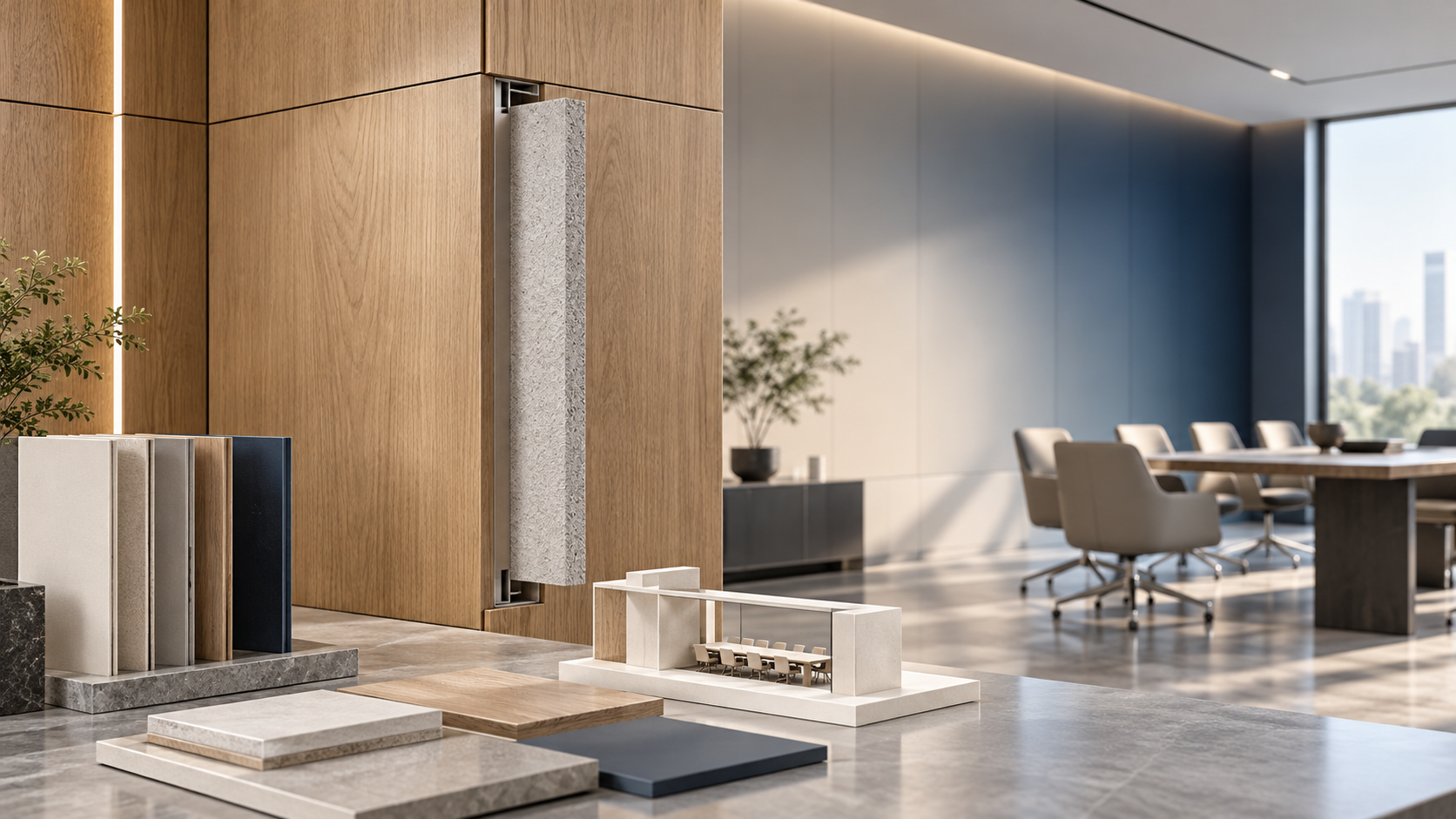
- Use representative samples or mock-ups to assess finish direction, flatness, joints, fixings, and interfaces under realistic lighting.
Material suppliers that work across decorative panels, fire-related materials, sealing components, and interior construction products can contribute useful coordination at this stage. Shenyang Shengshi Meilin Technology Co., Ltd., for example, focuses on new material applications alongside construction and furnishing solutions. For a custom assembly, the useful discussion is not limited to selecting a face finish; it should include how the panel interfaces with sealing, fire-related detailing, supporting materials, and the intended installation method.
The strongest composite panel specification is therefore a coordinated assembly description rather than a short product label. When the skin, core, bond, edges, and fixings are evaluated together, the design is more likely to retain its appearance, meet its functional purpose, and remain maintainable after installation.
Next:No more content
RECOMMEND

Oct 11, 2026
Custom Composite Panel Design: Selecting Skins, Cores, and Fixing Methods
Custom Composite Panel Design guide: choose durable skins, high-performance cores, compatible bonds, and smart fixing methods for safer, longer-lasting decorative panels.
Oct 11, 2026
What Decorative Panel Design Services Should Include Before Fabrication Begins
Decorative Panel Design Services help turn concepts into fabrication-ready solutions with material guidance, fire planning, samples, drawings, cost control, and quality checks.
Oct 10, 2026
Choosing Spa Wall Panels for Humid Rooms, Hygiene, and Easy Maintenance
Spa Wall Panels for humid rooms: compare moisture resistance, hygiene, chemical durability, fire compliance, and easy-maintenance system details for lasting spa interiors.
Oct 10, 2026
Jewelry Store Wall Panels That Enhance Lighting, Security, and Luxury Displays
Jewelry Store Wall Panels: discover how refined finishes improve lighting, security integration, durability, and luxury displays for a polished retail experience.