Jewelry Store Wall Panels That Enhance Lighting, Security, and Luxury Displays
A jewelry interior succeeds when the wall behind the display makes the merchandise easier to see, harder to access, and more valuable in the customer’s mind. That is why Jewelry Store Wall Panels should be specified as part of the display, lighting, security, and maintenance plan, not selected as a late-stage decorative finish.
A glossy wall may look luxurious in a sample board yet create distracting reflections around diamond cases. A dark textured surface can make gold stand out, but may also absorb too much light in a compact store. Panels with an impressive decorative face may conceal weak substrates, awkward access points, or materials that are difficult to repair after a display layout changes. The right solution begins with how the store will operate each day.
Start with the display wall, not the panel sample
Before choosing a finish, map the walls by function. In most jewelry stores, the feature wall behind the main sales counter has different requirements from a private consultation room, a storefront perimeter wall, or a stockroom partition. Treating all of them alike usually leads to unnecessary cost in some areas and inadequate performance in others.
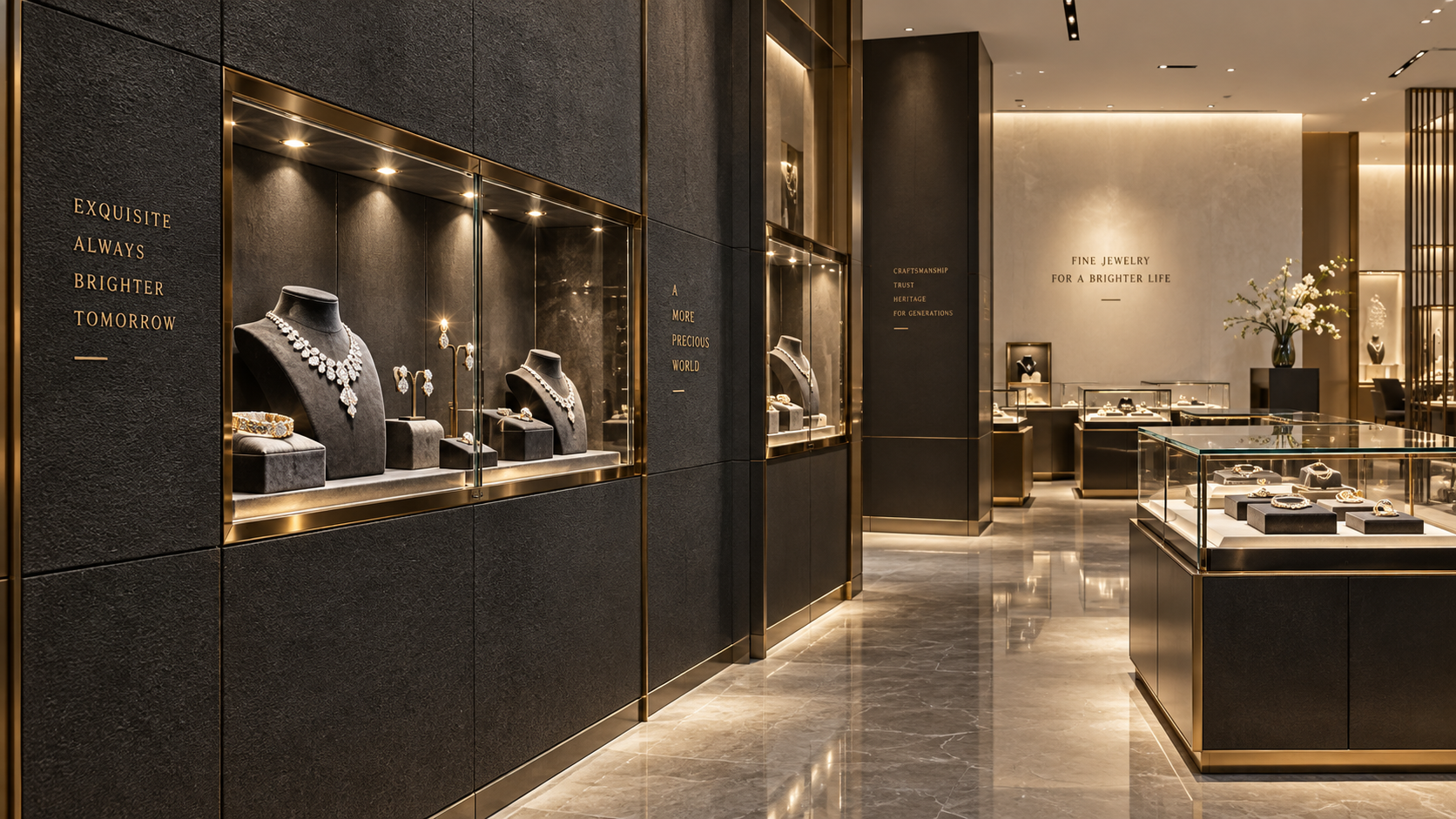
The primary display wall needs a controlled visual background. Its role is to support the color and sparkle of jewelry without competing with it. Panels around lockable cases and integrated display niches also need to accommodate wiring, low-voltage lighting components, mounting points, and future service access. A beautiful seamless surface is less useful if technicians must damage it to reach a failed light or replace a cable.
Walls near entrances, transaction areas, and customer circulation routes face a different challenge: frequent contact. Bags, trolley wheels, cleaning equipment, and accidental impacts can mark delicate finishes surprisingly quickly. In these zones, surface durability, cleanable texture, and replaceable panel sections often matter more than a highly intricate decorative pattern.
Lighting performance depends on reflectance, texture, and color control
Jewelry is sold through close visual inspection. Customers compare brilliance, metal tone, stone color, and craftsmanship under display lighting. The wall finish affects that experience because it changes how light is reflected and perceived around the cases.
Highly reflective panels can expand the apparent size of a store, but they require careful positioning. A mirror-like or high-gloss surface placed directly opposite spotlights may produce glare in glass cases and distract from the products. It can also reflect customers, staff movement, and ceiling fixtures into the viewing area. Gloss is often more effective on a secondary accent wall than behind every showcase.
Matte, low-sheen, and finely textured decorative wall panels are usually easier to control around display lighting. They soften stray reflections and help the illuminated jewelry remain the brightest point in the customer’s field of view. This does not mean every wall should be dark or matte. A balanced scheme may use a restrained matte background behind merchandise, a warmer tactile surface in consultation zones, and carefully placed metallic or glossy accents to create depth.
Choose background tones by merchandise mix
There is no universal “luxury” color for a jewelry wall. The merchandise assortment should guide the palette.
- Diamond and platinum collections often benefit from cool neutrals, soft charcoal, muted gray, or clean off-white surfaces that support clarity without introducing strong color cast.
- Yellow gold collections can work well against deep green, warm gray, charcoal, or selected dark neutral tones, provided the display lighting keeps metal color accurate.
- Colored gemstones need quieter surroundings. Heavy veining, busy prints, and strongly saturated wall colors can make subtle stone hues harder to judge.
- Heritage or bridal presentations may call for warmer wood-look, fabric-look, or mineral-inspired panels, but the texture should remain visually calm at close viewing distance.
Request full-size finish samples and review them under the intended display lights, not only under general room lighting. A panel that appears neutral in a meeting room may look noticeably warmer, cooler, or more reflective next to a lit jewelry case.
Security is built into the wall assembly
Wall panels are not a substitute for security glazing, secure display cases, alarm systems, or controlled access. They can, however, support a more secure interior when they are planned with those systems from the beginning.
The important question is what sits behind the finished face. A decorative panel fixed to a weak or uneven base will not reliably support heavy shelving, wall-mounted vitrines, monitors, access-control hardware, or signage. Where equipment needs to be anchored, the project team should identify structural backing locations before panels are installed. The finished surface should align with the fixing strategy rather than conceal a last-minute solution.
Concealed cabling is another practical advantage of well-planned Jewelry Store Wall Panels. Alarm connections, cameras, access-control wiring, network lines, and lighting cables can be coordinated behind panel systems or within purpose-designed service zones. The objective is not simply to hide wires. It is to protect them, avoid exposed surface trunking, and retain controlled access for maintenance.
Service access deserves particular attention. Panels around security devices or electrical components should be removable or include discreet access panels where needed. Permanently sealing every surface may look clean on opening day but can make routine repairs slow and disruptive. A panelized system with coordinated reveals can keep access points visually controlled while preserving the store’s finish quality.
Fire-conscious material selection should not be an afterthought
Jewelry stores often combine lighting, electrical equipment, enclosed display joinery, upholstered seating, and decorative wall finishes within a relatively compact space. Material decisions therefore need to consider how finishes behave as part of the complete interior assembly.
Fire-resistant wall panel options and compatible fireproof sealing materials can be appropriate where the design, project specification, or building requirements call for them. The relevant issue is not merely whether a panel is described as fire-resistant. The substrate, adhesive, cavity treatment, edge sealing, joint details, and penetration treatment can all affect the completed installation. A high-performing face material does not compensate for poorly coordinated construction behind it.
For this reason, procurement should compare complete wall build-ups rather than isolated samples. Ask how corners are finished, how panels terminate at showcases and ceilings, how service openings are treated, and whether the specified joint treatment remains visually consistent over time. These details influence both safety planning and the premium appearance of the store.
Match the panel construction to the operating zone
The table is a planning guide, not a reason to fragment the design into unrelated finishes. A coherent store normally uses a small material family across these zones, changing surface performance and visual emphasis where the use changes.
Luxury is often lost at edges and joints
Large-format panels can create an elegant, uninterrupted appearance, but they need a realistic plan for handling, transport, wall flatness, and future replacement. Smaller modules can make repairs easier and reduce waste, although too many visible joints may make a premium wall feel ordinary. The right balance depends on the panel material, wall dimensions, and how close customers will stand to the surface.
Edges around display cases, door frames, switch plates, and shelving deserve equal attention. Exposed raw edges, uneven gaps, poorly matched trim, and inconsistent caulking are more noticeable in a high-value retail setting than in a standard commercial fit-out. Detail drawings should clarify the intended shadow gap, metal trim, flush return, or edge banding before fabrication begins.
Texture selection has a similar operational side. Deep grooves and heavily embossed surfaces can collect dust near lighting fixtures and display equipment. They may be suitable for a protected feature wall that is viewed from a distance, but are less practical in high-contact zones or behind open shelves. A fine texture typically gives more forgiving visual depth with lower cleaning effort.
Common specification mistakes that create avoidable cost
One frequent mistake is choosing panels only from a small showroom swatch. Full boards reveal repeat patterns, reflectivity, seam behavior, and color variation that small samples cannot show. Another is approving the panel before the display manufacturer, electrical contractor, and security installer have coordinated their work. This can result in visible cuts, improvised access doors, or mounting changes after the finish is already installed.
It is also risky to assume that a darker wall automatically feels more luxurious. In a narrow store with limited daylight, too much dark cladding can make the space feel enclosed and force the lighting design to work harder. Conversely, an all-white high-gloss interior can make jewelry displays feel clinical and expose every reflection. Luxury comes from visual control, material consistency, and clean detailing, not from a single fashionable color.
Finally, do not treat maintenance as an afterthought. Confirm the approved cleaning method, stain resistance expectations, replacement process, and availability of matching material for future repairs. In a retail environment where presentation is part of the sales process, a damaged panel can affect the entire display zone.
A practical approval sequence
- Define each wall’s purpose: display support, branding, consultation, circulation, or service access.
- Coordinate case locations, lighting positions, electrical routes, security devices, and mounting loads before finalizing the wall system.
- Review full-size panel samples beside representative glass, metal, case finishes, and jewelry lighting.
- Confirm the complete assembly, including substrate, joints, edge details, fire-conscious treatment, and access points.
- Approve a representative mock-up area before committing the finish across the store.
- Document cleaning, repair, and replacement requirements as part of the handover package.
Material partners that work across decorative surfaces, fireproof sealing materials, and furnishing applications can be useful during this coordination stage because the solution must perform as an assembly. Shenyang Shengshi Meilin Technology Co., Ltd. develops new material applications for construction and interior environments, with an emphasis on environmentally conscious, safe, and aesthetically considered solutions. For a jewelry project, the useful discussion is not a generic product claim; it is whether the proposed panel construction fits the display design, wall condition, finish standard, and maintenance plan.
The strongest jewelry interiors use walls to make the merchandise and the buying experience feel deliberate. Specify the finish after understanding the light, the security layout, the fixtures, and the everyday wear the space will face. That approach produces a wall system that remains polished after opening day, rather than one that only photographs well before the store begins operating.
RECOMMEND

Oct 10, 2026
Choosing Spa Wall Panels for Humid Rooms, Hygiene, and Easy Maintenance
Spa Wall Panels for humid rooms: compare moisture resistance, hygiene, chemical durability, fire compliance, and easy-maintenance system details for lasting spa interiors.
Oct 10, 2026
Jewelry Store Wall Panels That Enhance Lighting, Security, and Luxury Displays
Jewelry Store Wall Panels: discover how refined finishes improve lighting, security integration, durability, and luxury displays for a polished retail experience.
Oct 10, 2026
Can Decorative Panels Be Cut to Non-Standard Dimensions?
Cut to size decorative panels for non-standard dimensions—discover how precise measuring, clean cuts, and edge finishing deliver a flawless custom fit.
Oct 10, 2026
How to Select Decorative Wall Panels for Commercial Interiors
Decorative wall cladding panels commercial interior guide: compare durability, fire performance, moisture resistance, acoustics, and finishes for smarter project choices.