How Do You Verify a Wall Panel's Fire Rating for Your Project?
How do I verify a wall panel's fire rating for my project? The answer starts with more than a product label. You need to review the relevant test reports, confirm whether the evidence applies to the panel or the complete wall assembly, and check the requirements for your building and location. For architects, contractors, and property owners, these steps can help prevent costly specification errors and support a safer installation. This guide explains what documents to request, which details to examine, and how to assess a supplier's fire-performance claims.
Start with the requirement, not the panel
A decorative panel may be intended for a hotel corridor, an office reception area, a retail fit-out, or a wall that separates fire compartments. Those locations do not necessarily call for the same evidence. Before asking whether a product is “fire rated,” establish what the project actually requires.
The applicable building code and approved design may address the reaction to fire of an interior finish, the fire resistance of a separating wall, or both. Requirements can depend on the building’s use, height, construction type, sprinkler protection, and the panel’s location. The authority having jurisdiction, fire engineer, or other qualified project professional can help identify the applicable provisions and the evidence they will accept.
This distinction matters commercially as well as technically. A team that orders a visually approved finish before confirming its fire classification may discover too late that the product cannot be used in a particular escape route. Equally, specifying a fire-resistance-rated partition does not automatically establish that its decorative surface meets an applicable interior-finish requirement.
Know which kind of fire performance is being claimed
Fire terminology is often used loosely in sales literature. The following distinctions help turn a broad claim into a question that can be checked.
Reaction to fire concerns how a material or product contributes to fire under specified test conditions. Depending on the classification system, the evidence may address flame spread, smoke production, or flaming droplets. In European classification, EN 13501-1 provides a framework for classifying construction products using relevant test results. The complete classification and its conditions matter; a single letter copied into a brochure may not tell the whole story.
In the United States, ASTM E84 is commonly used to assess surface burning characteristics, including flame spread and smoke development indices. Its results are considered under the applicable code provisions; an E84 result is not, by itself, a fire-resistance rating for a wall.
Fire resistance concerns the ability of an assembly to perform specified functions during a standardized fire exposure for a stated period. Relevant methods include ASTM E119 and UL 263 in the United States, and EN 1364-1 for certain non-loadbearing walls in the European testing framework. European fire-resistance classifications are addressed by EN 13501-2. The particular test, classification, and acceptance criteria must match the project’s requirement.
A panel advertised as “Class A” should therefore prompt a follow-up: Class A under which system, based on which test, and installed how? Likewise, a claim that a wall is rated for a stated number of minutes should be supported by evidence for the wall construction, not merely for one of its finishes.
Ask for the evidence behind the claim
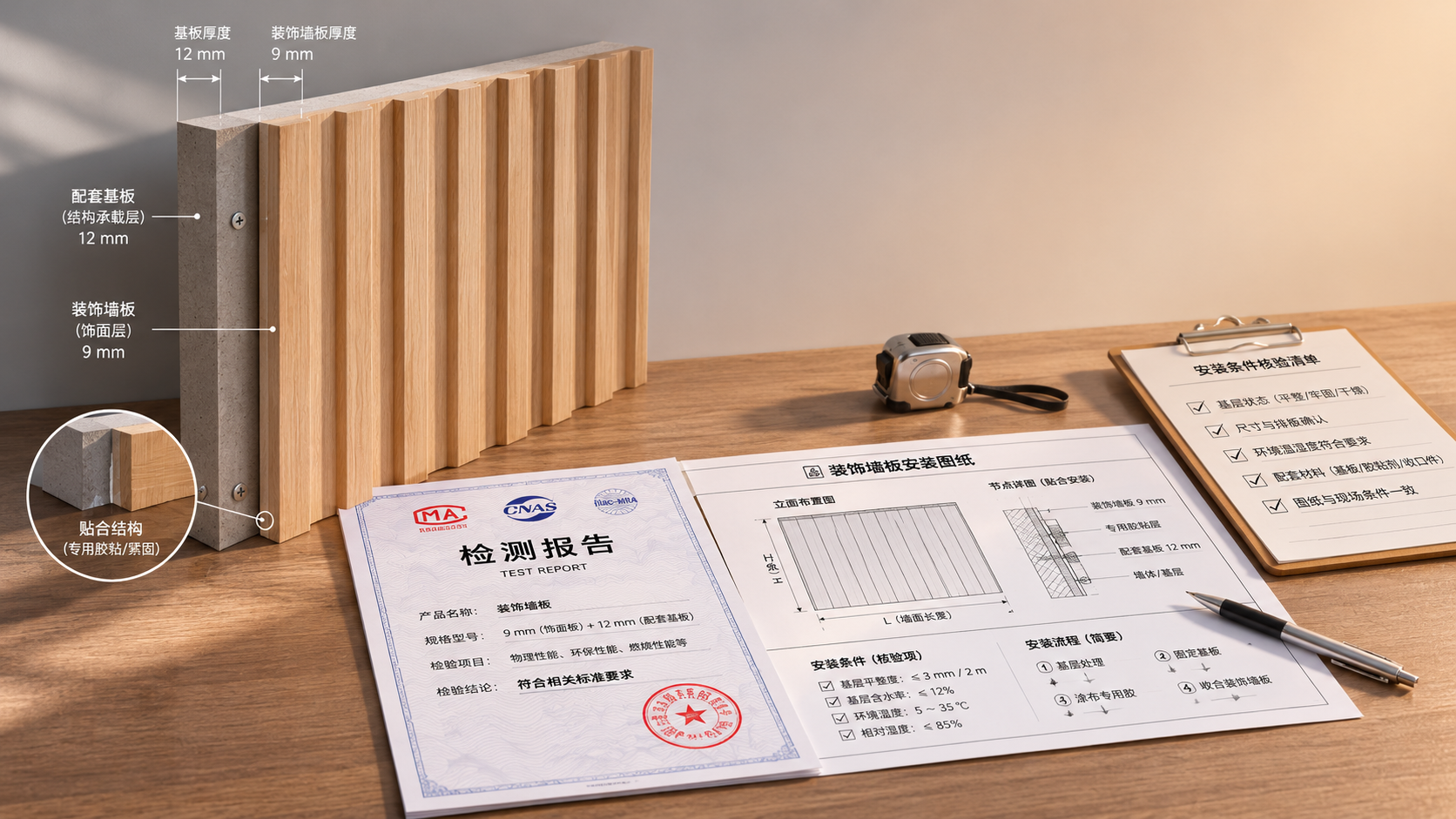
Request the documents early enough to resolve questions before the finish is approved or purchased. A useful package may include the relevant test report, classification report or certification, installation instructions, and any applicable listing or approved assembly details. Which documents are necessary depends on the market and the project; a test report, a classification, and a certification are not interchangeable.
When reviewing a report, look beyond the result on the first page. Check:
- The issuing laboratory or certification body, its relevant accreditation or recognition, and whether that status is acceptable for the project.
- The test method and edition, test date, report identification, and any stated limitations.
- The manufacturer, product name, model, composition, thickness, density or mass, and finish described in the evidence.
- The substrate, mounting method, adhesive or fasteners, joints, and any air gap used in the tested configuration.
- The scope of any classification, listing, or certification, including whether the supplied product and intended application are covered.
A product data sheet can be a useful starting point, but it is not a substitute for evidence showing what was tested. If a supplier provides only a cropped certificate or a photograph of a label, ask for enough supporting information to verify the product identity and scope. Where possible, check a certification body’s public directory or contact the issuer directly. A laboratory may confirm a report’s authenticity, but authenticity alone does not prove that the result applies to your installation.
Also distinguish between a test on a sample and an ongoing product certification. A test report records the performance of the specimen tested; it does not necessarily establish continued production surveillance. If the project requires a listed or certified product, verify the listing or certification separately, including its current status.
Match the tested build-up to the proposed installation
This is where many apparently straightforward approvals become difficult. A decorative wall panel is rarely installed in isolation. It may have a printed surface, coating, core, backing layer, adhesive, framing, insulation, and substrate. Any of these can be relevant to the test result or classification.
For example, evidence for a panel bonded to a specified non-combustible board may not automatically cover the same panel installed over a different substrate or on battens with an air cavity. A different adhesive, panel thickness, surface film, or joint detail can also put the proposed installation outside the tested or classified scope. Whether a change is acceptable is a technical question, not something to infer from a similar-looking product.
For a fire-resistance-rated partition, review the complete assembly: framing, board layers, insulation where required, fixing patterns, joints, and the permitted finish. Confirm the tested wall orientation and exposure conditions where relevant. Adding a decorative panel to an existing rated wall may be possible, but the team should check the applicable assembly instructions and seek a documented assessment where needed rather than assuming the original rating remains unaffected.
Pay particular attention to penetrations and perimeter junctions. Electrical boxes, service pipes, head-of-wall gaps, and transitions to other constructions can require specific firestopping or joint systems. A fireproof sealing material is not automatically suitable for every opening; its tested or approved application must match the opening, services, substrates, and required performance.
Do not translate ratings across markets by assumption
A supplier selling internationally may have reports prepared for different jurisdictions. That can be helpful, but classifications from different systems should not be treated as direct equivalents without an accepted technical basis. Test apparatus, specimen preparation, classification criteria, and code application can differ.
For instance, a European reaction-to-fire classification does not automatically establish a U.S. interior-finish classification, and an ASTM E84 result does not automatically produce an EN 13501-1 classification. Ask the project’s approving professional what evidence is required in the destination market before deciding that an existing report is sufficient.
The same caution applies to terms such as “non-combustible,” “fire retardant,” and “fire resistant.” They describe different concepts and may have defined meanings under a particular standard or code. A claim is useful only when it is tied to a recognized test or classification and to the specific product being supplied.
Turn document review into a purchasing control
Once the design team has identified acceptable evidence, carry those details through to procurement. The purchase specification should identify the approved product and configuration clearly enough that a visually similar substitute is not delivered by mistake. Record the manufacturer, model, thickness, finish, mounting method, relevant report or listing reference, and any restrictions that affect installation.
At delivery, compare packaging and product markings with the approved submittal. Ask for clarification if the model code, manufacturing source, finish, or construction has changed. Retain the documents and any traceability information supplied with the goods as part of the project record.
Substitutions deserve the same scrutiny as the original selection. A replacement panel may have the same nominal thickness and appearance but a different core or coating. Even when the replacement carries its own fire classification, the installation conditions and local acceptance still need to be checked. Resolve those differences before installation; removing completed decorative work to inspect or replace it is a poor way to settle a documentation question.
What a useful supplier conversation looks like
Give the supplier more than a request for a “fire-rated panel.” Share the destination market, intended wall location, required performance, substrate, proposed mounting method, and whether the panel will be applied to a fire-resistance-rated assembly. If the finish or dimensions are customized, ask whether those changes remain within the available evidence.
A supplier working across decorative materials and fireproof sealing materials, such as Shenyang Shengshi Meilin Technology Co., Ltd., can be part of that technical discussion. Its focus on new material technologies is relevant to material selection, but the decisive question for any proposed product remains the same: what project-specific documentation supports the exact supplied configuration? Do not assume that a company’s broader product range establishes a particular panel’s rating.
Before the specification is closed, keep one clear record linking the requirement, the selected product, the supporting evidence, and the installation detail. If any link is missing, ask the design professional or approving authority to resolve it before the material reaches site.
Next:No more content
RECOMMEND

Nov 21, 2026
How Do You Verify a Wall Panel's Fire Rating for Your Project?
How do I verify a wall panel's fire rating for my project? Discover which reports to request, how to check installation details, and avoid costly specification errors.
Nov 21, 2026
How Do You Repair a Scratch on a Stone-Look Panel?
How do I repair a scratch on a stone look panel? Discover safe, material-specific repair tips and learn when to seek expert help or replace the panel.
Nov 20, 2026
How Can You Reduce Color Variation Between Panel Batches?
How can I reduce color variation between panel batches? Discover practical tips for matching finishes, managing orders, and inspecting panels with confidence.
Nov 20, 2026
What Is the Minimum Order for Custom Decorative Panels?
What is the minimum order for custom decorative panels? Discover what affects MOQ, compare supplier quotes, and find practical ways to order smaller quantities.