How Can You Reduce Color Variation Between Panel Batches?
Color differences between decorative panel batches can disrupt an otherwise consistent interior, delay installation, and make replacements difficult to source. If you are asking, “How can I reduce color variation between panel batches?”, the most effective answer begins before production: define the appearance you need, plan quantities carefully, and agree on how panels will be inspected. Consistent materials and processing matter, but so do lighting, storage, and the way panels are arranged on site.
Some variation is inherent in decorative materials, especially those with natural wood veneers or stone-like patterns. The practical goal is therefore not always perfect uniformity. It is to keep differences within an agreed range and prevent them from becoming distracting once the panels are installed together.
Why do decorative panel batches look different?
A panel’s final appearance is the result of several layers and processes. Depending on the product, it may include a substrate, a printed or natural decorative surface, coatings, and protective treatments. A change at any stage can affect the way the finished surface reflects light.
Common sources of variation include:
- Raw materials: Natural veneer varies in grain and tone, while decorative films, papers, pigments, and resins may differ slightly between production lots.
- Production settings: Changes in coating application, pressing conditions, curing, or surface treatment can alter color or gloss.
- Surface texture: Embossing depth and grain direction influence shadows, making otherwise similar panels look different.
- Storage and exposure: Sunlight, moisture, heat, and aging can change the appearance or condition of some materials over time.
- Viewing conditions: Two panels that look close in a warehouse may appear different under the warmer or cooler lighting used in the finished room.
These factors do not necessarily indicate a defect. They do, however, need to be understood before a project depends on panels from several production runs matching one another.
Start with a reference that everyone can use
A color name or a digital image is rarely enough to control appearance. Screens, photographs, and printed catalogs are useful for narrowing choices, but they do not reliably show the exact color, sheen, or texture of the finished panel.
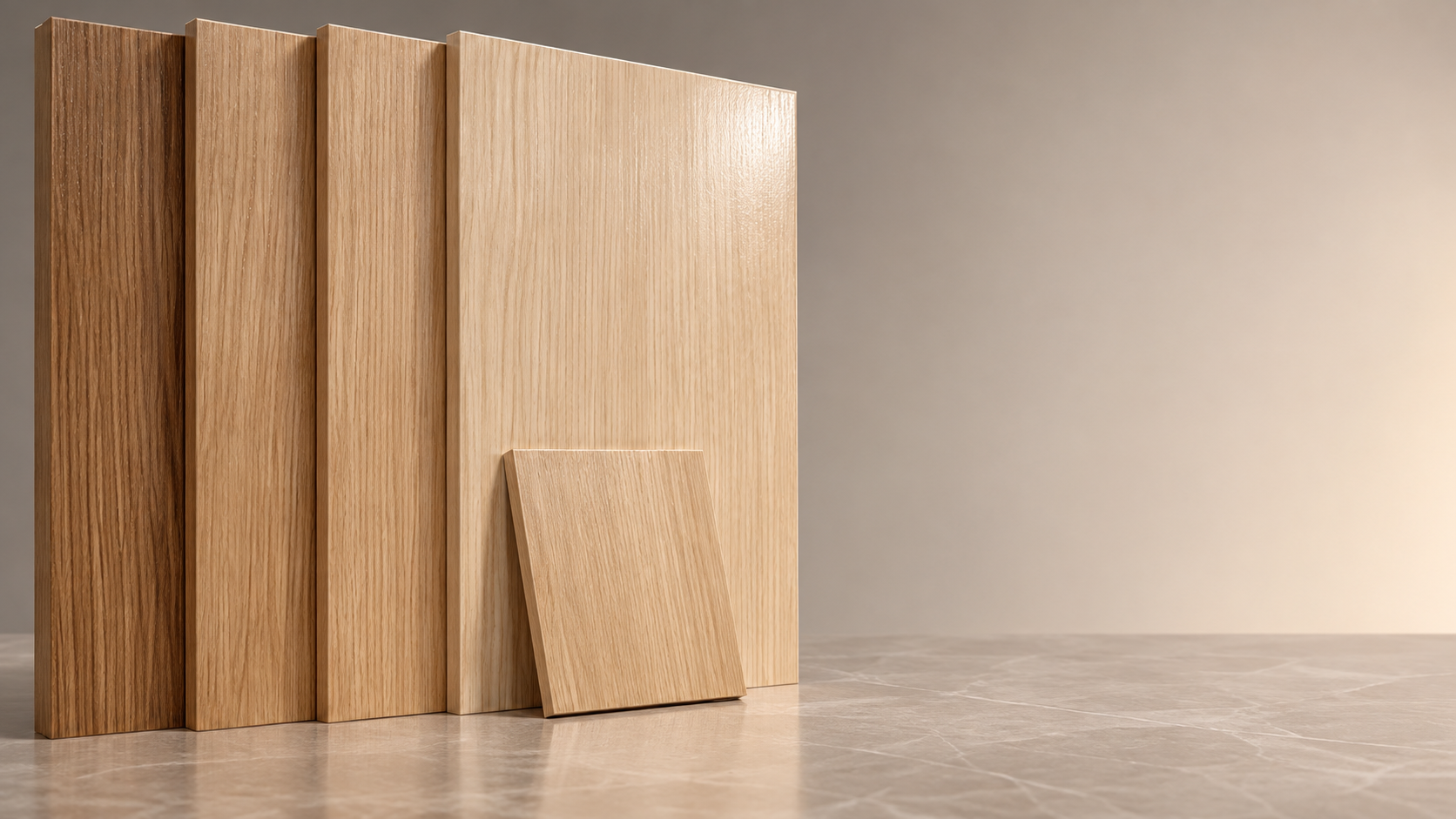
Instead, agree on a physical reference sample with the supplier before ordering. Ideally, it should represent the actual construction and finish being purchased, rather than only the decorative layer. For products with directional grain or a pronounced pattern, use a sample large enough to make those characteristics meaningful.
One sample alone may not communicate the acceptable range. Ask whether the supplier can provide a set of approved boundary samples showing the lightest, darkest, or otherwise most visibly different appearances that both parties consider acceptable. Keep the reference samples identified and protected, and make sure the purchasing, inspection, and installation teams know which samples apply to the project.
For natural finishes, discuss whether the desired effect is a controlled blend or a close visual match. A lively veneer with noticeable grain variation may be entirely appropriate in a hospitality space, for example, while a restrained office reception wall may call for more careful selection. The specification should reflect that distinction rather than simply stating “uniform color.”
Order and allocate panels as one project
One of the simplest ways to reduce visible differences is to purchase the full requirement for a connected installation at the same time. This gives the supplier a better opportunity to plan materials and production together. It also reduces reliance on a later batch that may have been made with different raw-material lots or equipment settings.
Before placing the order, calculate quantities for the entire scope, including cutting losses, damaged pieces, and a reasonable provision for future repairs. The appropriate allowance depends on panel dimensions, room geometry, pattern matching, and the complexity of the installation. A wall with many openings or a continuous grain layout will generally require more planning than a straightforward grid.
Ask for batch identification to remain visible on packaging and delivery records. When the order arrives, record which batch is assigned to each room, elevation, or installation zone. This is especially useful on phased projects: if construction pauses for several months, the team can avoid unknowingly placing a later batch beside an earlier one on a prominent wall.
Where a single production run cannot cover the full project, discuss the division before panels are made. Separate batches may be easier to manage across different rooms or elevations than across one uninterrupted feature wall. That does not eliminate variation, but it places inevitable differences where they are less likely to draw attention.
Control the production variables that affect appearance
For manufacturers and purchasers working closely with a supplier, color consistency is best treated as a process rather than a final inspection task. Checking finished goods matters, but it cannot fully correct a mismatch created earlier in production.
Keep material changes visible
Decorative paper, film, veneer, coating materials, and substrates should be identified by lot where practical. If a key material changes during an order, the supplier can assess whether a new approval or additional comparison is needed. Even when two materials share the same description, their interaction with coatings or surface treatments may produce a different visual result.
Maintain consistent processing
The relevant controls depend on the panel construction, but may include coating quantity, mixing, application settings, press conditions, curing, and surface finishing. Operators should compare production output with the approved reference during the run, not only after the entire order is complete.
Gloss deserves particular attention. A difference in sheen can make panels appear lighter or darker even when their underlying color is close. For that reason, a color match should be considered alongside surface texture and reflectivity.
Check after the panel is finished
Raw decorative surfaces and finished panels do not always look identical. Adhesives, coatings, and protective layers can affect the final appearance. Where possible, approve and inspect the completed panel system rather than relying solely on an unfinished swatch. If the project includes edge banding or matching trims, review those components together as well.
Inspect panels under lighting that reflects the real space
Lighting is one of the most overlooked causes of disagreement. A panel may appear neutral under one light source and warmer or cooler under another. Two surfaces can even seem well matched under one condition but visibly different under another, a phenomenon known as metamerism.
For a meaningful comparison, place the reference and production panels side by side, in the same orientation, and view them under consistent lighting. Remove temporary protective film if appropriate and if it can be removed without compromising the panel. Look at the surfaces both straight on and from an angle to assess color, gloss, and texture.
Whenever feasible, review samples under lighting similar to the planned installation, as well as under a controlled inspection light. Natural daylight can also be useful, but it changes with weather, time, and orientation; it should not be the only basis for a repeatable approval. Avoid comparing one panel in a shaded corner with another directly beneath a lamp.
Instrumental color measurement may support visual assessment for suitable, relatively uniform surfaces. If it is used, agree in advance on the measurement method, instrument settings, sample preparation, locations, and acceptable tolerance. Textured, patterned, or highly glossy panels can be difficult to characterize with a single reading, so numerical results should be interpreted alongside an agreed visual review.
What should happen when a new batch arrives?
Do not wait until the last panel is fixed to the wall to discover a mismatch. A short receiving and layout check can prevent an expensive interruption later.
- Confirm identification. Match packaging and delivery records to the order, finish, and batch details.
- Inspect before installation. Compare representative panels from different packs with the approved reference and, where relevant, the earlier batch.
- Review a larger area. Lay several panels together to see how pattern, grain direction, and gloss interact across the intended layout.
- Separate questionable material. Keep it identified and contact the supplier before cutting, modifying, or installing it.
- Record the decision. Note the batch, inspection conditions, location, and approval or concern so the same question does not reappear later.
If a difference is visible but still within the agreed range, the installation team may be able to distribute panels deliberately rather than allowing one group to form a conspicuous patch. This approach should be approved by the project’s decision-makers. Random mixing is not always suitable: some patterns, book-matched veneers, and directional designs require a planned sequence.
Protect consistency after delivery
Good manufacturing control can be undermined by poor site handling. Store panels according to the supplier’s instructions, in a clean, dry, protected area with suitable support. Keep packaging and batch labels available until the panels have been checked and allocated. Avoid leaving some packs in direct sunlight while others remain covered, particularly for materials sensitive to light or temperature.
Allow panels to acclimate when the product instructions require it. Moisture and temperature changes can affect dimensional stability and, for some materials, appearance. Acclimation is not a substitute for color matching, but it helps prevent installation problems that complicate the assessment of the finished surface.
Retain spare panels in conditions recommended by the supplier and identify the area they were intended to repair. Even then, a stored spare and an installed panel may age differently, particularly if the installed surface receives strong sunlight. For future maintenance, it is sensible to preserve enough material for a small continuous area rather than assuming one replacement piece will always blend invisibly into an exposed wall.
Questions to settle with a supplier before approval
A useful conversation goes beyond asking whether batches will “match.” Consider agreeing on the following points in writing:
- What physical samples define the target appearance and acceptable variation?
- Will the order be produced together, and how will any production lots be identified?
- Which lighting and viewing conditions will be used for acceptance?
- Are color, gloss, texture, and pattern all covered by the approval?
- How will a material substitution or production change be communicated?
- What should the receiving team do if panels appear outside the agreed range?
Shenyang Shengshi Meilin Technology Co., Ltd. works in new material technologies for construction and home furnishing applications. When discussing decorative material requirements with a supplier, sharing the installation setting, expected order schedule, reference samples, and appearance priorities can help both sides identify practical controls before production begins.
Ultimately, reducing color variation between panel batches is a shared task. Clear specifications guide the supplier, traceable batches help the site team, and a well-planned layout protects the visual result. The aim is a finished space where the panels work together naturally—and where any expected variation has been understood rather than discovered too late.
Next:No more content
RECOMMEND

Nov 20, 2026
How Can You Reduce Color Variation Between Panel Batches?
How can I reduce color variation between panel batches? Discover practical tips for matching finishes, managing orders, and inspecting panels with confidence.
Nov 20, 2026
What Is the Minimum Order for Custom Decorative Panels?
What is the minimum order for custom decorative panels? Discover what affects MOQ, compare supplier quotes, and find practical ways to order smaller quantities.
Nov 19, 2026
Are Magnesium Oxysulfate Honeycomb Panels Suited to Commercial Interiors?
Are magnesium oxysulfate honeycomb panels suitable for commercial interiors? Explore their uses, key performance considerations, and specification tips.
Nov 19, 2026
What Should You Do If a Laminated Panel Starts to Peel?
What should I do if a laminated panel starts to peel? Learn how to assess the damage, repair loose edges, and know when replacement is the better choice.