What Should You Do If a Laminated Panel Starts to Peel?
If a laminated panel starts to peel, first check how far the surface has lifted and whether the material underneath is dry and sound. A small loose edge on a stable panel can often be bonded back down. If the core is swollen, the laminate is lifting across a large area, or the cause is still present, replacement may be the more reliable choice.
Act before the opening collects more water and dirt, but resist the temptation to press it down with whatever glue is nearby. The right response depends on what has separated, what caused it, and whether the panel has a decorative function or also forms part of a rated or load-bearing assembly.
Start by finding out what is peeling
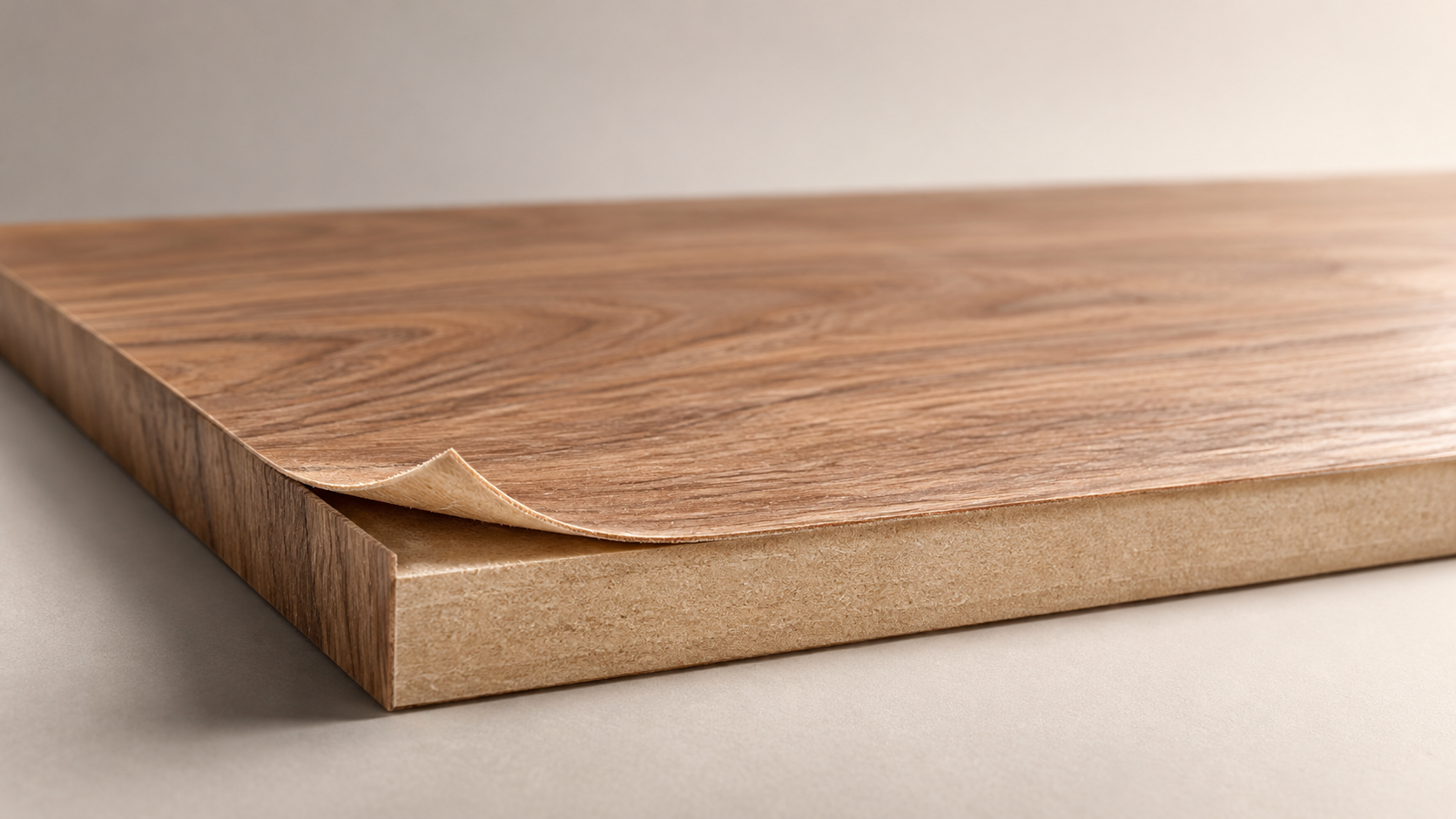
“Laminated panel” can describe several constructions. A cabinet door may have a thin decorative film wrapped around its edges, while a worktop may have a thicker laminate sheet bonded to a particleboard or plywood core. Some panels have factory-applied coatings that can look like laminate but behave differently when damaged.
Look closely at the lifted section without pulling it farther away. If a flexible film is coming loose around a shaped door or edge, the repair may require a different adhesive and clamping method from a flat, rigid laminate sheet. If the surface is cracking, crumbling, or losing its printed layer rather than separating cleanly, glue alone will not restore its appearance.
Check the exposed core as well. Particleboard and MDF can become soft, rough, or swollen after taking in moisture. Plywood may show separation between its own layers. A dry, firm, flat core gives a local repair a reasonable chance; a distorted or friable core leaves little sound material for the adhesive to grip.
Do not cut into or remove layers from a panel if its construction is unknown and it could be part of a fire-rated door, wall assembly, or other safety-critical installation. Have the responsible contractor or manufacturer assess the damage against the assembly’s repair requirements.
Look for the cause before choosing a repair
Peeling is often a symptom of conditions at an edge or joint. If those conditions continue, a neat repair can fail in the same place.
- Moisture: Look for leaks around sinks, plumbing, windows, and cleaning equipment. Darkening, swelling, a musty smell, or a raised joint can point to water exposure. Condensation and repeated wet cleaning can also affect vulnerable edges.
- Heat: Check panels near ovens, dishwashers, kettles, heating appliances, or direct sources of hot air and steam. A loose edge close to a heat source may indicate that the installation is exposed beyond what the original bond can tolerate.
- Physical damage: Impact, abrasion, or a frequently caught edge can start a separation that spreads as the panel is used or cleaned.
- Bond or installation problems: Localized lifting at a seam or edge may be associated with inadequate bonding, contamination, or an exposed edge. The visible defect alone rarely proves which occurred.
Remove the source of moisture or excessive heat before repairing the surface. A leak may need a plumbing repair; an appliance may need its ventilation or clearances checked against the manufacturer’s instructions. Allow a damp panel to dry, but do not assume that drying reverses swelling. If the core remains raised, soft, or misshapen, the surface is unlikely to sit flat again.
Decide whether repair is worthwhile
A local repair is most practical when the lifted area is small, the laminate remains intact, and the core is dry and firm. The loose section should be reachable for cleaning and adhesive application, and it should be possible to hold it in its original position while the adhesive sets.
Replacement deserves consideration when the damage extends across a large surface, several edges are lifting, or the core has deteriorated. A swollen cabinet shelf, for example, may no longer fit properly even if its decorative surface can be stuck back down. On a heavily used counter, an uneven patch can catch during cleaning and allow water back underneath.
Appearance matters too. A repaired film or laminate can retain a visible line, chip, or slight change in texture. For a concealed shelf edge, that may be acceptable. For a prominent reception counter or a run of matching cabinet doors, replacing a panel may give a more consistent finish. Check whether a replacement finish and edge profile are available before removing an otherwise usable component.
For multiple panels showing similar defects, inspect the surrounding conditions and other units before repairing them one by one. Repeated damage near the same appliance, wet area, or cleaning route may point to a shared exposure. If panels are still covered by a warranty, document the damage and contact the supplier before using adhesive or dismantling them; an unauthorized repair may affect the available remedy.
How to repair a small loose edge
For a sound, non-safety-critical panel, a careful local repair can extend its useful life. Adhesive selection is important: choose a product whose instructions specifically allow bonding the facing material to the exposed core, and check that it is suitable for the service conditions. An adhesive intended for rigid decorative laminate may not be suitable for a thin wrapped film, and an ordinary multipurpose glue may not tolerate the heat or moisture at the installation.
- Prepare access. If practical, remove a cabinet door or detachable panel and place it on a protected, flat work surface. Support the lifted laminate; do not bend it sharply or force open material that is still bonded.
- Clean and inspect. Remove loose dirt and only adhesive residue that can be taken away without damaging the facing or core. Keep both surfaces dry. Avoid soaking the core or using a solvent unless it is compatible with both materials and the adhesive instructions permit it.
- Dry-fit the piece. Press the loose section gently into place without glue. It should return to its original position without a bulge or substantial force. If it will not lie flat, investigate whether the core has swollen or debris remains underneath.
- Apply adhesive as directed. Follow the product’s instructions for surface preparation, coverage, any waiting period before joining, and ventilation. Use a thin, controlled application so excess does not prevent the surface from seating properly.
- Press and secure. Align the facing and apply even pressure. A clean, flat block with a protective layer can help distribute clamp pressure; for a suitable small edge, low-tack tape may hold the piece in place if the adhesive instructions allow it. Avoid marking the finish or crushing the core.
- Allow the bond to cure. Leave the panel undisturbed for the time specified by the adhesive manufacturer. Clean away excess adhesive using the recommended method, and avoid moisture, heat, and normal loading until the bond is ready for service.
Some contact adhesives require coating both surfaces and allowing them to reach a specified condition before the pieces are joined. Others work differently. Follow the chosen product’s directions rather than applying a universal technique, and keep ignition sources away where the product label calls for it.
If the loose piece cannot be held down evenly, or if it springs back as soon as pressure is removed after the specified curing period, stop and reassess. Additional glue will not correct a warped facing, swollen core, or continuing heat exposure. A specialist may be able to replace an edge strip or resurface a suitable panel, but the cost and appearance should be compared with replacing the component.
When the panel needs replacement
Replace a panel when its core has lost integrity, its surface is extensively detached, or the damage affects its ability to support the intended load. A shelf that has softened around its supports should be unloaded until it is assessed. A door with damaged hinge fixings may also need more than a cosmetic surface repair.
For installed joinery, identify whether the affected part can be replaced separately. A removable cabinet door, shelf, or end panel may be straightforward to exchange; a bonded worktop or integrated wall panel can require more extensive removal. Before ordering, check dimensions, thickness, finish, edge treatment, and fixing positions. The replacement also needs to suit the exposure that caused the original damage, especially near water or heat.
If the panel forms part of a fire-rated assembly, use an approved repair or replacement route for that specific assembly. Decorative facing, core, fixings, and seals can all be relevant to its performance, so a visually similar board is not necessarily an equivalent substitute.
Reduce the chance of peeling again
Keep exposed edges and joints as dry as the application allows. Wipe up standing water promptly, use cleaning methods compatible with the finish, and avoid directing steam or excessive water into seams. Around sinks and appliances, inspect seals and junctions periodically and address gaps or leaks before moisture reaches the core.
Heat protection begins with the installation. Check appliance instructions for required clearances and ventilation, and investigate recurring steam or hot-air discharge onto adjacent panels. A new panel installed in the same unsuitable position can develop the same problem.
After a local repair, watch the edge during normal use and cleaning. If it begins to lift again, or the adjacent core changes shape, treat that as a reason to revisit the cause and the condition of the panel before attempting another bond.
RECOMMEND

Nov 19, 2026
Are Magnesium Oxysulfate Honeycomb Panels Suited to Commercial Interiors?
Are magnesium oxysulfate honeycomb panels suitable for commercial interiors? Explore their uses, key performance considerations, and specification tips.
Nov 19, 2026
What Should You Do If a Laminated Panel Starts to Peel?
What should I do if a laminated panel starts to peel? Learn how to assess the damage, repair loose edges, and know when replacement is the better choice.
Nov 18, 2026
Can Decorative Wall Panels Handle Spa Humidity?
Can decorative wall panels handle the humidity in a spa? Discover how to choose the right materials and wall systems for lounges, showers and steam rooms.
Nov 18, 2026
How Do You Match Colors for Wood Grain Panels?
Master wood grain panel color matching with practical tips on undertones, lighting, flooring, and finishes. Create a cohesive space with confidence.