What Is the Minimum Order for Custom Decorative Panels?
What is the minimum order for custom decorative panels? The answer depends on factors such as panel material, dimensions, finish, and the complexity of your design. A small order may be possible when a manufacturer can cut an existing board and apply a standard finish. A project requiring a new surface pattern, special tooling, or a dedicated production run may face a higher minimum or a separate setup charge. Before comparing suppliers, establish exactly what must be customized and how the quantity will be measured.
There is no single minimum order for every type of panel
A minimum order quantity, or MOQ, is the smallest order a supplier is willing to accept under specified production and pricing conditions. For decorative panels, it may be expressed in pieces, square meters, sheets, production batches, or order value. Those units are not interchangeable: a requirement for finished pieces may produce a different purchasing quantity from a requirement for full sheets.
The scope of the minimum matters just as much as the number. A supplier might accept several sizes within one order if they share the same substrate and finish, but apply a separate minimum to each custom color. Another might quote a project total while requiring each design to meet its own threshold. Ask whether the MOQ applies per order, material, thickness, color, pattern, or individual size.
It is also useful to distinguish the minimum order from the minimum economical order. A manufacturer may agree to produce a small quantity, but setup, material waste, packing, and freight can make the effective cost per panel high. The lowest accepted quantity is not necessarily the most economical way to buy.
Why customization changes the order requirement
Material availability and sheet yield
When a supplier already stocks a suitable substrate, a small batch may be easier to schedule. If the specified board, thickness, or surface material must be purchased specifically for the project, the panel manufacturer may need to meet its own upstream minimum. That requirement can then affect your order.
Finished dimensions also determine how efficiently panels can be cut from the available stock. A size that leaves large unusable offcuts can cost more than one designed around the sheet layout, even when both cover a similar installed area. For irregular shapes, ask the supplier to review the cutting layout before finalizing dimensions. Grain direction, edge allowance, and machining tolerances can all change the yield.
Finishes, colors, and patterns
An existing finish generally involves fewer variables than a finish developed for one project. A custom color match, printed design, textured surface, or special coating may require preparation, trial work, and material that cannot readily be used elsewhere. The supplier may recover those costs through a higher MOQ, a setup fee, or both.
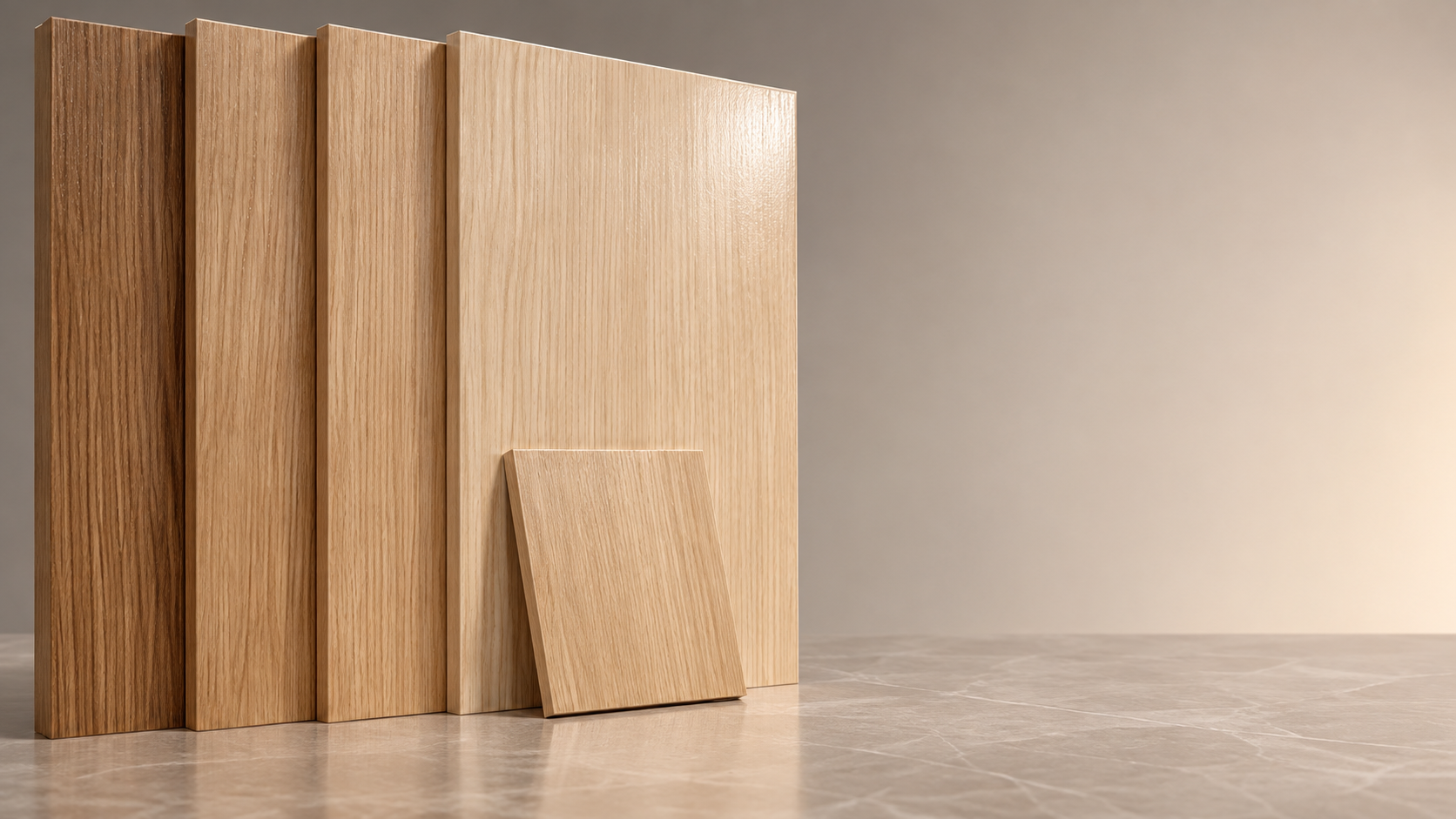
Patterns introduce a further question: how much variation is acceptable? A wood-look panel, for example, may need a particular grain direction or repeat arrangement across a wall. If the design requires close visual alignment, the manufacturer may need extra material and a more controlled layout. State whether panels will be viewed individually, installed in sequence, or matched to existing surfaces.
Machining and special construction
Straight cutting from standard stock is different from producing panels with shaped edges, grooves, perforations, concealed fixing details, or multiple bonded layers. These operations can require programming, tooling, extra handling, and inspection. A supplier may accept a limited run if the buyer pays those preparation costs separately; another may combine them into the unit price.
The key is not to assume that “custom size” and “custom construction” are equivalent. Cutting a standard board to a project dimension may be relatively straightforward. Changing its composition or developing a new surface can affect both feasibility and the minimum quantity.
Compare quotes on the same basis
A low unit price can conceal costs that appear elsewhere in the quotation. Conversely, a higher unit price may already include work that another supplier charges separately. Before deciding which offer is better, ask each manufacturer to clarify the following:
- Whether the quoted quantity refers to full sheets, usable finished panels, or total surface area.
- Which dimensions, thicknesses, colors, and designs can be combined to meet the minimum.
- Whether setup, tooling, color matching, sampling, packing, and freight are included.
- How damaged, defective, or out-of-tolerance pieces are handled and whether replacements affect the delivery schedule.
- Whether the price and production conditions will apply to a later repeat order.
Pay particular attention to yield. If the supplier charges by full sheet but you need finished components, confirm how many acceptable pieces are expected from each sheet and who retains the offcuts. Also confirm whether the quoted quantity includes overproduction or only the number of pieces you have requested.
For an imported order, compare the agreed delivery terms as well as the panel price. The party responsible for freight, insurance, customs procedures, and unloading can change the total landed cost. These responsibilities should be documented rather than inferred from a short quotation.
How to make a small custom order more practical
If the proposed MOQ is too high, the most productive conversation is often about which specification is driving it. Ask the supplier to identify the constraint before redesigning the project. A change in finish may solve the problem; reducing the number of sizes may not help if the actual constraint is a separately sourced substrate.
Using an existing material and finish while customizing only the cut size is one possible route. Standardizing thickness across a furniture range or choosing a common surface for several rooms may also allow more components to share a production run. Where appearance permits, a stock finish that is close to the intended design may avoid the preparation associated with a new color or pattern.
Another option is to request two quotes: one for the exact specification and one for the nearest practical alternative. Compare not only the price but also the visual differences, installation implications, and availability of replacement material. A compromise that saves money at the factory may be expensive if it requires a different fixing system or creates visible variation on site.
If a project has several phases, combining quantities can sometimes improve production efficiency. Do not assume, however, that the manufacturer will store finished panels or raw material between phases. Storage conditions, ownership, payment, and release dates need explicit agreement. Decorative surfaces can also be damaged by unsuitable storage or handling, so the plan should cover protection as well as space.
Samples help, but they do not settle every production question
A sample can help confirm color, texture, construction, and general workmanship before committing to a production quantity. Ask whether the sample is made using the same material and process proposed for the final order. A hand-finished sample or a small surface swatch may not represent the appearance of a full production panel.
Review the sample under the lighting conditions expected in the space where possible. For patterned panels, a larger sample or an agreed visual reference may be needed to assess grain, repeat, and variation. Record what has been approved, including the viewing side, gloss or texture expectations, and any acceptable variation. Keep the reference available for production inspection.
A sample order is not automatically a promise that the same specification can be supplied later in any quantity. Confirm its cost, lead time, and whether any charge is credited against production. If the project depends on a future repeat order, ask how material availability and color consistency will be managed. Even with an approved reference, batch-to-batch matching should be discussed rather than assumed.
Allow for installation, replacement, and compliance
The quantity shown on a drawing is rarely the whole purchasing decision. Installation cuts, damaged pieces, pattern matching, and future repairs can create a need for additional material. The appropriate allowance depends on the layout, panel size, installation method, and the consequences of a visible mismatch. Ask the installer and manufacturer to review the cut plan instead of applying an arbitrary percentage.
Performance requirements can affect the choice of material and therefore the MOQ. A decorative surface intended for a commercial interior may need evidence of performance under requirements applicable to that project and location. Depending on the application, buyers may also need to assess moisture exposure, cleaning methods, emissions, or fire-related properties.
Request documentation for the actual panel construction and intended use, not just a generic statement about one component. A substrate, finish, adhesive, and installed assembly may not be interchangeable for assessment purposes. The project designer or relevant authority should confirm which requirements and evidence apply locally before a specification is locked in.
What to send with a quotation request
A useful request describes the finished application as well as the desired appearance. Include drawings or a cutting list with quantities for each size, the preferred substrate and thickness if known, finish references, edge treatment, and any machining or fixing details. Identify which dimensions are critical and where alternatives are acceptable.
Add the destination, required delivery date, packaging constraints, and whether the order is a one-time project or a likely repeat. If the panels will be installed in a regulated setting, provide the applicable project requirements or ask what documentation the manufacturer can supply. This gives the supplier a basis for identifying constraints instead of returning a nominal MOQ that may change later.
Shenyang Shengshi Meilin Technology Co., Ltd., based in Shenyang, works in new material technologies and offers products spanning materials, fireproof sealing materials, furniture, and home furnishings. For a decorative panel inquiry, the practical starting point is still a defined specification: the company’s ability to supply a particular construction, order size, or performance document should be confirmed against the project requirements.
Before placing an order, ask for the minimum quantity and price for the exact specification, then request an alternative if the quantity is impractical. Confirm the approved sample, production schedule, packing method, and replacement arrangements in writing. Those details will tell you more about whether an order is workable than a standalone MOQ figure.
RECOMMEND

Nov 20, 2026
How Can You Reduce Color Variation Between Panel Batches?
How can I reduce color variation between panel batches? Discover practical tips for matching finishes, managing orders, and inspecting panels with confidence.
Nov 20, 2026
What Is the Minimum Order for Custom Decorative Panels?
What is the minimum order for custom decorative panels? Discover what affects MOQ, compare supplier quotes, and find practical ways to order smaller quantities.
Nov 19, 2026
Are Magnesium Oxysulfate Honeycomb Panels Suited to Commercial Interiors?
Are magnesium oxysulfate honeycomb panels suitable for commercial interiors? Explore their uses, key performance considerations, and specification tips.
Nov 19, 2026
What Should You Do If a Laminated Panel Starts to Peel?
What should I do if a laminated panel starts to peel? Learn how to assess the damage, repair loose edges, and know when replacement is the better choice.