

What Can Shengshi Meilin Deliver for Custom Hotel Panel Projects?
What a hotel project team should expect from a custom panel supplier
For a custom hotel panel project, Shengshi Meilin can be relevant when the brief calls for decorative surfaces, coordinated material support, fire-conscious detailing, and repeatable manufacturing rather than a one-off decorative sample. The practical value lies less in supplying a panel with an attractive finish and more in helping a project team control the gap between an approved mock-up and hundreds of installed panels across guestrooms, corridors, lift lobbies, public areas, and back-of-house spaces.
That distinction matters because hotel interiors place unusual pressure on decorative materials. Panels may need to align with furniture, doors, skirting, metal trims, fire-rated assemblies, acoustic treatments, and concealed services. They must also survive frequent cleaning, luggage impact, humidity changes, maintenance access, and phased installation. A supplier with material-development capability and experience across boards, sealing materials, furniture, and home furnishing components is better positioned to discuss those interfaces than one focused only on a surface finish.
Shengshi Meilin's offering should therefore be evaluated as a custom material and manufacturing capability for commercial interiors. Whether it is the right fit depends on the panel construction, performance requirements, approval process, and delivery controls established before production begins.
Custom hotel panels are an assembly, not just a finish
Architects and hotel owners often begin with the visible layer: wood grain, stone effect, fabric-look texture, solid color, metallic accent, or a bespoke decorative treatment. That is a sensible starting point for design, but it is insufficient for procurement. The appearance of a hotel panel depends on several connected decisions: substrate, surface layer, edge treatment, backing, adhesive system, machining, reinforcement, and how the panel joins the adjacent construction.
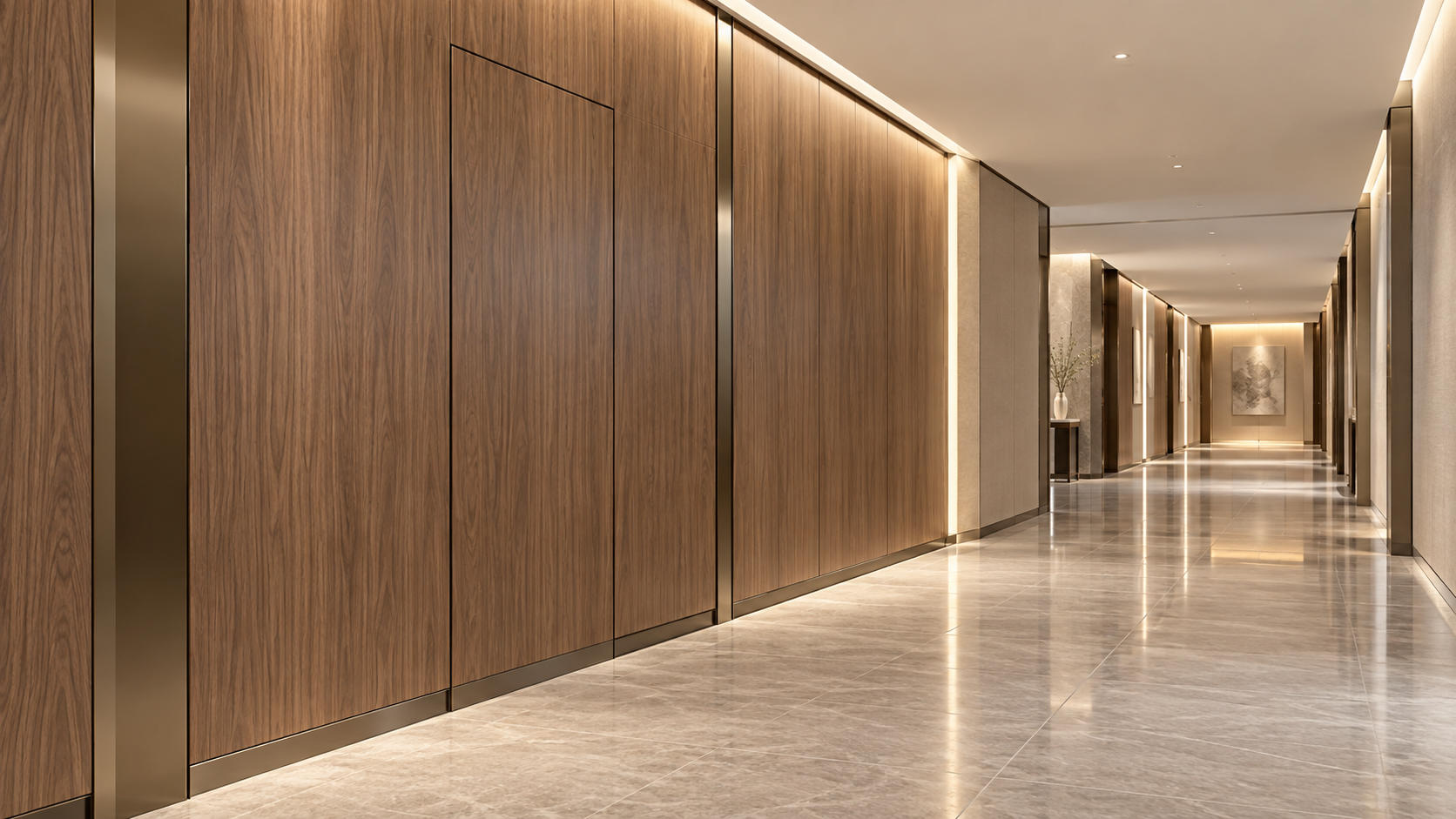
A decorative panel that looks convincing in a showroom can create problems after installation if these decisions were left unresolved. A large-format wall panel may require a different substrate from a vanity surround. A corridor wall surface may need more impact resistance than a guestroom headboard. A service door integrated into a panelized wall needs hardware reinforcement and a clear opening strategy. A panel near a wet area has different edge and moisture risks from one in a dry guestroom.
This is where a broad materials background can be useful. Shengshi Meilin operates in new materials and offers products ranging from material solutions to fireproof sealing materials and furnishing-related products. For hotel teams, that creates an opportunity to discuss the panel as part of a built interior system rather than treating each board as an isolated item.
The supplier should still be asked to define its scope precisely. “Custom panel” can mean very different things:
- supplying raw or finished boards for a local fabricator;
- providing cut-to-size panels with edge finishing and machining;
- producing panels with specified decorative surfaces and matching components;
- supporting fire-related seals or compatible material details around panelized assemblies;
- coordinating panel materials with furniture, cabinetry, or other fixed interior elements.
Those options have different responsibilities, lead times, quality risks, and installation implications. A project should not assume that a decorative-board supplier is automatically responsible for installation tolerances, subframe design, fire assembly approval, or site rectification. Those boundaries need to be recorded early, particularly when several trades touch the same wall or joinery package.
Reliability in OEM panel manufacturing is measured by repeatability
For commercial interiors, Meilin Board OEM panel manufacturing reliability should be judged through consistency rather than broad statements about quality. A hotel fit-out may use the same panel finish across many floors, but each location can introduce variations in panel size, cut-out position, grain direction, edge exposure, fixing method, and lighting conditions. The manufacturing challenge is to maintain a coherent result while accommodating those variations.
The first test is whether the supplier can translate a design intent into a controlled specification. A reliable manufacturing discussion should move beyond a sample board and establish a panel schedule that identifies panel codes, dimensions, substrate type, finish, edge method, drilling or routing requirements, face direction, protection requirements, and any special packaging instructions. Where the project uses book-matched or directional patterns, the schedule should clearly show orientation and sequence. “Same finish” is not enough when adjacent panels must read as a continuous composition.
The second test is sample discipline. For hotel work, the relevant sample is often not a small hand sample. It may need to include the specified substrate, intended edge detail, joints, trim interface, backing, and the lighting conditions that affect how the finish reads. If a panel is expected to coordinate with furniture fronts, doors, or stone surfaces, those materials should be reviewed together. Color and texture mismatches are often discovered too late because samples were approved separately rather than as part of the room or corridor composition.
Production control also matters after the sample is signed off. A supplier should be able to distinguish between an approval sample, a production reference sample, and an acceptable manufacturing variation. This is particularly important for wood-effect, mineral-effect, textured, or batch-sensitive surfaces. A hotel design may tolerate natural variation in some materials, but that tolerance needs definition. Otherwise, a project team may approve a general look while expecting a level of uniformity that the selected material cannot realistically maintain.
These questions are not administrative details. They determine whether custom manufacturing reduces site work or transfers complexity downstream to the installer. In large commercial interior packages, a modest error rate can create a disproportionate schedule impact when panels must be removed, remade, shipped, and reinstalled after adjoining work is complete.
Fire-conscious material decisions need project-specific evidence
Hotel projects commonly involve fire-performance requirements, but a frequent mistake is treating a fire-related material claim as if it automatically applies to the completed wall or joinery assembly. It does not. The behavior of a finished installation can depend on the board, decorative layer, adhesive, substrate, insulation, cavities, fixing method, edge treatment, sealants, and the surrounding construction.
Shengshi Meilin's involvement with fireproof sealing materials may be useful where panel systems meet penetrations, perimeter gaps, service openings, or compartmentation details. Yet sealing material and decorative panel selection should be coordinated without being conflated. A fireproof seal may have a specific role in an approved detail, while the panel itself is evaluated under a separate requirement. The design team, contractor, and relevant fire specialists need to determine what evidence applies to each component and what evidence is required for the combined construction.
For a purchaser, the useful question is not simply, “Is this panel fireproof?” A better sequence is:
- What fire-performance requirement applies to this exact location and assembly?
- Does the selected board construction match the product configuration supported by the available documentation?
- Will decorative overlays, backers, adhesives, trims, or machining alter that configuration?
- Are sealing products being used within the conditions for which they were specified?
- Who is responsible for maintaining the approved detail when site changes occur?
The same principle applies to environmental and indoor-air expectations. A supplier committed to environmentally conscious material solutions can support the direction of a project, but environmental suitability should be evaluated against the actual project requirement, the specified panel build-up, and the documentation requested by the client or certification framework. A general environmental claim should never replace a clear material submittal and approval process.
Design flexibility has limits, especially after engineering begins
Custom hotel work often changes after the first design issue. A lobby feature wall gains a reveal; a guestroom joinery panel receives an access hatch; a minibar unit changes depth; a corridor wall needs greater protection near service routes. These revisions affect more than drawings. They can alter panel sizes, nesting efficiency, edge exposure, waste, pack-out, handling, and the feasibility of using a previously approved construction.
Shengshi Meilin can add value where it is brought into the material and fabrication conversation early enough to identify those effects. Early technical dialogue is particularly useful for large panels, intricate grooves, narrow edge returns, repeated cut-outs, concealed doors, and assemblies that combine decorative boards with furniture or fire-sealing details. The supplier does not need to redesign the hotel interior, but it should be able to flag conditions that need a decision before manufacturing is released.
There is also a commercial reason to resolve these points early. OEM manufacturing is efficient when repetition is real and documentation is stable. It becomes less predictable when each floor contains undocumented exceptions or when panel dimensions change after materials have been allocated. A procurement team comparing suppliers should therefore compare the quality of the pre-production process, not only the initial quotation. A lower unit price can lose its advantage if the manufacturing workflow cannot absorb controlled revisions, replacement needs, or staged delivery requirements.
What should be agreed before a hotel panel order is released
A sound release package gives both the buyer and the manufacturer a common definition of the work. It should include the approved material and finish references, final panel schedule, drawings identifying codes and orientations, machining details, visible and concealed edge treatments, quantity by area or floor, packing sequence, delivery dates, and site storage constraints. Where multiple finishes are adjacent, a coordination sample or mock-up is more useful than a set of unrelated swatches.
The contract or purchase order should also state how deviations are handled. That includes visual variation, dimensional tolerances, damaged deliveries, missing labels, site-measured changes, and replacement panel requests. Such provisions are especially important in hotel projects because handover dates are tied to room completion, and one delayed wall or joinery element can hold up several finishing activities.
For commercial interiors, manufacturing reliability is ultimately visible in a simple outcome: installers receive the right panels, in the right sequence, with the right finish, machining, protection, and documentation to place them without improvisation. Shengshi Meilin's material range and OEM orientation can support that outcome when the project team uses the supplier as a controlled production partner and evaluates each panel package against the actual demands of the hotel environment.
The best starting point is not a broad request for “custom decorative boards.” It is a defined room type or wall assembly, a clear visual reference, the applicable performance expectations, and a manufacturing brief detailed enough to expose unresolved decisions before they become site problems.
RECOMMEND

Sep 30, 2026
How to Select Fireproof Waterproof Wall Panels for Commercial Spaces
Luxury interior wall panels with stone texture finish options: learn how to select fireproof, waterproof systems for durable, elegant commercial spaces.
Sep 29, 2026
How Reliable Is Meilin Board for OEM Commercial Interior Panels?
Fireproof waterproof composite wall panels for commercial spaces: discover how Meilin Board supports reliable OEM interiors with customizable finishes, quality control, and durable performance.
Sep 30, 2026
What Can Shengshi Meilin Deliver for Custom Hotel Panel Projects?
Meilin Board OEM panel manufacturing reliability for commercial interiors: discover how Shengshi Meilin supports custom hotel panels with repeatable finishes, coordinated materials, and delivery control.
Sep 29, 2026
What Stone-Texture Finishes Are Available for Luxury Wall Panels?
Shengshi Meilin custom decorative panel capability for hotel projects delivers marble, travertine, and onyx wall finishes tailored for luxury interiors.