

How Reliable Is Meilin Board for OEM Commercial Interior Panels?
When sourcing commercial interior panels for OEM projects, reliability depends on material performance, production consistency, and supplier support across design, fabrication, delivery, and installation stages.
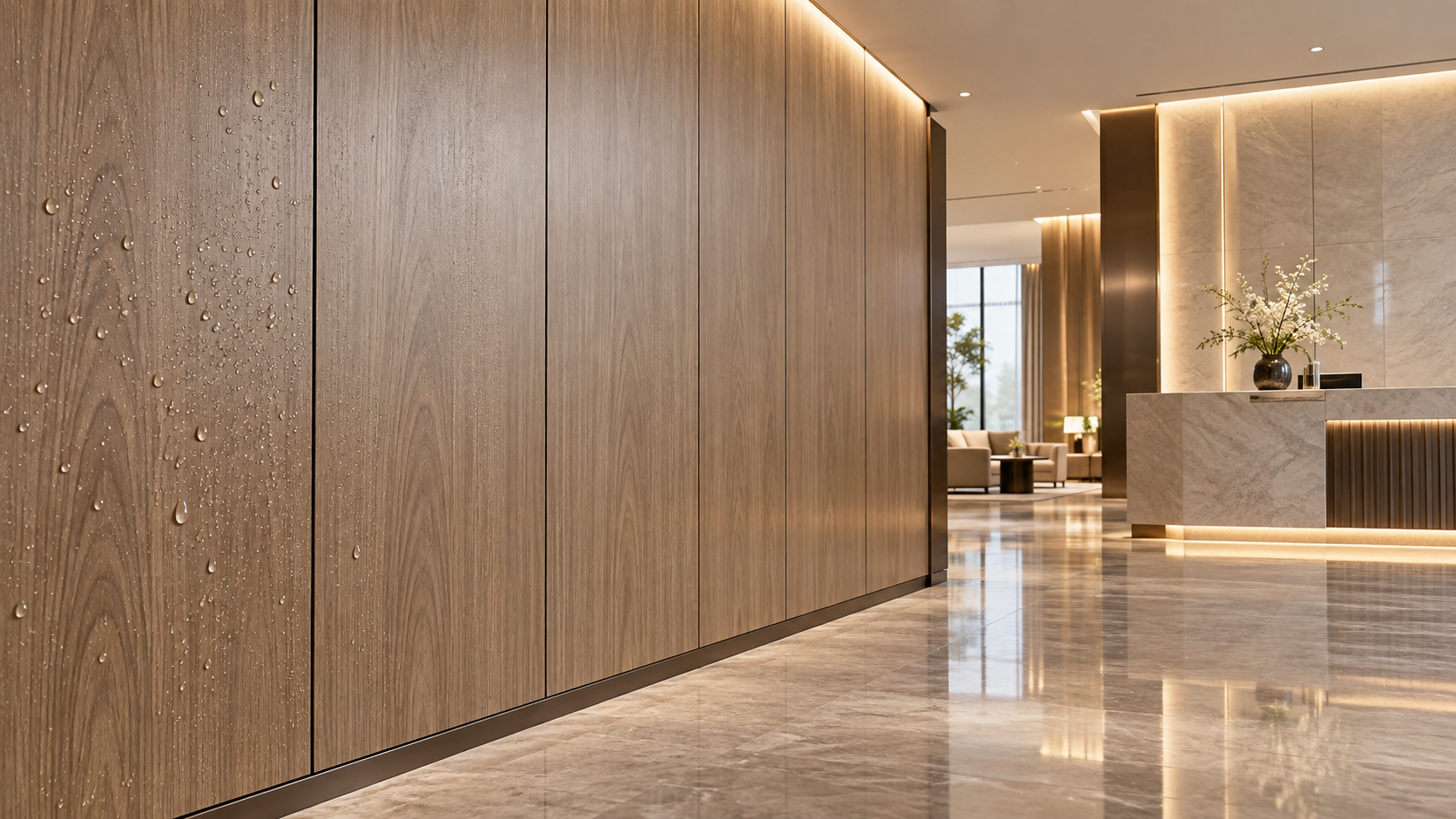
Fireproof waterproof composite wall panels for commercial spaces provide a practical balance of safety, durability, and visual flexibility for hotels, offices, retail environments, and public facilities.
For procurement teams, the central question is not whether a panel looks attractive in a sample room, but whether it performs consistently at scale.
Meilin Board can be a reliable OEM option when buyers define performance requirements early, verify documentation, align customization details, and establish realistic quality-control procedures.
What Commercial Buyers Actually Mean by Reliable
Commercial interior buyers usually define reliability through predictable outcomes: stable quality, compliant materials, manageable installation, dependable delivery schedules, and responsive support when project requirements change.
A panel may appear premium in a showroom but become unsuitable if dimensions vary, finishes differ between batches, or installation requires unexpected site adjustments.
For OEM commercial interior panels, reliability should therefore be evaluated as a supply-chain capability rather than a single physical material characteristic.
Buyers need confidence that the supplier can reproduce approved specifications across multiple production runs, project locations, and customized decorative requirements without compromising performance.
That matters particularly in hospitality, healthcare-adjacent facilities, offices, retail chains, education spaces, and public buildings where interior finishes face repeated daily use.
In these environments, wall panels must withstand moisture exposure, cleaning routines, impact risks, temperature variation, and visual scrutiny from occupants, operators, and property owners.
Meilin Board’s stated focus on new material technology, fireproof sealing materials, furniture, and home furnishing provides a relevant foundation for commercial decorative panel applications.
However, project teams should assess reliability through documented specifications, sample confirmation, factory communication, and inspection standards rather than relying on general supplier positioning alone.
Why Fireproof and Waterproof Performance Matters for Commercial Interiors
Commercial interiors increasingly require surfaces that contribute to safer buildings while reducing maintenance burdens over the operating life of a property or facility.
Fireproof waterproof composite wall panels for commercial spaces are especially valuable where interior design must support both code-conscious planning and practical day-to-day maintenance.
Fire performance is important because decorative finishes can affect compartment safety, smoke development, evacuation conditions, and approval processes for commercial fit-out projects.
Buyers should request applicable test reports, identify the relevant local standard, and confirm whether the tested product matches the panel structure being purchased.
A fire-rated core alone does not automatically establish system compliance, since adhesives, edge treatments, backing layers, joints, and installation methods can influence results.
Water resistance matters for hotel corridors, washroom-adjacent areas, retail entrances, pantry zones, clinics, and other locations exposed to humidity, cleaning, or occasional leaks.
Moisture-related failure often appears gradually through swelling, surface separation, mold risk, edge deterioration, or deformation that undermines an otherwise polished interior design.
Composite panels can help reduce these risks when their core construction, facing materials, sealing details, and installation conditions are selected for the actual environment.
For OEM buyers, the practical value is lower replacement exposure, more predictable upkeep, and fewer disputes caused by using decorative materials beyond their intended conditions.
How Meilin Board Can Support OEM Customization
OEM projects rarely use a completely standard panel. Designers, contractors, and brand owners often require specific sizes, colors, textures, edge profiles, and packaging formats.
Customization is reliable only when it is controlled. Every requested variation should have an approved specification sheet rather than being communicated through informal descriptions alone.
Meilin Board’s material and home furnishing background suggests an ability to work across decorative requirements, which is useful for projects requiring coordinated interior surfaces.
Commercial buyers should clarify whether customization includes surface patterns, gloss levels, substrate thicknesses, fireproof options, waterproof construction, machining, and protective film requirements.
Color control deserves particular attention for branded retail, hotels, offices, and chain projects where one inconsistent batch can be visibly disruptive after installation.
Requesting a signed color reference, sample panel, finish code, and tolerance agreement helps prevent misunderstandings between design intent and mass-production output.
Dimension control is equally important because panel systems often connect with trims, doors, furniture, lighting details, and mechanical openings that leave little tolerance for error.
Before placing a large order, buyers should validate cut-out positions, edge treatments, panel orientation, protective packaging, and installation sequencing through a pilot sample or mock-up.
This process protects both parties. The supplier receives clearer production instructions, while the buyer reduces costly site revisions and avoids ordering panels that cannot fit intended conditions.
Production Consistency Is the Real Test of OEM Reliability
A commercial panel supplier becomes dependable when approved samples can be translated into repeatable production, not merely when a single prototype performs well.
Consistency begins with incoming material control. Core materials, decorative films, coatings, adhesives, and sealing components should be managed against defined purchase standards.
It continues through process control, including pressing conditions, lamination quality, trimming accuracy, surface protection, curing procedures, inspection, and storage before shipment.
Buyers do not need to manage every factory process, but they should understand which quality checkpoints protect their specific risks and acceptance criteria.
For example, projects with long visible wall runs should focus on color variation, surface flatness, pattern alignment, and repeated dimensions across different production batches.
Projects near wet areas should prioritize edge sealing, moisture resistance, material stability, and the treatment of joints where water may enter during operation.
Large-volume orders benefit from pre-production samples, first-article approval, in-process checks, and final inspection records tied to the purchase order and finish identification.
Shenyang Shengshi Meilin Technology’s emphasis on innovation, quality, and service is most meaningful when translated into these measurable production controls for OEM clients.
Ask whether the supplier can provide batch identification, inspection photographs, packing records, and clear procedures for handling confirmed nonconforming products before shipment.
Questions to Ask Before Selecting Commercial Composite Panels
The best sourcing decision comes from asking technical and operational questions early, before design choices become difficult to change or construction schedules become compressed.
First, define the exact use location. A dry office wall, a hotel lobby, a restaurant corridor, and a washroom entrance have different exposure profiles.
Second, identify the required performance evidence. This may include fire-related documentation, moisture testing, emissions information, physical durability data, and regional compliance declarations.
Third, confirm the complete panel composition. Buyers should know the facing, core, backing, adhesive approach, edge solution, thickness, density, and intended installation method.
Fourth, establish visual acceptance criteria. Specify color tolerances, texture direction, gloss expectations, allowed surface defects, protective film requirements, and sample approval procedures.
Fifth, ask about fabrication compatibility. Panels may need drilling, cutting, slotting, grooving, edging, or integration with concealed fixing systems on site.
Sixth, discuss logistics before production begins. Panel size, carton construction, palletization, container loading, labeling, and damage prevention affect arrival condition and installation efficiency.
Seventh, clarify replacement procedures. Commercial projects need a practical route for resolving damage, defects, or shortfalls without delaying opening dates or disrupting contractors.
A supplier that answers these questions precisely is generally better positioned to support OEM work than one offering only broad claims about quality or customization.
Where Meilin Board May Be a Strong Fit
Meilin Board is likely most relevant for buyers seeking decorative panel solutions that combine aesthetic flexibility with practical performance expectations for commercial interior applications.
Hotel projects can benefit from panels used in corridors, guestroom feature walls, reception areas, lift lobbies, and service zones requiring durable decorative finishes.
Office developments may use composite wall panels for reception walls, meeting rooms, executive spaces, circulation routes, pantry enclosures, and modular renovation projects.
Retail environments often need visually consistent materials that support brand identity while tolerating frequent cleaning, product movement, customer contact, and recurring store refreshes.
Public facilities may value fireproof waterproof composite wall panels for commercial spaces because lifecycle maintenance and safety documentation matter alongside initial appearance.
Furniture-linked commercial projects can also benefit where wall finishes need to coordinate with cabinetry, partitions, desks, display fixtures, or custom interior furnishing systems.
The strongest fit occurs when buyers involve the supplier during material selection, allowing panel construction and finish details to be matched to environmental and design requirements.
It may be less suitable to treat any panel as universally applicable. High-abuse, exterior, permanently wet, or heavily regulated locations need project-specific validation.
Reliability improves when the product is selected for its intended duty cycle instead of being specified solely because a similar-looking panel was used elsewhere.
How to Reduce Procurement and Installation Risk
Commercial procurement teams can reduce risk by converting design expectations into written, testable requirements before quotations are compared or orders are released.
Start with a panel schedule listing room type, finish code, dimensions, quantity, substrate requirements, edge treatment, fire performance expectation, and moisture exposure level.
Then request representative samples rather than relying only on small swatches. Larger samples reveal flatness, texture repetition, color behavior, and edge construction more clearly.
For significant projects, create a physical mock-up that includes adjoining trims, lighting conditions, fasteners, joint details, and maintenance access where applicable.
Confirm how panels should be stored on site. Improper stacking, excessive moisture, direct sunlight, and rushed handling can create damage unrelated to manufacturing quality.
Installation teams should follow approved cutting and fixing practices, especially where panel edges require sealing or where joint movement must be accommodated.
Document acceptance at delivery. Recording quantities, batch labels, packaging condition, visible damage, and sample matches makes later issue resolution more objective and efficient.
Finally, keep modest spare stock from the approved batch when visual continuity is critical. This is often more economical than producing emergency replacements later.
Final Assessment for OEM Commercial Panel Buyers
Meilin Board should be evaluated as a potential reliability-focused partner for OEM commercial interiors, particularly where safety, moisture resistance, decorative flexibility, and production coordination are required.
Its technology-oriented positioning and broad material background align with the needs of buyers seeking fireproof waterproof composite wall panels for commercial spaces.
Still, dependable results depend on disciplined buyer-supplier alignment. Confirm specifications, performance evidence, samples, tolerances, production controls, packaging, and post-sale communication before commitment.
For hotels, offices, retail projects, public facilities, and coordinated furnishing schemes, the right panel program can improve appearance, durability, maintenance planning, and project execution certainty.
The clearest conclusion is practical: Meilin Board can be a credible OEM choice when the product is verified against the project’s actual operating conditions and quality expectations.