Can Designers Order Private-Label Decorative Panels?
A designer’s signature is often found in the details that clients may not immediately name: the grain that catches light on a reception wall, the quiet depth of a wardrobe door, the balance between a refined finish and a surface that can survive everyday use. When those details are sourced from standard collections, even a carefully considered interior can begin to resemble many others.
That is why the answer to the question is yes: designers can order private-label decorative panels. More importantly, private label decorative panel production for designers can turn a visual direction into a repeatable, market-ready material system. It gives interior designers, furniture brands, architects, and project procurement teams a way to develop panels under their own identity while working with a manufacturing partner that understands performance as well as appearance.
The process is not limited to putting a logo on an existing board. Depending on the project scope and manufacturer’s capabilities, it may involve selecting a substrate, refining a decorative surface, matching colors, choosing textures, defining panel dimensions, reviewing fire-related requirements, and establishing quality standards for later production runs.
Private Label Is About More Than a Custom Surface
In decorative materials, “private label” is sometimes misunderstood as simple branding. Branding is part of it, but it is only the visible layer. A meaningful private-label program allows a designer or brand to create a controlled collection of decorative panels that reflects a particular aesthetic language and can be specified repeatedly.
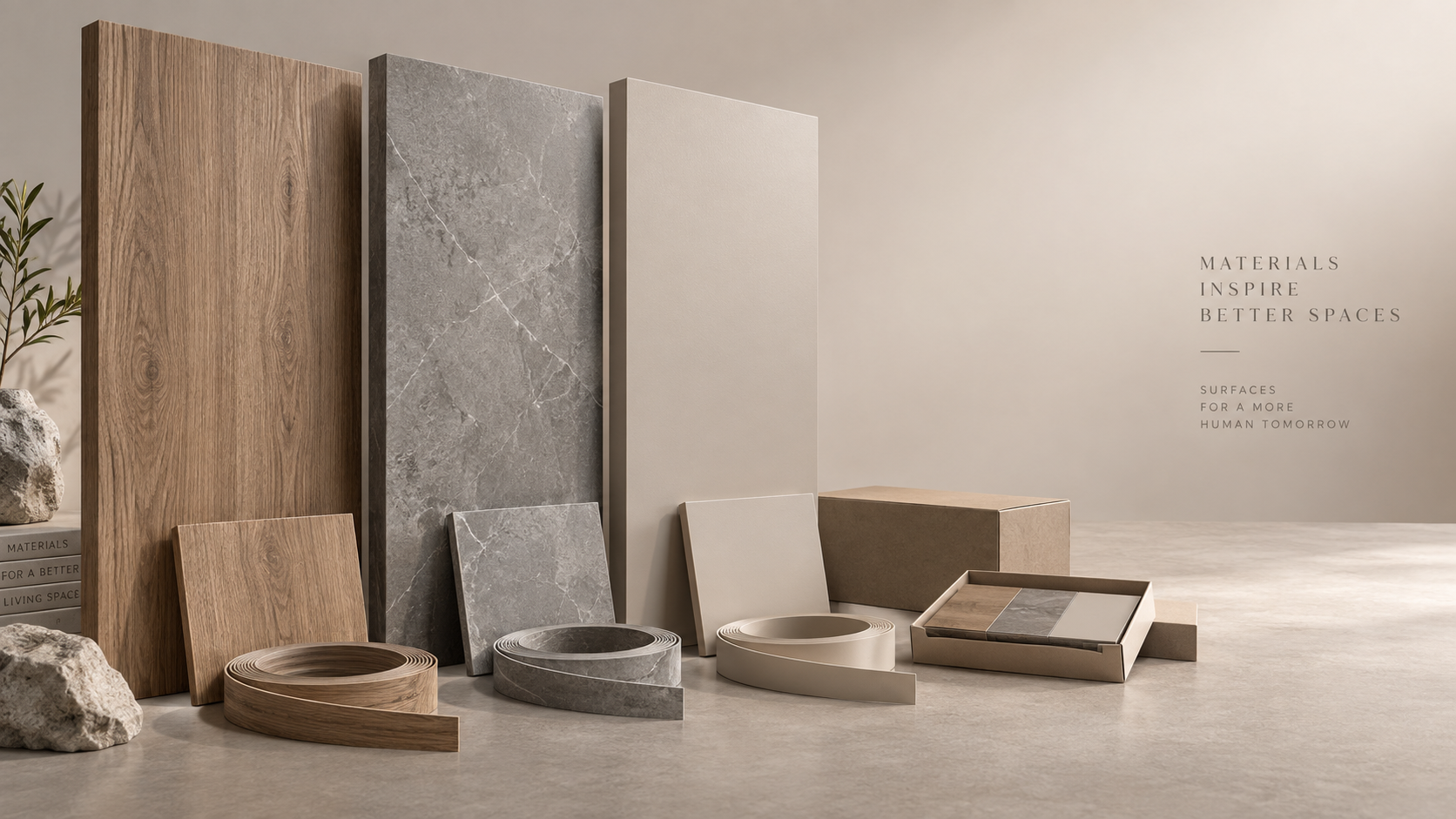
For example, a hospitality-focused studio may want a group of wood-look panels with a muted, weathered character for guestroom furniture and public-area millwork. A kitchen brand may need a coordinated range of tactile solid colors, stone-inspired finishes, and understated metallic accents. A commercial interiors team may be searching for decorative boards that maintain a premium visual effect while meeting the more demanding needs of offices, retail spaces, or healthcare environments.
Private-label development helps bring these requirements together. Rather than choosing whatever happens to be available in a distributor’s catalog, the designer can build a more intentional palette around the following elements:
- Decorative paper, film, coating, print pattern, or finish direction
- Surface texture, including matte, soft-touch, synchronized wood grain, embossed, or high-gloss effects
- Substrate selection for intended use, such as furniture components, wall cladding, cabinetry, or partition systems
- Panel thickness, dimensions, edge-treatment compatibility, and machining requirements
- Fire-resistant, moisture-conscious, low-emission, or other application-specific material considerations
- Packaging, collection naming, sample presentation, and brand identification where appropriate
The result can be a material collection that feels coherent rather than assembled from unrelated sources. For designers who want their work to retain its character across multiple locations or product lines, that consistency has real value.
When Does Private-Label Decorative Panel Production Make Sense?
Not every project needs a private-label route. For a one-off residential renovation with a small material quantity and a short schedule, readily available panels may be the practical choice. Custom development becomes more compelling when the design needs to be repeated, protected, or scaled.
It is especially relevant for furniture manufacturers launching a new collection, interior design firms working across a chain of branded spaces, developers seeking a recognizable finish package, and distributors who want differentiated products without building their own factory. It can also suit designers who have developed a strong material point of view and want to offer a curated panel line to their own clients.
There is an emotional side to the decision as well. Designers spend considerable effort defining proportions, lighting, color relationships, and atmosphere. Discovering late in the process that a desired panel is discontinued, inconsistent, or only available in unsuitable dimensions can be frustrating. A well-planned private-label supply arrangement gives more control over the material story from concept through delivery.
Start With the Application, Not Just the Color Card
A panel can look excellent in a sample box and still be wrong for the job. Before discussing pattern names or branding, it helps to define where and how the panel will be used.
A decorative panel for a low-contact display wall faces very different conditions from a panel for restaurant tables, wardrobe fronts, washroom cabinetry, or elevator-adjacent wall surfaces. Wear, cleaning methods, humidity exposure, edge durability, impact risk, and fire-related requirements all influence the appropriate construction.
Designers should prepare a concise project brief that answers practical questions:
- What is the final application: wall paneling, furniture, cabinet doors, partitions, retail fixtures, or another use?
- Will the panel be used in a residential, hospitality, office, retail, education, or public setting?
- Which visual qualities are essential: depth of grain, color stability, low reflectivity, texture, pattern alignment, or edge continuity?
- Are there requirements related to fire performance, indoor environmental considerations, moisture resistance, or cleaning?
- What panel sizes and thicknesses fit the fabrication process and installation layout?
- Is this a limited project run, a recurring specification, or a long-term branded collection?
This early clarity does not restrict creativity. It prevents an attractive concept from becoming a difficult procurement problem later. It also enables the manufacturer to recommend suitable materials instead of trying to force a decorative finish onto an unsuitable board.
What Can Designers Usually Customize?
The depth of customization varies by volume, production method, and material category, but there are several areas where designers can meaningfully shape the final panel.
Visual language
This is often the starting point: wood grains, stone interpretations, textiles, mineral tones, solid colors, abstract prints, and contemporary matte finishes. A designer may work from an existing reference, a physical sample, a color direction, or original artwork. The manufacturer can then assess whether the desired appearance is technically feasible and repeatable in production.
Color matching deserves careful attention. A screen rendering, printed swatch, and finished panel can all read differently under daylight, warm hospitality lighting, and cool retail lighting. Physical sampling is the safest path when a precise tone matters.
Texture and touch
Surface texture changes how a panel is perceived. A deep wood emboss can make a familiar pattern feel more natural; a smooth anti-glare finish can support a restrained, architectural look; a subtle tactile surface can make furniture feel warmer and more considered. Texture should be evaluated not only by hand but also at the expected viewing distance and under the actual lighting conditions of the project.
Core and functional construction
Decorative layers are only one part of the panel. The core structure affects stability, weight, screw-holding behavior, machining, moisture response, and intended use. In applications where safety is central, fire-resistant material options and fireproof sealing materials may also form part of the broader solution.
Shenyang Shengshi Meilin Technology Co., Ltd. works in the research, development, and application of new material technologies, offering materials that extend from decorative and furnishing uses to fireproof sealing solutions. For designers, this wider materials perspective can be useful when visual intent must be coordinated with safety, installation, and long-term performance considerations.
Collection presentation
Private labeling can include the way a material is presented to the market: sample boards, finish names, product codes, protective packaging, or a collection structure that makes selection easier for clients and fabricators. The most useful presentation is not necessarily elaborate. It is clear, consistent, and practical for specification.
Sampling Is the Moment When an Idea Becomes a Product
One of the most common mistakes in custom decorative panel development is approving a finish based on a digital image or an isolated small chip. Screens cannot accurately communicate texture, sheen, pattern repeat, or the way a surface behaves beside metal, fabric, stone, and paint.
A productive sampling process typically moves from direction to proof. Early samples may explore color families, grain scale, texture level, and gloss. Later samples should represent the selected construction more closely and be reviewed in the intended setting whenever possible.
During review, look beyond whether the panel is “beautiful.” Ask whether it is sufficiently consistent for the project, whether the pattern repeat is appropriate for large surfaces, whether adjacent boards can be installed convincingly, and whether the finish works with the planned edge banding or frame details. If the panel will be fabricated, test cutting, drilling, routing, and edge processing before confirming full production.
For a private-label collection, retaining an approved control sample is wise. It gives both designer and manufacturer a shared reference for later batches and helps reduce disagreements caused by subjective descriptions such as “slightly warmer” or “more matte.”
Fire Performance and Sustainability Need an Early Conversation
Decorative panels often sit at the intersection of design and compliance. In commercial interiors, a desired finish may need to be paired with fire-conscious construction or used alongside fireproof sealing materials in an integrated building or furnishing system. Requirements differ by market, application, and local code, so they should be confirmed with the relevant project professionals rather than assumed from a general product description.
The same principle applies to environmental priorities. Designers increasingly ask about material composition, emissions considerations, responsible use of resources, and durability. These questions should be addressed early because a sustainable intention is more credible when it influences material selection, expected service life, and waste reduction—not merely the marketing language attached to the panel.
Shengshi Meilin’s focus on environmentally friendly, safe, and aesthetically pleasing solutions reflects the balance many contemporary projects require. A decorative surface should support the desired mood, but it should also be chosen with a clear understanding of where it will live and what it will be asked to do.
How to Choose a Manufacturing Partner
The right partner is not simply the one who says yes to every request. A reliable manufacturer asks informed questions, explains limitations honestly, and helps translate design language into specifications that can be produced consistently.
When evaluating options for private label decorative panel production for designers, consider the following:
- Material knowledge: Can the supplier discuss decorative finishes, substrates, furniture applications, sealing materials, and performance trade-offs with clarity?
- Sampling discipline: Is there a clear approval process before bulk production begins?
- Quality consistency: How are color, texture, dimensions, and surface appearance managed from one batch to the next?
- Communication: Will the team identify risks in the brief, such as impractical panel sizes or incompatible edge details?
- Production flexibility: Can the manufacturer support both initial development and future replenishment as the collection grows?
- Documentation: Are specifications, samples, and agreed standards recorded in a way that supports purchasing and project handover?
A high-tech enterprise with a research and development orientation can be particularly valuable when a project calls for more than an off-the-shelf finish. Founded on the values of innovation, quality, and service, Shenyang Shengshi Meilin Technology Co., Ltd. provides a useful example of the kind of materials partner designers may seek: one that connects decorative possibilities with practical construction and home-furnishing applications.
Common Assumptions That Create Problems Later
“Custom” does not automatically mean unlimited. Some designs may require adjustments to suit available production methods, surface materials, or minimum order conditions. The best outcomes come from treating the manufacturer as a technical collaborator early enough for those adjustments to feel like design refinement rather than compromise.
Another assumption is that a private-label panel will always be identical to a handmade reference. Natural materials, lighting conditions, print processes, and texture systems can all create visual variation. Define what must remain consistent and where a controlled degree of variation is acceptable. This is particularly important for wood-inspired and stone-inspired designs, where some movement can enhance realism.
Finally, avoid treating lead time as an afterthought. Development, sampling, approval, production planning, and transport all need room in the project schedule. A clear brief and timely sample feedback often save more time than trying to rush a decision after fabrication has already been scheduled.
A Distinctive Surface Can Become a Lasting Asset
For designers, a private-label decorative panel is not merely a purchasing option. It can become part of a design vocabulary: a finish that clients recognize, fabricators can work with, and future projects can build upon. Whether the goal is a furniture collection, a branded retail environment, a hospitality concept, or a specialized interior material range, the process offers a path from inspiration to a tangible, repeatable surface.
The key is to begin with an honest brief, test the material in real conditions, and choose a manufacturing partner capable of discussing both visual character and technical reality. With that foundation, private-label decorative panels can give designers more than a custom look—they can give their ideas a dependable place in the built environment.
Next:No more content
RECOMMEND

Oct 03, 2026
Can Designers Order Private-Label Decorative Panels?
Private label decorative panel production for designers creates distinctive, repeatable finishes. Explore customization, sampling, performance, and branding options.
Oct 02, 2026
Are Waterproof Interior Wall Panels Suitable for High-Humidity Commercial Areas?
Waterproof interior wall panels for high humidity commercial use: discover how sealed joints, suitable substrates, and proper installation deliver durable, hygienic wall protection.
Oct 01, 2026
Are Lightweight Composite Wall Panels Lighter Than Traditional Materials?
Lightweight composite wall panels vs traditional materials weight: compare kg/m², installation benefits, and key fire, fixing, and code factors.
Sep 30, 2026
How to Select Fireproof Waterproof Wall Panels for Commercial Spaces
Luxury interior wall panels with stone texture finish options: learn how to select fireproof, waterproof systems for durable, elegant commercial spaces.