How Do You Read an E0 Decorative Board Test Report?
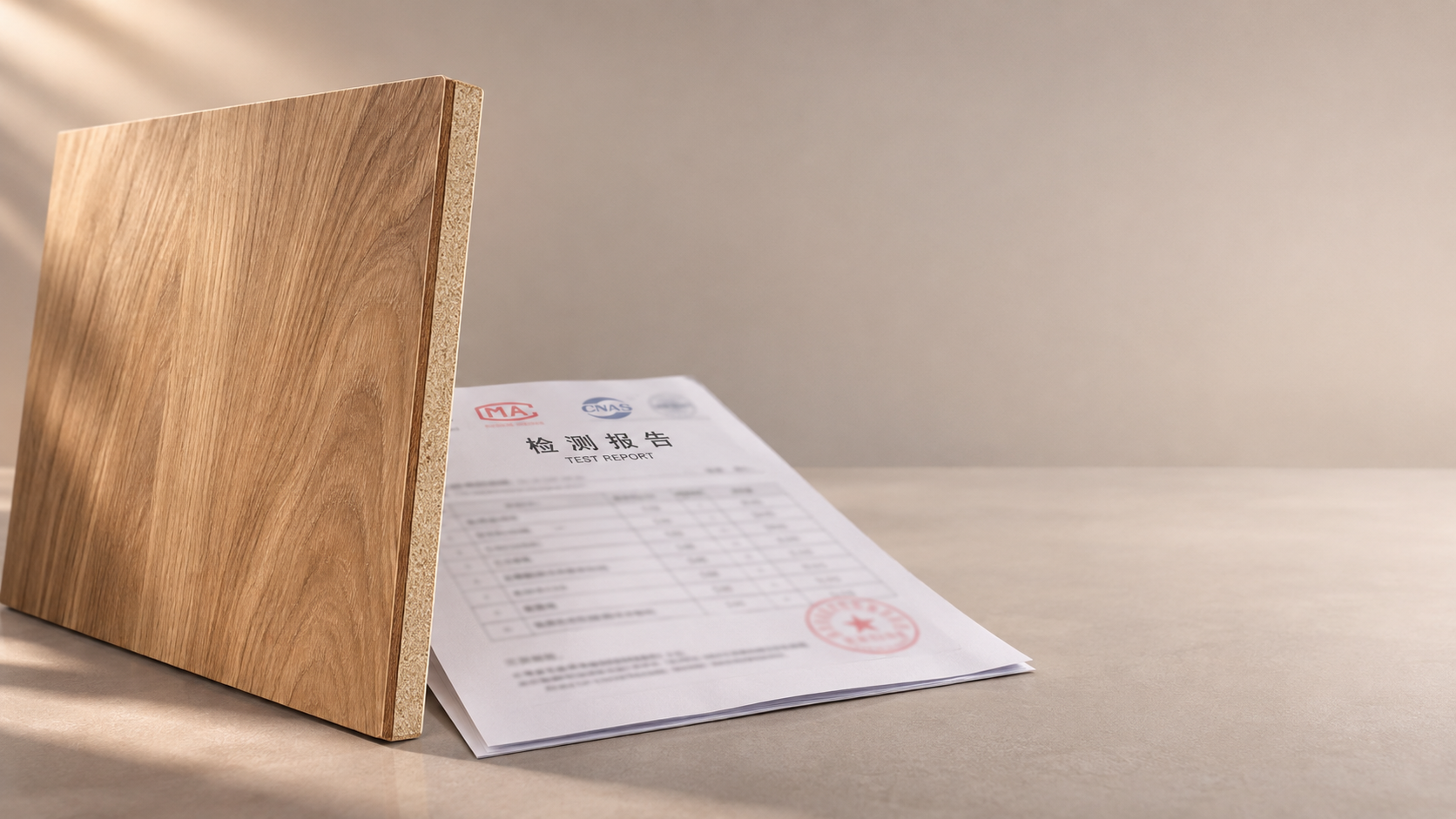
An E0 decorative board test report is useful when it shows that the board being offered was tested against an identifiable formaldehyde emission standard and that the measured result meets the applicable limit. The E0 label alone does not establish any of those points. Start with the sample description, the test method, the result and its unit, and the standard used for the classification.
Then check how closely the tested sample matches the material you intend to buy. A report for an unfinished substrate may tell you something about the core, but it does not necessarily describe the finished decorative board. For furniture and interior projects, the most useful report is one that can be connected to the actual product specification and evaluated against the requirements of the destination market and project.
Start with the result, the limit and the standard
Find the section containing the formaldehyde emission result. Read the number together with its unit, the test method and the limit used to judge it. A result without these details is difficult to interpret: the same-looking number can have a different meaning under a different method or measurement basis.
Under the Chinese standard GB/T 39600-2021, for example, E0 is a formaldehyde emission class for wood-based panels and their products, with a limit of 0.050 mg/m³ when determined using the specified 1 m³ climate chamber method. That figure is useful only in its stated context. A result expressed in mg/m³ under a different chamber method should not automatically be treated as directly equivalent, and a result expressed in another unit should not be converted by simply moving a decimal point.
Check that the report identifies the relevant standard and edition, as well as the method actually used. A document may cite one standard for testing and another for classification; both references matter. If the supplier describes the board as E0, but the report gives only a measured value and no classification, compare the result with the appropriate limit under the applicable standard. If the report states a classification, check that the stated result supports it.
For example: a result of 0.040 mg/m³ measured under the method specified for the E0 classification above is below its 0.050 mg/m³ limit. That observation applies to the tested sample and the stated conditions. It does not, by itself, establish that every board supplied under the same trade name will produce the same result.
Pay attention to the relationship between the reported value and the limit. A result just below a threshold may still meet the stated criterion, but a buyer who needs consistent compliance across production should ask how the supplier controls variation and what additional evidence is available. Do not infer a production safety margin from a single test result.
Match the tested sample to the board being purchased
The sample description is where many apparently convincing reports become less useful. Look for the product name, material or substrate, thickness, surface treatment and identifying details such as a model, batch or sample number. Compare those details with the quotation, technical specification and purchase documents.
For a decorative board, the distinction between the core and the finished panel matters. A finished product can include a substrate, decorative facing, coatings and adhesives. Its emission behavior may differ from that of the bare core. A report for a plain particleboard or MDF substrate therefore should not automatically be presented as evidence for every finished panel made from it.
The reverse requires care too. If the finished board was tested with particular faces or edges covered or sealed, check whether the supplied boards and their intended installation will have a comparable configuration. The report should describe specimen preparation and any edge treatment required by the method or applied to the sample. An exposed cut edge in a fabricated cabinet is not necessarily represented by a sealed test specimen.
Differences in thickness, facing or construction do not automatically invalidate a report, but they do weaken the connection between the tested sample and the order unless the supplier can explain why the evidence still applies. Ask for a report covering the relevant construction or for technical documentation that identifies the product variants represented by the tested sample.
- Does the product name or code on the report match the item on the quotation?
- Is the report for the finished decorative board, the unfinished substrate, or a component?
- Are the thickness, facing and other identifying features consistent with the order?
- Does the report identify a batch or sample, and can the supplier connect it to the product being supplied?
- Were edges or faces treated during specimen preparation, and is that configuration relevant to the intended use?
Read the test conditions before comparing suppliers
Two reports can both describe formaldehyde emissions and still provide results that are unsuitable for a direct ranking. Chamber size, specimen preparation, loading conditions, temperature, humidity and sampling time can affect a measurement. The method governs these conditions, so start by comparing method identifiers and editions before comparing the numbers.
Units are an immediate warning sign. A concentration in mg/m³ and a result reported per mass or area are not interchangeable without a valid method-specific basis. Even when both results use mg/m³, differences in the test protocol can limit what the comparison shows. Ask for results obtained under the same applicable method and for comparable product constructions if a numerical comparison is important to the purchasing decision.
The reporting format matters as well. A result written as “not detected” or “below the reporting limit” does not necessarily mean zero emissions. Look for the detection or reporting limit and compare it with the threshold you need to assess. If the report does not provide enough detail, request clarification from the supplier or testing laboratory before using it to substantiate a claim.
A report may also contain a conclusion such as “pass.” Read the criterion beside that conclusion. A pass against one formaldehyde limit does not automatically demonstrate compliance with a different market’s requirements. For an export order, identify the rules and evidence required for the destination and application, then check whether the report’s method, product scope and supporting documents address them.
Check what the report can prove
A test report records the examination of a sample under stated conditions. It is evidence about that sample; it is not automatically a certificate for all current production. Look for the laboratory name, report number, issue date, sample receipt and test dates, and any stated limitations. Read whether the sample was submitted by the applicant or selected under a defined sampling arrangement, because that affects what can be inferred about the wider production run.
Review the complete report rather than relying on a cropped result table or a promotional image. The pages containing the sample description, method, conditions and conclusions should belong to the same report. If a document has an amended version, use the final version and check what changed. Where the laboratory offers a report verification service, use its stated process to check the document.
Laboratory accreditation can strengthen confidence in the testing process, but a logo alone is not enough. Check whether the laboratory’s accreditation covers the relevant method and material at the time of testing. Accreditation also does not replace the need to match the tested sample to the board being supplied.
Consider the report date alongside the product’s history. An older report may still be informative, but changes in substrate, adhesive, facing, manufacturing process or supplier can reduce its relevance. A recent report is not automatically representative either if it covers a different construction. Ask what has changed since the sample was tested and what evidence supports the current specification.
Turn the report into a purchasing decision
Before approving a decorative board, put the emission requirement into the product specification: identify the applicable standard and edition, the required class or limit, the product construction and the evidence the supplier must provide. This gives both parties a clear basis for reviewing a report and resolving discrepancies before material is ordered.
If the report covers a representative sample rather than the exact batch, decide whether that evidence is sufficient for the project. Depending on the contractual requirements and the consequences of a mismatch, the buyer may request more recent production evidence, batch traceability or independent testing of an agreed sample. Any sampling and testing arrangement should state who selects the sample, which product configuration is tested and which method and acceptance criterion apply.
Finally, keep the board result in proportion to the finished application. An E0 classification concerns formaldehyde emissions under a defined testing and classification scheme; it does not establish that a furnished room will meet every indoor air requirement or that the material is free of all other substances of concern. Cabinet assembly, other materials, the amount of board used and ventilation can all affect the completed space. Where the project has a separate indoor air requirement, assess that requirement on its own terms.
A report is most valuable when it makes a purchase easier to specify and verify. If the result, method and limit align but the sample cannot be tied to the offered board, the remaining question is product identity. Resolve that link before treating the E0 claim as evidence for the order.
Next:No more content
RECOMMEND

Nov 17, 2026
How Do You Read an E0 Decorative Board Test Report?
Learn how to read an E0 decorative board test report, verify emission limits and sample details, and choose the right board with confidence.
Nov 17, 2026
How Do You Choose Lightweight Wall Panels for Hotels?
Choose lightweight panels for hotel walls with confidence. Compare fire safety, durability, installation and cost to find the right finish for every space.
Nov 16, 2026
How Can You Check a Panel Sample Against the Production Finish?
How can I check if a panel sample matches the final production finish? Compare color, sheen, texture and pattern under consistent lighting before installation.
Nov 15, 2026
How Long Does It Take to Make a Custom Panel Sample?
How long does a custom panel sample take to make? Explore typical lead times, key production factors, and practical tips to plan your project with confidence.