

Are Waterproof Interior Wall Panels Suitable for High-Humidity Commercial Areas?
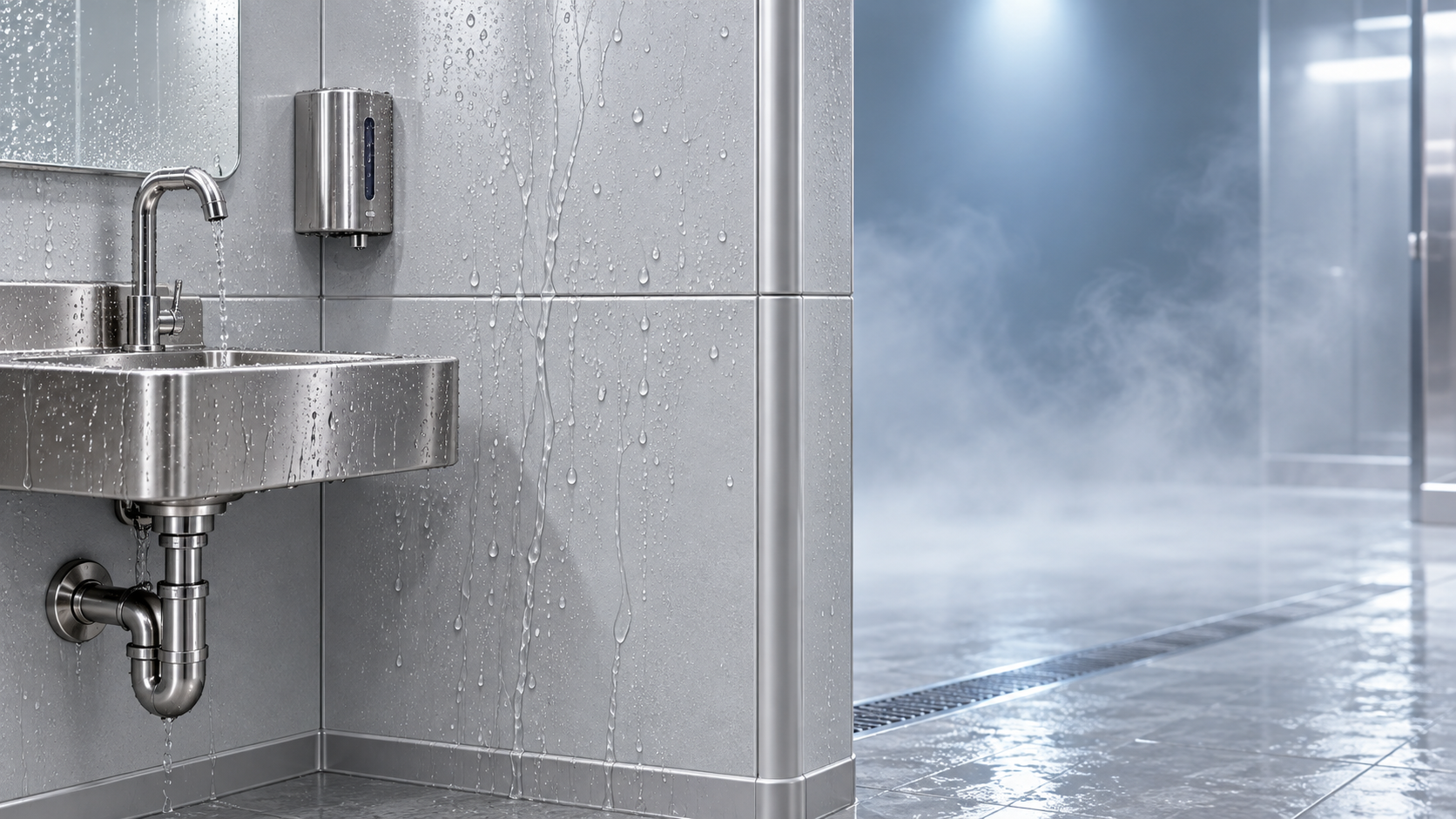
A wall finish can look clean on opening day and still fail quickly in a busy washroom, commercial kitchen, spa changing area, clinic utility room, or gym shower zone. Humidity alone is rarely the only issue. These spaces may also face direct splashing, frequent washdown, steam, cleaning chemicals, impact from carts, and moisture entering through joints or service penetrations.
Yes, waterproof interior wall panels can be suitable for high-humidity commercial areas, but only when the panel material, joint system, substrate condition, installation method, and cleaning requirements match the actual exposure level. A panel labelled “water-resistant” is not automatically appropriate for a shower enclosure, food-preparation washdown area, or constantly damp changing room. The practical question is not simply whether a panel repels water on its face; it is whether the complete wall assembly can keep moisture from reaching the wall behind it.
Start with the type of moisture the room creates
Commercial humidity is not one uniform condition. A reception-area washroom may have high humidity for short periods and occasional splashing around basins. A health-club shower corridor can have prolonged steam, wet floors, and regular cleaning. A commercial kitchen may expose walls to grease, heat, condensation, and aggressive cleaning agents. These settings place different demands on interior wall panels.
Before selecting a panel system, separate the space into exposure zones:
- Humid but normally dry walls: corridors beside pool areas, restroom entrances, locker rooms with effective ventilation, and back-of-house rooms where condensation is possible but direct water is limited.
- Splash zones: walls behind washbasins, handwashing stations, janitor sinks, beverage counters, and areas near shower exits.
- Direct wet zones: shower walls, wet-room perimeters, spa treatment rooms with rinse facilities, and locations receiving repeated direct spray.
- Washdown or hygiene-critical zones: food service support rooms, healthcare cleaning rooms, laboratories, and other spaces cleaned frequently with water or chemical agents.
Waterproof interior wall panels for high humidity commercial use are often a strong choice in the first two categories and can also work in direct wet zones when they are installed as part of a properly sealed system. In washdown environments, however, chemical resistance, edge sealing, substrate protection, and detailing around fixtures become more important than the panel’s advertised water resistance alone.
The face of the panel is only one part of the system
A common selection mistake is to inspect only the visible panel surface. Smooth PVC-based panels, composite decorative boards, and other waterproof-faced products may resist moisture well across the main field of the wall. Failure usually begins elsewhere: at vertical joints, top and bottom edges, internal and external corners, screw penetrations, plumbing openings, or the transition between wall and floor.
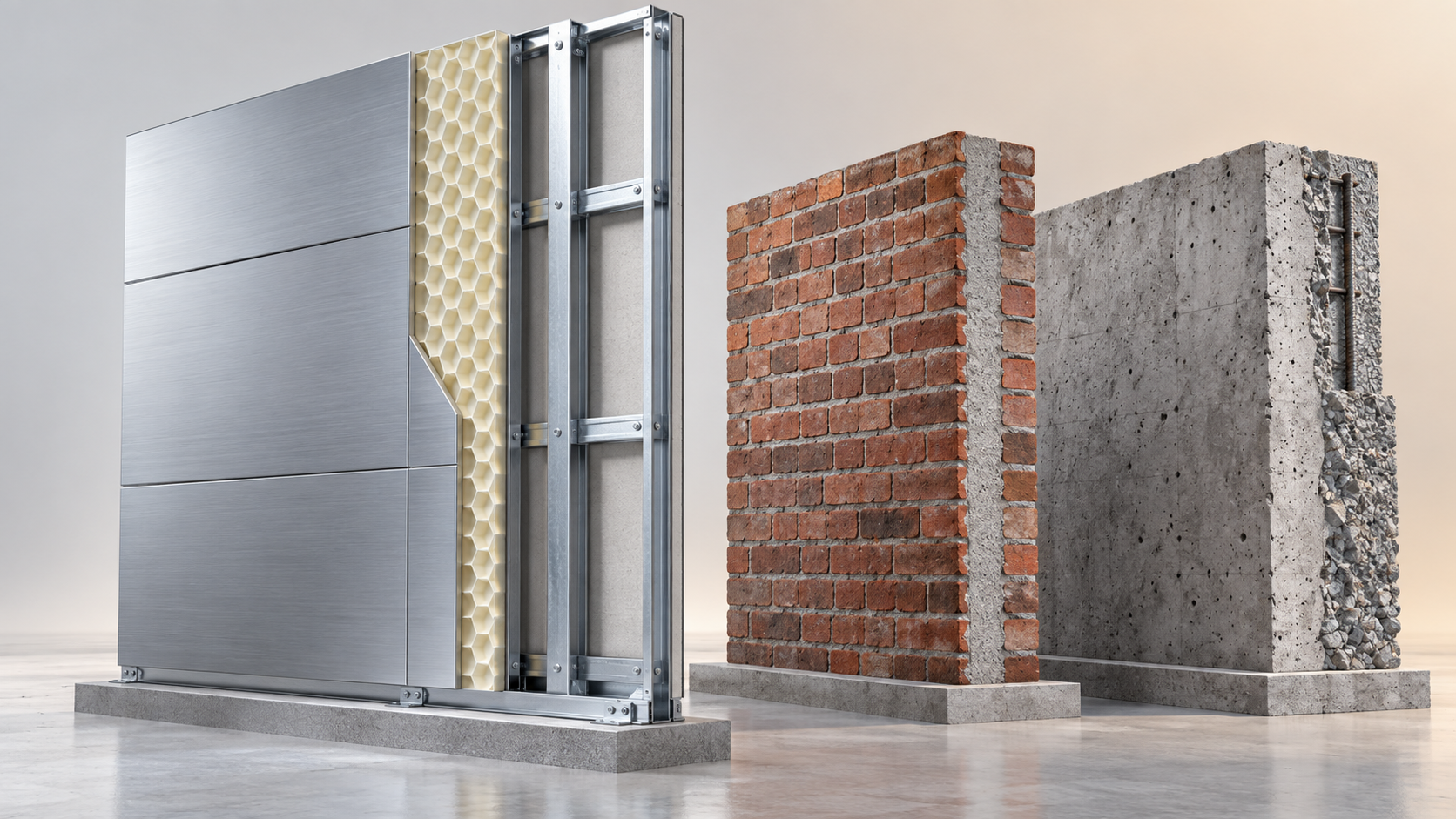
Think of the wall as a sealed envelope rather than a collection of boards. Water can travel behind panels through a narrow unsealed gap even when the panel surface itself is unaffected. Once trapped, that moisture may contribute to adhesive failure, staining, swelling of an unsuitable substrate, odor, or hidden microbial growth. The visible panel can remain intact while the wall behind it deteriorates.
For this reason, a commercial specification should identify how each vulnerable point will be treated. Depending on the panel design and site conditions, that may involve compatible trims, welded or interlocking joints, sealant at joints and perimeters, waterproof backing, closure profiles, and properly detailed penetrations. Mixing unrelated components can create weak points. A sealant that does not bond reliably to the panel surface or trim material is not a dependable moisture barrier.
“Waterproof” and “water-resistant” should not be treated as the same claim
These terms are often used loosely in product discussions, yet they describe different levels of performance. Water-resistant materials can tolerate occasional moisture and routine cleaning but may not be intended for continuous wet exposure. Waterproof panels are designed to prevent water from passing through the panel itself, but that still does not guarantee that the installed wall will withstand direct spray at every joint.
Procurement decisions should therefore request clear product information about intended applications rather than relying on a single marketing term. Ask whether the panel is intended for humid rooms, splash areas, shower walls, or washdown areas. Those are materially different installation conditions.
Where waterproof wall panels usually perform well
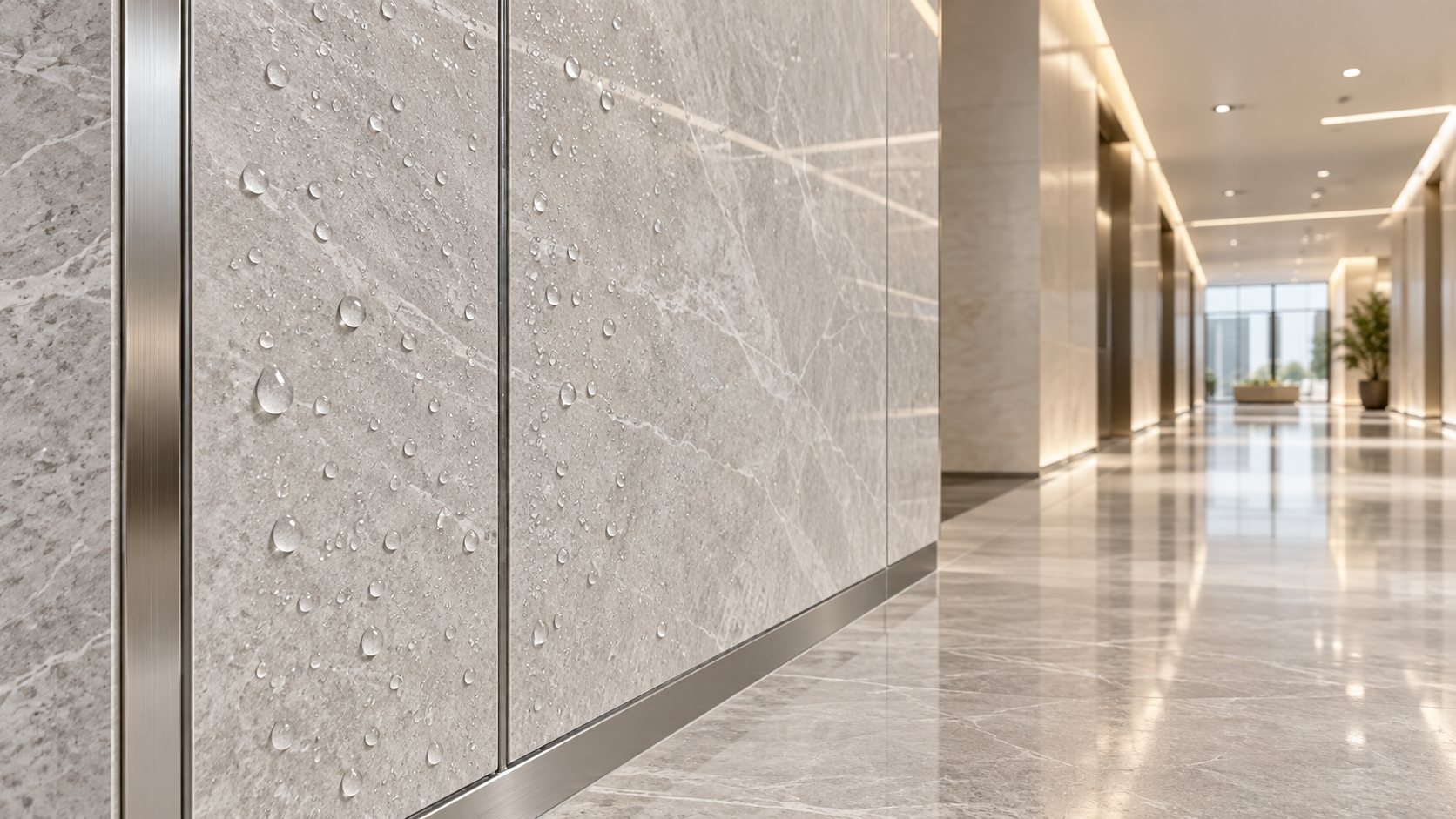
In commercial restrooms, waterproof wall panels can provide a practical alternative to painted drywall or finishes with many grout lines. Their smooth surface can reduce places where dirt and moisture collect, and they can help maintain a consistent appearance where walls are cleaned often. Behind vanity units and hand dryers, panels may also protect finishes from routine splash and contact.
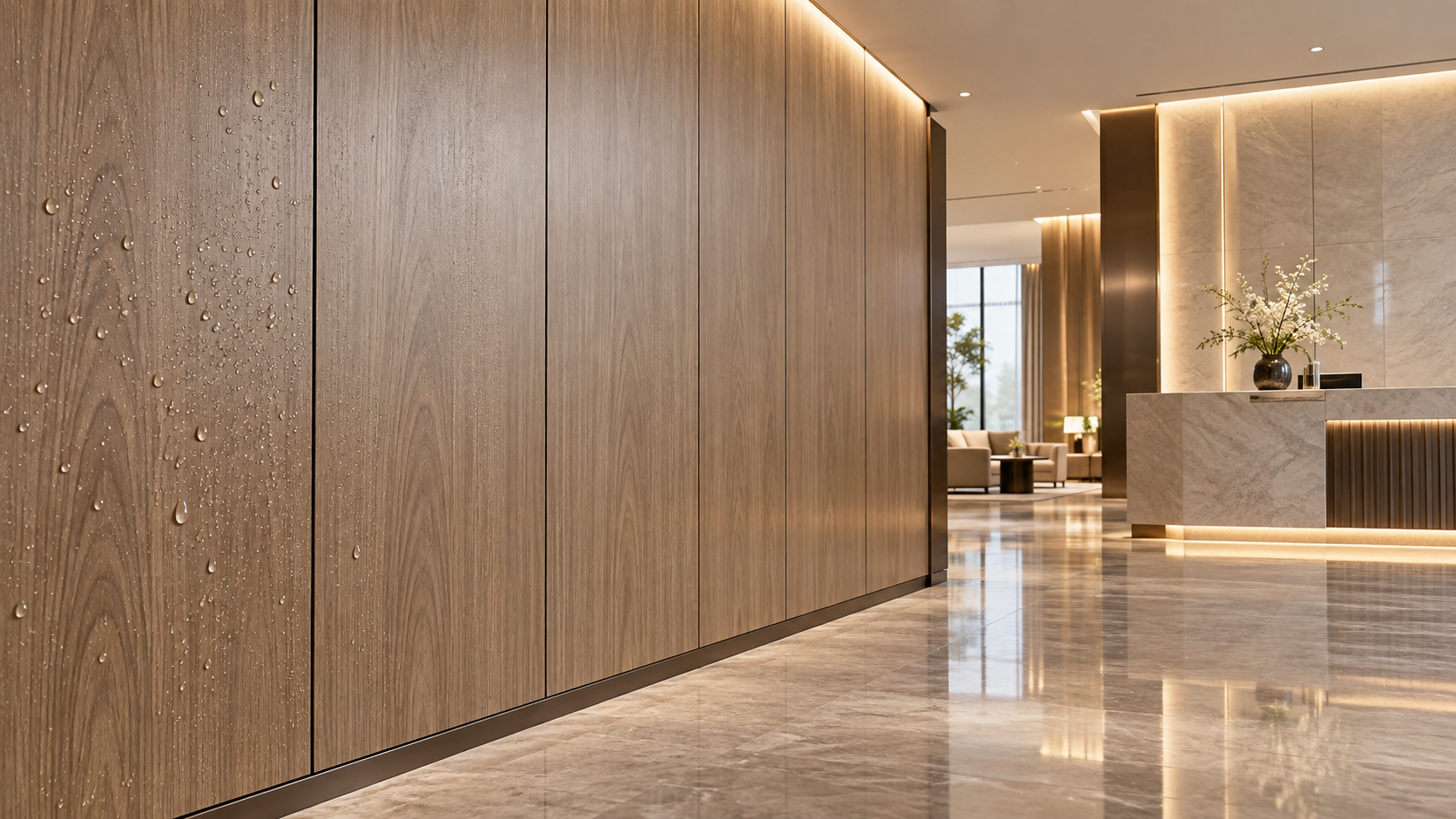
Changing rooms, spa corridors, treatment-room wash areas, and salon shampoo zones are also suitable applications when ventilation is adequate and the wall details are planned before fixtures are installed. A panel can be especially useful where a seamless or low-joint surface is preferred for cleaning and visual continuity.
Healthcare and care facilities may use moisture-resistant wall finishes in utility rooms, wash areas, and sanitary spaces, but selection should account for cleaning protocols. A surface that withstands mild routine cleaning may not perform equally well under repeated exposure to stronger disinfectants. Compatibility with the actual cleaning products matters, including the frequency of use and the time chemicals remain on the wall.
Commercial kitchens require a more cautious assessment. Steam and condensation alone may be manageable, but grease, heat sources, impacts, and intensive cleaning change the demand. Panels near cooking equipment may need different performance characteristics than panels in a dishwashing-adjacent corridor or staff washroom. Do not assume one wall material should cover every kitchen zone.
Substrate condition can decide whether the installation succeeds
Waterproof panels do not repair a damp, unstable, or contaminated wall behind them. Installing over existing moisture damage may hide the symptom while allowing the underlying problem to continue. Before panel installation, inspect the substrate for signs of water ingress, loose coatings, crumbling board, corrosion, mold-related staining, unevenness, or movement around structural joints.
A sound substrate should be dry enough for the selected adhesive or fixing method, flat enough to support the panel without excessive stress, and capable of holding mechanical fasteners where they are required. Walls with recurring leaks, failed plumbing, roof ingress, or persistent condensation need those causes corrected first. Covering the wall before resolving active moisture can create a more difficult repair later.
Adhesive selection deserves equal attention. Some systems are installed with adhesive across the full panel back; others use mechanical fixing, battens, or a combination. The correct method depends on panel type, wall condition, room temperature, expected moisture load, and access to the substrate. In humid spaces, gaps behind poorly bonded panels can become places where condensation accumulates. Adhesives and sealants should be suitable for both the panel material and the service environment.
Details around edges, fixtures, and floors are where commercial walls are tested
Walls in high-humidity facilities are rarely uninterrupted. They include faucets, pipe sleeves, electrical boxes, dispensers, grab rails, mirrors, signage, access panels, and mounted equipment. Every opening interrupts the moisture barrier. A clean circular cut around a pipe is not enough if water can enter the annular gap behind it.
Plan penetrations before installation whenever possible. Openings should be accurately cut, sealed with compatible materials, and detailed so water sheds outward rather than collecting at the edge. Heavy wall-mounted items require secure fixing to suitable backing; relying on a decorative panel alone to carry a grab rail, shelving unit, or commercial dispenser can damage both the panel and the seal.
The lower edge deserves special attention. In washrooms and wet rooms, water can sit against the wall-floor transition after mopping or shower use. If the base detail is left open, moisture can wick behind panels. The upper edge matters as well in steam-heavy rooms, particularly where condensation can run down from ceilings or collect behind an unfinished top trim.
Choose surface properties based on cleaning, not appearance alone
A glossy panel may look easy to maintain, but cleaning performance depends on more than smoothness. Consider whether the finish marks easily, whether it can tolerate repeated wiping, and whether the cleaning process leaves residue. Textured surfaces can be visually attractive, yet deep texture may hold soil in hygiene-sensitive locations.
Ask the maintenance team what is actually used: neutral detergent, diluted disinfectant, degreaser, descaler, abrasive pad, steam cleaner, or pressure equipment. A wall panel that is compatible with one method may be damaged by another. Harsh abrasives can dull surfaces; certain solvents can affect some polymers; poorly rinsed cleaning chemicals may leave streaks or stress seals over time.
Maintenance instructions should be practical enough for the site. If a finish requires specialized cleaners or careful treatment that does not fit the daily routine, the risk is not only cosmetic. Damaged surfaces and broken seals can make moisture control harder.
Questions to resolve before approving a panel system
Rather than selecting by color, thickness, or initial cost alone, review the intended assembly against the room’s real operating conditions. The following questions usually reveal whether a panel is appropriate:
- Will the wall receive only humid air, or will it receive regular direct water spray?
- Are there steam cycles, temperature changes, or cleaning routines that could affect panel movement or sealant performance?
- What is behind the panel, and has the substrate been checked for existing dampness or movement?
- How will seams, corners, floor transitions, ceiling transitions, and service penetrations be sealed?
- What cleaning chemicals and tools will be used after handover?
- Will equipment, rails, or cabinetry need reinforced fixing locations?
- Does the product guidance specifically cover the exposure zone being specified?
These questions are especially important where one project contains several moisture conditions. A restroom lobby wall, a basin splashback, and a shower enclosure may look similar on a drawing, but they should not automatically receive the same installation detail.
Installation quality determines long-term performance
Even a suitable panel can underperform when installed in a rush. Panels need to be acclimated and handled according to their material requirements. The installer should check wall flatness, align panels carefully, maintain the correct expansion allowances where required, and avoid forcing boards into position. Excessive stress can lead to joint opening or distortion as temperature and humidity change.
Sealants should be applied to clean, dry, compatible surfaces and finished so that there are no skips, pinholes, or unbonded edges. A thick bead is not automatically better; the goal is a continuous, properly adhered seal that accommodates expected movement. Once fixtures are fitted, inspect again. New holes drilled after installation are a frequent source of water entry when they are not resealed.
Before the room enters service, examine the wall from a maintenance perspective. Can staff reach and clean the joints? Are trims firmly seated? Are lower edges protected from routine wet mopping? Are exposed cut edges fully closed? This final review is more useful than judging the wall only by its visual finish.
Practical questions from commercial projects
Can waterproof panels be installed over existing tiles?
They can be installed over some tiled surfaces if the tiles are firmly bonded, clean, reasonably flat, and compatible with the selected fixing method. Loose tiles, hollow areas, cracked grout with active moisture behind it, or heavily contaminated surfaces should be addressed first. The new panel system should not be used to conceal an unresolved leak.
Are panels better than tiles in a high-humidity room?
Neither option is automatically better. Panels can reduce the number of joints and may simplify cleaning, while tiles can be suitable when the backing, grout, and waterproofing system are correctly designed. The decision should consider the wet exposure level, desired appearance, cleaning routine, repair strategy, and installation quality available on site.
Do waterproof wall panels eliminate the need for ventilation?
No. Panels protect the wall surface and assembly, but ventilation controls airborne moisture and condensation throughout the room. Without adequate extraction and air movement, humidity can still affect ceilings, doors, fixtures, concealed cavities, and surfaces not protected by panels.
For high-humidity commercial spaces, the most reliable approach is to specify the wall finish by exposure zone and treat the panel, joints, backing, penetrations, and maintenance routine as one system. When that level of detail is addressed before installation, waterproof interior wall panels can provide a durable and cleanable finish without turning hidden moisture into the next maintenance problem.
Next:No more content
RECOMMEND

Oct 02, 2026
Are Waterproof Interior Wall Panels Suitable for High-Humidity Commercial Areas?
Waterproof interior wall panels for high humidity commercial use: discover how sealed joints, suitable substrates, and proper installation deliver durable, hygienic wall protection.
Oct 01, 2026
Are Lightweight Composite Wall Panels Lighter Than Traditional Materials?
Lightweight composite wall panels vs traditional materials weight: compare kg/m², installation benefits, and key fire, fixing, and code factors.
Sep 30, 2026
How to Select Fireproof Waterproof Wall Panels for Commercial Spaces
Luxury interior wall panels with stone texture finish options: learn how to select fireproof, waterproof systems for durable, elegant commercial spaces.
Sep 29, 2026
How Reliable Is Meilin Board for OEM Commercial Interior Panels?
Fireproof waterproof composite wall panels for commercial spaces: discover how Meilin Board supports reliable OEM interiors with customizable finishes, quality control, and durable performance.