

Are Magnesium Oxysulfate Composite Boards Safe for Enclosed Commercial Spaces?
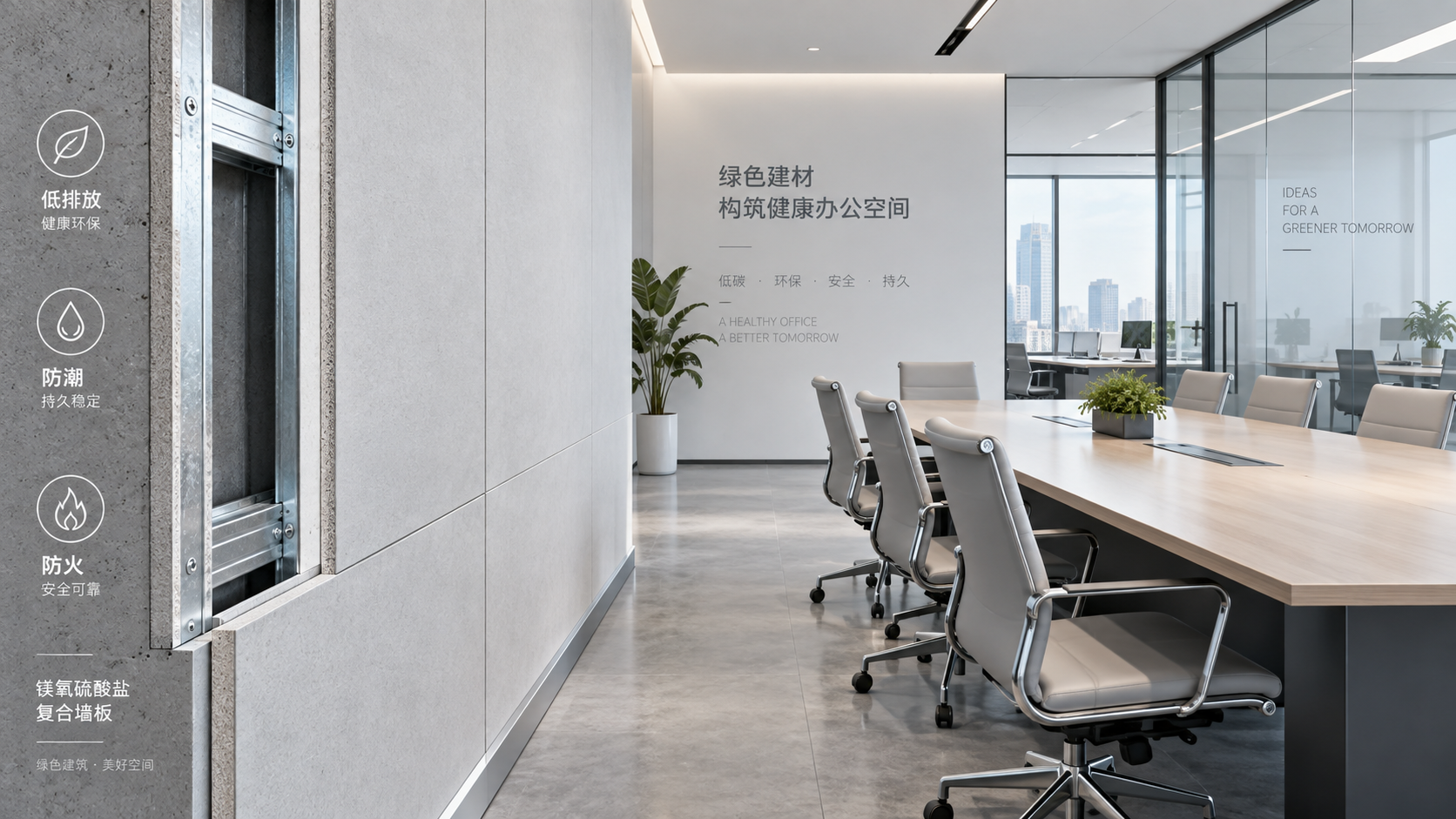
Magnesium oxysulfate composite boards can be a safe option for enclosed commercial interiors, but safety cannot be inferred from the board’s name, fire rating, or appearance alone. In offices, retail units, hotels, clinics, classrooms, and similar spaces with limited ventilation, the decisive questions are whether the supplied board has been assessed for indoor emissions, whether its formulation is stable under expected humidity, and whether the complete installed assembly introduces additional pollutants.
The important distinction is between material hazard and installed-space exposure. A mineral-based board may have low inherent combustibility and may contain no added formaldehyde in its core, yet an enclosed room can still experience unacceptable odour or volatile organic compound (VOC) exposure if the facing, coating, adhesive, joint compound, sealant, laminate, or cleaning treatment is poorly specified. Conversely, a board with sound emissions documentation can perform poorly in service if water exposure causes surface deterioration, salt migration, or microbial growth on adjacent materials.
For commercial decision-makers, magnesium oxysulfate (MOS) composite board is therefore best treated as a system material that requires evidence-based specification rather than as a universally “green” substitute for every interior panel.
Why magnesium oxysulfate chemistry matters
Magnesium-based boards are not a single product category. Their performance depends heavily on the binder chemistry, reinforcement, fillers, density, surface treatment, and manufacturing control. Magnesium oxysulfate boards use a magnesium oxide–magnesium sulfate binder system. This differentiates them from magnesium oxychloride (MOC) boards, which use magnesium chloride in the binder.
The distinction is relevant because chloride-containing formulations have historically raised concerns in some humid applications. If chloride salts become mobile under moisture exposure, they can contribute to efflorescence, surface “weeping,” fastener corrosion, and damage to nearby finishes. These risks are formulation- and exposure-dependent; they should not be used to characterize every magnesium board. However, they explain why purchasers should ask specifically what binder system is used rather than accepting broad descriptions such as “MgO board” or “magnesium board.”
MOS chemistry is often selected partly because it avoids chloride as the principal salt component. That can reduce one important compatibility concern, especially where metal framing, fasteners, or decorative finishes are present. It does not eliminate the need for moisture assessment. Sulfate-bearing materials can still be affected by prolonged wetting, and the panel’s dimensional stability, water absorption, edge integrity, and coating compatibility remain relevant to an enclosed commercial installation.
“Composite” adds another layer of variation. The board may include glass-fibre mesh, nonwoven facings, decorative films, insulation layers, lightweight fillers, or surface coatings. These additions can improve strength, appearance, handling, or acoustic and thermal performance, but they also change the indoor-air and fire-performance profile. Safety documentation must correspond to the actual finished product, including its face treatment, not merely to an uncoated core board tested in isolation.
Indoor air quality: the board core is only part of the question
For enclosed spaces with ventilation concerns, low emissions are more important than broad environmental claims. The relevant exposure pathway is the release of substances into occupied air over time, particularly after installation when ventilation may be reduced outside operating hours.
A mineral binder and inorganic reinforcement do not normally create the same formaldehyde profile associated with some resin-bonded wood panels. That is a meaningful potential advantage. Yet it should not be translated into an unqualified statement that every magnesium oxysulfate composite board is “zero emission.” VOCs and odours can originate from several components:
- protective coatings, primers, decorative films, and inks;
- lamination adhesives and edge-banding materials;
- jobsite adhesives used to bond boards to substrates;
- joint fillers, tapes, sealants, and repair compounds;
- packaging residues or surface treatments applied during production.
In a large, continuously ventilated lobby, minor short-term emissions from an installation product may dissipate quickly. In a small meeting room, hotel guestroom, treatment room, or interior retail compartment with limited outdoor-air exchange, the same installation choice can become more consequential. The safe material decision is therefore not simply “board versus board.” It is a specification for the board, the installation consumables, the finished surface, and the time allowed for curing and flushing before occupancy.
Emission testing should be reviewed in the context of the intended market and project requirement. Depending on jurisdiction and procurement rules, this may involve chamber-based VOC emissions testing, formaldehyde testing, or voluntary indoor-air schemes. Examples frequently referenced in commercial specifications include CDPH Standard Method v1.2 for VOC emissions, California Department of Public Health requirements where applicable, French VOC labelling, and other regional low-emission frameworks. None of these should be assumed from a generic declaration or a supplier’s marketing statement.
The report should identify the tested product clearly: manufacturer, plant where relevant, product code, thickness, facing or coating, and test date. A report for a raw substrate does not automatically validate a PVC-laminated, painted, or adhesive-mounted version of that substrate. Where a project requires low-emitting materials, the installation adhesive and sealant should be documented to the same discipline.
Fire safety is valuable, but it answers a different question
Magnesium oxysulfate composite boards are often considered for their noncombustible or fire-resistant characteristics. In commercial interiors, this can be an important reason to evaluate them for wall linings, partitions, ceilings, service enclosures, backing boards, or decorative systems. Mineral-based panels may contribute less fuel than many organic alternatives, and a suitable board can support a fire-conscious interior design.
However, fire safety and indoor-air safety are separate performance questions. A board can perform well in a fire test while still requiring emissions verification for its finish and adhesive package. The reverse is also true: a low-emission panel is not automatically appropriate for a fire-rated assembly.
Fire documentation must be read carefully because test results apply to a defined construction. A reaction-to-fire classification concerns how a material contributes to fire under prescribed conditions. A fire-resistance rating concerns an assembly’s ability to maintain functions such as integrity, insulation, and sometimes loadbearing capacity for a stated period. Board thickness, framing type, fastener pattern, joint treatment, cavity insulation, service penetrations, and orientation can all affect the result.
For an enclosed commercial space, it is risky to assume that a board’s individual classification transfers to a partition or ceiling system. If the project depends on a fire-resistance period, the specified configuration should match a tested or assessed assembly accepted under the governing building rules. Decorative laminates, coatings, and foam-backed layers deserve particular scrutiny because they may change reaction-to-fire performance even when the base board is mineral.
Moisture performance can become an indoor-health issue
Ventilation concerns are often discussed only in terms of chemicals, but moisture is equally important. Inadequate air exchange can increase indoor humidity, prolong drying after cleaning or leaks, and allow condensation in cold corners or concealed cavities. Under those conditions, a board’s resistance to water-related change affects not only appearance and durability but also the risk of secondary indoor-air problems.
A stable mineral board is not a food source for mould in the way untreated cellulose-rich board can be. That does not mean an installed wall or ceiling is immune to mould. Dust, paint films, paper facings, adhesives, insulation facers, and accumulated surface contamination can support growth if the assembly remains wet. Moisture trapped behind a low-permeability decorative finish may be more significant than the board’s core composition.
Commercial specifications should distinguish between occasional high humidity and direct or repeated water exposure. A board that remains acceptable in a climate-controlled office may not be suitable behind a frequently wet service area, near an unprotected exterior opening, or in a location with chronic condensation. Wet rooms and high-splash zones require a complete waterproofing strategy, correctly detailed joints, compatible sealants, and a drainage or drying path where applicable. A water-resistant board alone is not a waterproof wall system.
Metal compatibility also deserves attention. Although MOS boards avoid the chloride mechanism associated with some MOC products, corrosion risk cannot be judged from chemistry alone. Board moisture content at installation, actual humidity, cut-edge treatment, coating damage, dissimilar metals, and the selected screw or frame finish can all influence long-term performance. Project teams should obtain written guidance on approved fasteners and framing components rather than substituting materials based only on availability.
What “safe” should mean in a commercial specification
In practice, a safe selection is one that satisfies the project’s applicable regulatory requirements and does not create a foreseeable exposure, durability, or compatibility problem in its installed condition. That is more demanding than choosing a board with a favourable brochure description.
A useful review begins with the room rather than the product. Is the space continuously occupied? Does it have mechanical outdoor-air supply, operable windows, or only recirculated air? Will the room be occupied immediately after fit-out? Are humidity spikes expected from guests, cooking, cleaning, medical activity, or poor thermal control? Will the board be exposed, painted, laminated, or hidden behind another finish? The answers determine what evidence carries the most weight.
For rooms with limited ventilation, the specification should normally require a product-specific emissions declaration or test report where low-emission criteria apply. It should also identify every added material that remains exposed to indoor air. A board installer may select an adhesive, filler, or primer at site level unless the contract documents name approved products. That creates a common compliance gap: the panel meets the stated requirement, but the completed wall does not have a documented low-emission material package.
Material safety data sheets remain useful for handling and occupational controls, especially during cutting and installation, but they are not a substitute for finished-product indoor-emission testing. A safety data sheet can indicate hazardous constituents and handling measures; it does not necessarily establish low VOC release from a finished decorative board under chamber-test conditions.
Installation decisions that affect enclosed spaces
Even a well-documented MOS board can become a poor fit-out choice if installation is rushed. Panels should arrive dry, be stored off the floor, and be protected from rain and condensation. Installing boards with elevated moisture content can trap water inside a completed wall or ceiling, extending drying time after the space is closed.
Cutting, drilling, and sanding create dust. The mineral nature of the board does not remove the need for dust control. Contractors should follow the manufacturer’s cutting guidance and apply appropriate local extraction, cleanup, and personal protective measures. Dust management matters both for installers and for post-construction indoor cleanliness, particularly in healthcare, hospitality, and occupied-retail refurbishments.
Joint treatment should be regarded as part of the material system. Incompatible compounds can crack, remain odorous, discolor, or perform poorly under movement and humidity. If a decorative finish is bonded to the board, the adhesive’s cure conditions and emissions profile should be checked before the board is approved for a tightly enclosed area. A low-VOC label on one component does not establish that a multi-layer assembly will have low total emissions.
Commissioning also matters. Where practical, fit-out materials should be installed early enough to complete curing before occupancy. Ventilation and filtration should operate during the relevant curing period in accordance with product instructions and project requirements. A flush-out strategy may be appropriate where required by the building’s indoor-air plan, but it should not be used to compensate for unsuitable high-emission materials.
Documents that reduce procurement uncertainty
The most reliable procurement process asks for traceable documents before shipment and repeats key checks when goods arrive. For magnesium oxysulfate composite boards, the essential file usually includes a technical data sheet, installation instructions, safety data information where applicable, fire test or classification documentation relevant to the intended assembly, and emissions evidence relevant to the required market or certification scheme.
It is also prudent to confirm board dimensions, thickness tolerance, density where relevant, facing composition, moisture-related performance, approved fasteners, and recommended joint materials. These details affect whether a supplier’s sample and a delivered batch are genuinely equivalent. A specification should avoid vague wording such as “MgO board or equivalent” when chloride content, surface treatment, emissions limits, and assembly requirements are material to the project.
For cross-border supply, document matching is particularly important. Test standards, classification systems, and accepted certification routes vary by destination. A test report from one market may provide useful technical information without satisfying the legal or contractual requirement of another. Importers and project owners should verify the governing code, authority requirements, and client specification before placing an order, rather than treating a general certificate as universal acceptance.
A conditional yes—not a blanket approval
Magnesium oxysulfate composite boards can be appropriate for enclosed commercial spaces, including spaces where ventilation capacity is a concern, when the actual product is supported by credible low-emission evidence, the decorative and installation layers are controlled, and the assembly is designed for its moisture and fire conditions. Their mineral-based composition and chloride-free MOS binder can offer meaningful advantages, but neither feature proves total indoor-environment safety by itself.
The most defensible decision is to specify the finished board variant, verify emissions and fire documentation for the intended use, control adhesives and jointing products, and prevent moisture from being locked into the construction. In enclosed interiors, safety is not a single board property. It is the outcome of chemistry, tested performance, detailing, installation quality, and the way the room is ventilated and maintained after handover.
Next:No more content
RECOMMEND

Oct 06, 2026
Are Magnesium Oxysulfate Composite Boards Safe for Enclosed Commercial Spaces?
Are magnesium oxysulfate composite boards safe for enclosed commercial spaces with ventilation concerns? Explore VOC, moisture, fire, and installation checks for safer specifications.
Oct 05, 2026
How Long Does Custom Panel Prototyping Take to Reach Sample Approval?
How long does custom decorative panel prototyping usually take from submission to sample approval? Explore key timeline factors and speed approval with expert planning.
Oct 04, 2026
Are Aluminum Honeycomb Panels Suitable for High-Rise Interiors?
Aluminum honeycomb composite panels for high-rise interiors offer lightweight strength, flatness, and design flexibility. Explore fire, installation, and specification insights.
Oct 03, 2026
Can Designers Order Private-Label Decorative Panels?
Private label decorative panel production for designers creates distinctive, repeatable finishes. Explore customization, sampling, performance, and branding options.