

What Are the Risks of Standard Panels in Premium Commercial Interiors?
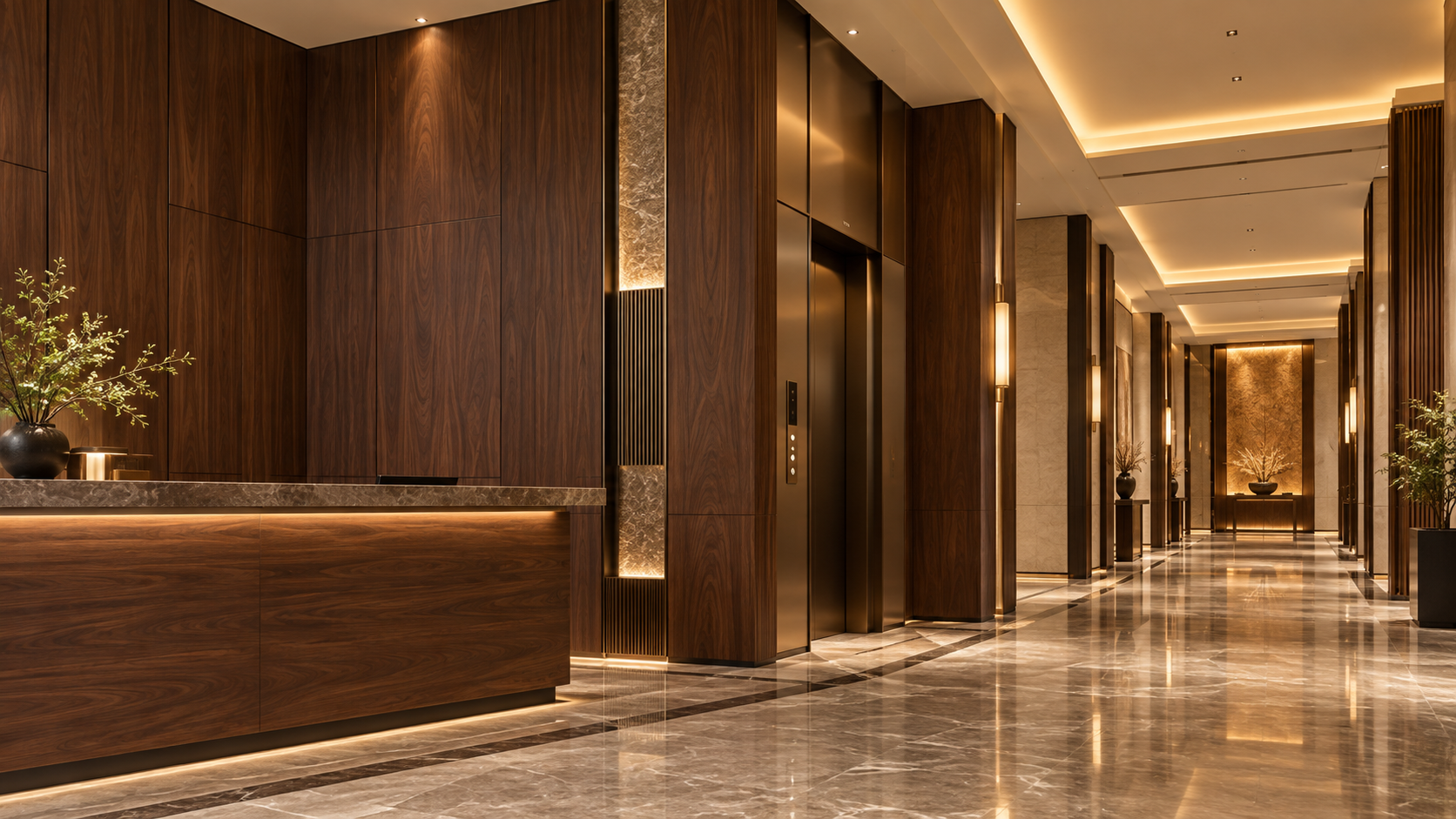
A premium commercial interior is rarely judged by a single surface. Guests notice how a hotel corridor feels under warm lighting, how a reception desk holds up to constant contact, whether retail wall panels still look intentional after a busy season, and whether an office lobby communicates confidence rather than compromise. Decorative panels sit at the center of many of these experiences.
So, what are the key risks of using standard decorative panels in premium commercial interior projects? The concern is not that conventional panels are always unsuitable. They can be practical in low-traffic, dry, budget-sensitive applications. The risk arises when a material designed for ordinary use is expected to meet the visual, safety, durability, and maintenance demands of a high-end public environment. In that situation, an initially economical choice can create expensive corrections later.
The short answer: standard panels can weaken both performance and perception
Premium commercial projects usually involve more than decorative intent. They must account for heavy foot traffic, repeated cleaning, fire-code requirements, indoor air quality, installation tolerances, long operating hours, and a consistent brand image across many surfaces.
A standard decorative panel may look acceptable in a small sample or showroom setting, yet reveal weaknesses once installed across a large lobby, guestroom floor, store network, restaurant, or public venue. Differences in sheen, texture, edge treatment, core density, fire performance, or moisture resistance can become highly visible over time.
For designers, contractors, owners, and procurement teams, the central question should not be “Does this panel look good today?” It should be “Will it still look, perform, and comply as intended after installation and daily use?”
1. Finish inconsistency can disrupt the design language
In premium interiors, decorative panels are often used in broad visual fields: wall cladding, lift lobbies, reception counters, retail displays, partitions, cabinetry, doors, and feature ceilings. When these surfaces are placed side by side, even slight variation becomes noticeable.
Standard panels may have less controlled color matching, grain direction, gloss level, or embossing depth between batches. A wood-effect surface can appear warmer on one wall and cooler on another. A matte finish may show uneven reflection under architectural lighting. Metallic, stone, fabric, and solid-color finishes are especially sensitive because commercial lighting often exposes differences that were invisible under warehouse conditions.
This is not merely an aesthetic inconvenience. In hospitality and retail environments, visual inconsistency can dilute the atmosphere that designers worked to create. A carefully specified calm, refined setting may instead feel pieced together. Replacing mismatched panels after fit-out can also be difficult, particularly when the original production batch is no longer available.
Before approving a panel, project teams should review full-size samples or sample boards under the actual lighting conditions whenever possible. It is also wise to clarify batch-control procedures, directionality requirements, acceptable color variation, and the amount of matching material that should be ordered for future repairs.
2. Fire performance may be insufficient for public-use spaces
One of the most serious risks of standard decorative panels in premium commercial interiors is inappropriate fire performance. Not every panel substrate, decorative film, adhesive layer, edge band, or backing material is designed to meet the same fire requirements. A panel that appears similar on the surface may behave very differently when exposed to heat or flame.
Hotels, office buildings, shopping areas, healthcare facilities, schools, and transport-related spaces may have specific fire-rating requirements based on local regulations, location within the building, escape routes, wall or ceiling use, and the overall assembly. Decorative surfaces should never be evaluated only by the face material. The installed system matters: panel core, adhesive, sealants, substrates, joints, and installation method all affect the final result.
A common mistake is assuming that a fire-rated board automatically makes the finished wall system compliant. In reality, compliance can depend on documented testing, product classification, application conditions, and local code interpretation. Using an unsuitable panel can lead to redesign, delayed inspections, replacement work, or additional liability.
Material selection should therefore begin with the project’s fire strategy, not end with it. Suppliers should be able to provide clear technical documentation relevant to the intended application. For projects requiring integrated performance, compatible fireproof sealing materials and properly designed joints are also important, especially around penetrations, transitions, and service areas.
3. Surface wear becomes visible faster than expected
Commercial interiors are handled more aggressively than residential spaces. Luggage brushes against hotel walls. Bags hit restaurant partitions. Retail fixtures are moved. Cleaning staff wipe surfaces repeatedly. Office furniture and service carts create constant points of impact. In these settings, a decorative panel must do more than look attractive; it must tolerate life.
Standard panels may be more vulnerable to scratching, abrasion, scuffing, impact marks, fading, or staining. Dark matte surfaces can reveal fingerprints. High-gloss finishes may show fine scratches. Light-colored decorative papers may absorb stains around coffee stations, reception zones, and food-service areas. When the surface layer is thin or poorly bonded, damage can expose the substrate beneath, making localized repair difficult.
Premium projects should examine the expected contact level for each location rather than applying one panel specification everywhere. A quiet executive meeting room and a high-turnover café require different performance priorities. Entrance areas, corridors, elevator surrounds, washroom approaches, and retail touchpoints generally need more robust surface properties than low-contact decorative walls.
Ask practical questions during specification: How does the panel respond to abrasion? Is it easy to clean without changing the finish? Can minor damage be repaired discreetly? Will strong daylight, artificial lighting, or frequent disinfection affect its appearance? These questions often prevent disappointment long before handover.
4. Moisture sensitivity can cause swelling, warping, and edge failure
Moisture is not limited to bathrooms. It enters commercial interiors through humid climates, wet umbrellas, condensation, cleaning processes, pantry areas, HVAC fluctuations, exterior-adjacent walls, and occasional plumbing incidents. Standard decorative panels with moisture-sensitive cores or inadequate edge protection may swell, warp, delaminate, or develop visible joint lines under these conditions.
Edges are often the first point of failure. Once water reaches an exposed or poorly sealed edge, the panel core can expand and permanently distort the surface. This may happen behind kick plates, near floor transitions, around service counters, or in locations where cleaning water repeatedly accumulates.
The right response is not automatically to select the most expensive moisture-resistant board for every wall. It is to map moisture exposure honestly. A well-considered specification may combine different panel constructions across a project, using higher-resistance materials and more carefully sealed details where conditions demand them.
Installation quality is equally important. Gaps, unsealed cut-outs, incompatible adhesives, and insufficient movement allowance can turn a suitable panel into a weak system. Premium interiors depend on details that are often invisible when the project is new.
5. Standard panel cores can compromise dimensional stability
Large-format wall panels and precisely aligned joinery demand stability. When a panel expands, contracts, bows, or twists, the effect is quickly visible: reveals become uneven, shadow gaps wander, doors no longer align, and adjacent surfaces seem poorly installed even when the original workmanship was careful.
Changes in temperature and humidity can affect panel cores differently. Lower-density or poorly balanced constructions may move more than expected, particularly in spaces with strong air-conditioning, sunlight exposure, or seasonal climate changes. A decorative face that looks flawless at installation may later develop cracking near joints, lifting at corners, or visible rippling.
This risk is amplified where panels connect to metal, glass, stone, or other materials with different movement characteristics. Designers should consider panel size, orientation, fixing methods, expansion gaps, support spacing, and the stability of the substrate behind the panel. Good material selection cannot compensate for an installation detail that ignores movement.
6. Indoor air quality expectations are higher than they used to be
Premium commercial spaces increasingly face questions about indoor air quality, especially in hotels, offices, education facilities, healthcare environments, and residential-style amenities. Panels can contain composite wood cores, resins, coatings, inks, laminates, and adhesives. Their emissions profile may matter to project owners, occupants, and certification goals.
Using standard panels without reviewing material documentation can create uncertainty around formaldehyde emissions, volatile organic compounds, odor, and compatibility with low-emission interior strategies. The issue is particularly relevant in enclosed spaces with limited ventilation or in projects where occupants spend long periods indoors.
A responsible specification looks beyond the visible finish. It considers the complete material package, including bonding systems and installation adhesives. Environmental performance should be supported by relevant product information rather than broad claims. For a company such as Shenyang Shengshi Meilin Technology Co., Ltd., whose work spans new material technologies, furniture and home furnishing solutions, and fireproof sealing materials, this whole-system perspective is central: safer interiors depend on how materials work together, not only on the decorative layer selected from a swatch book.
7. Cleaning and maintenance may cost more than the original material savings
A panel that is difficult to clean can quietly increase operating costs for years. Commercial cleaning teams need surfaces that can withstand routine wiping, occasional stronger cleaning agents, and repeated contact without becoming dull, sticky, streaked, or discolored.
Standard panels are sometimes chosen based on purchase price alone, while maintenance requirements are left unclear. The result can be a surface that looks good only when cleaned gently and infrequently—conditions that do not exist in an active hotel, restaurant, or retail setting.
Maintenance planning should be part of the material decision. Owners should request recommended cleaning methods, understand which chemicals to avoid, and verify whether the finish can tolerate the actual cleaning regime used on site. A more durable panel may carry a higher initial cost but reduce replacement frequency, labor, guest complaints, and visible wear.
8. Weak edge details can make a refined project look ordinary
In luxury and premium commercial design, edges are not minor details. They are where users touch the material and where workmanship is most closely inspected. Standard edge banding can peel, chip, discolor, or create a visible plastic line that undermines an otherwise sophisticated surface.
This is particularly important for reception desks, cabinet fronts, display units, wall returns, door frames, and furniture pieces with frequent hand contact. The choice of edge treatment should reflect the panel’s role: exposed edges may require matched edging, sealed profiles, solid-core solutions, or a different material construction altogether.
There is also a coordination issue. A panel face, edge band, adhesive, and machining process need to be compatible. Choosing them separately can result in color mismatch, weak bonding, or uneven seams. Mock-ups are valuable here because they reveal the tactile and visual quality that technical sheets cannot fully convey.
9. Limited customization can restrict brand expression
Premium commercial interiors are often designed around a distinctive brand story. A boutique hotel may need warm, layered textures. A financial office may require restrained precision. A beauty retailer may rely on carefully controlled color and light reflection. When standard panels offer only generic finishes, limited dimensions, or inconsistent repeat patterns, they can force the design to compromise.
The issue is not that every project needs bespoke materials. It is that the selected decorative material should support the intended identity rather than flatten it into a familiar, off-the-shelf appearance. Surface texture, panel proportion, joint layout, color continuity, and detailing all influence how a space is remembered.
Early dialogue among designer, fabricator, contractor, and material supplier can identify whether a standard panel is genuinely appropriate or whether a higher-performance decorative solution would better protect the concept. This conversation is most useful before tendering, when changes remain manageable.
A practical way to decide whether a standard panel is appropriate
Rather than treating “standard” and “premium” as fixed categories, assess the material against the actual demands of the location. A conventional panel may be perfectly reasonable for a protected back-of-house cabinet or a low-contact internal partition. It becomes riskier when used on highly visible, heavily used, code-sensitive, or moisture-exposed surfaces.
- Where will the panel be installed? Consider traffic, humidity, sunlight, cleaning, and proximity to food, water, or entry points.
- What does the building code require? Confirm fire-related needs for the exact application and assembly.
- How visible is the surface? Large wall fields, reception areas, and branded spaces demand tighter finish control.
- What will users do to it every day? Touching, impact, rolling luggage, cleaning, and furniture movement all matter.
- Can the panel be maintained and repaired realistically? Evaluate the operating team’s methods, not ideal conditions.
- Are samples representative? Review batch consistency, edge details, and full-size mock-ups where the project warrants them.
Final perspective
The risks of standard decorative panels in premium commercial interiors are rarely dramatic on day one. They emerge slowly—in a scratched counter, a swollen edge, a failed inspection, a mismatched replacement board, or a lobby wall that no longer carries the intended sense of quality.
That is why material selection should be treated as a long-term design and operational decision. High-performance decorative materials, appropriately specified fire-resistant components, thoughtful edge details, and environmentally conscious material systems help create interiors that remain safe, coherent, and appealing beyond the opening day. For commercial spaces built around lasting impressions, the panel is not simply a background finish. It is part of the experience people take with them.
Next:No more content
RECOMMEND

Sep 20, 2026
What Are the Risks of Standard Panels in Premium Commercial Interiors?
What are the key risks of using standard decorative panels in premium commercial interior projects? Explore fire, wear, moisture, and compliance risks.
Sep 11, 2026
How to Manage the Logistics of a Custom Decorative Panel Manufacturing Project with Multiple Suppliers?
Learn how to manage Custom Decorative Panel Manufacturing with multiple suppliers. Discover strategies for supply chain coordination, quality control, and logistics to ensure project success. Streamline your process with expert tips.
Sep 11, 2026
How to Select the Right Color Palette for Commercial Interior Panel Solutions in a Tech Startup Office?
Learn how to select the perfect Commercial Interior Panel Solutions color palette for your tech startup office. Discover the psychology of color, practical tips for durability, and how to create a productive, inspiring workspace that boosts brand identity and employee morale.
Sep 11, 2026
What Are the Most Common Mistakes When Specifying Architectural Decorative Panel Solutions for Schools?
Avoid costly mistakes when specifying Architectural Decorative Panel Solutions for schools. Learn how to ensure fire safety, acoustic performance, and durability. Our guide helps you choose panels that meet all functional requirements for safer, smarter learning environments. Click to master your specification process.