Are Aluminum Honeycomb Panels Worth the Extra Cost for a Hotel Lobby?
Are aluminum honeycomb panels worth the extra cost for a hotel lobby? For hotel owners and designers, the answer depends on more than the initial price. These lightweight decorative panels can deliver a refined appearance while supporting durability and easier handling in high-traffic spaces. This article examines their upfront cost, practical benefits, design flexibility, and long-term value to help you decide whether they are the right investment for your lobby.
The short answer is that they can be worth the premium when the design calls for large, flat surfaces, a lightweight assembly, or a finish expected to remain presentable through years of guest traffic. They are harder to justify on a small, protected wall where a simpler material can achieve the same appearance and where panel flatness or weight makes little difference.
What the extra cost actually buys
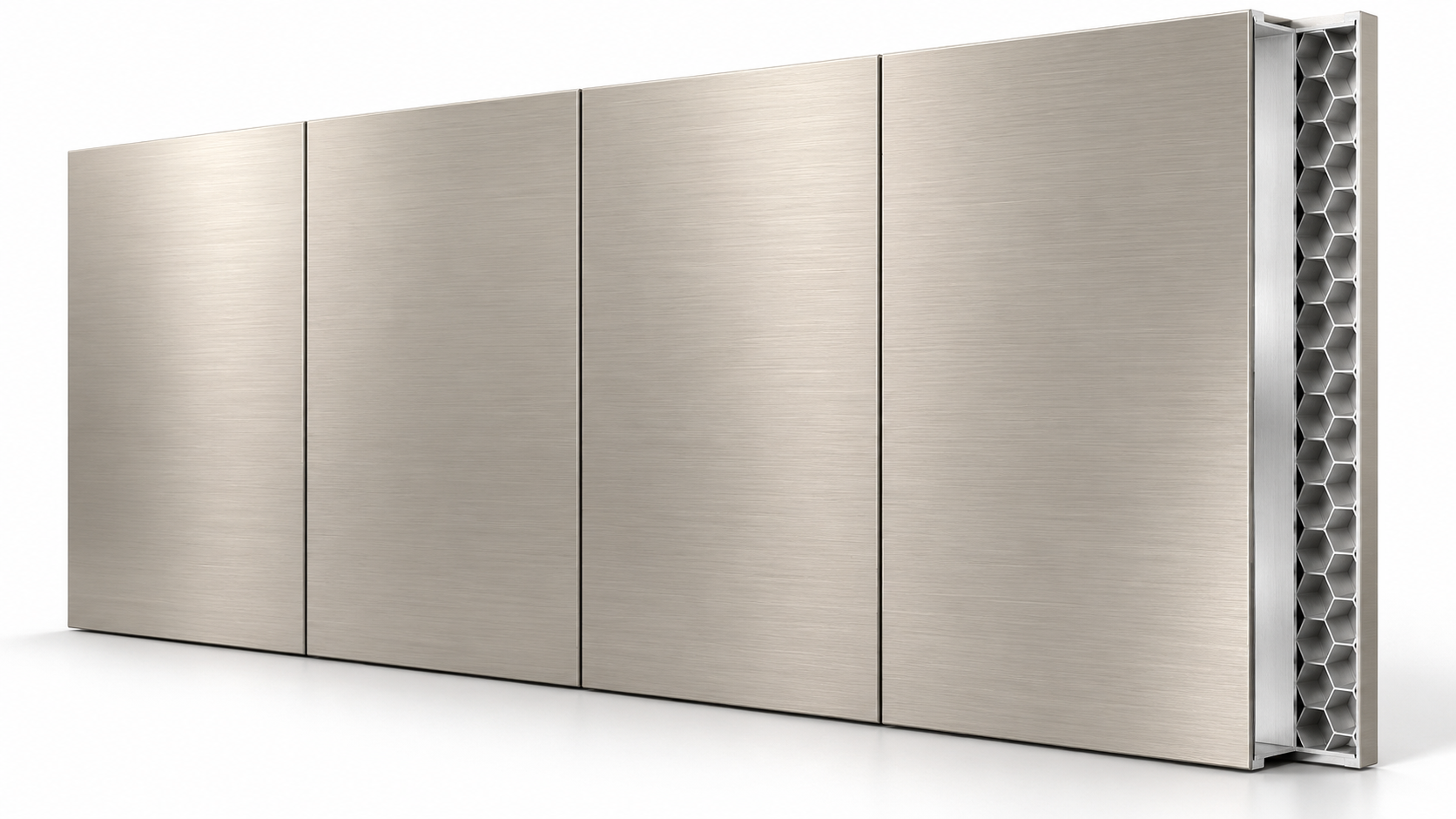
An aluminum honeycomb panel typically consists of thin aluminum skins bonded to a honeycomb core. The core separates the skins and helps the panel resist bending without relying on a thick, solid sheet of metal. The result is a relatively light panel for its stiffness, although performance depends on the skin thickness, core construction, bonding method, panel dimensions, and support details.
That distinction matters in a lobby. A reception backdrop or a tall wall beside the entrance may be viewed from several angles and under strong grazing light. Small irregularities can be conspicuous. A suitably designed honeycomb panel can help achieve a flatter-looking surface across larger modules than a thin sheet used without comparable reinforcement.
The material alone does not guarantee a flawless wall. Substrate alignment, fixing points, panel tolerances, joint widths, and lighting all influence the finished result. If the installation system is poorly designed, paying for a stiffer panel will not solve every visual problem.
Compare installed systems, not panel prices
The price of a decorative panel is only one line in a lobby fit-out. A useful comparison includes fabrication, edge treatment, subframes, fixings, transport, installation, access equipment, finishing around openings, and any special fire or moisture requirements. Waste also matters: an attractive large-format layout may become expensive if doors, columns, and service openings force many custom cuts.
Light weight can make panels easier to move and handle than some heavier alternatives, but it does not automatically reduce the installed cost. A large panel may still require several installers, careful lifting, and a substantial support system. Ask bidders to describe their proposed method rather than assume that a lighter material needs less labor.
Likewise, compare materials on the same visual and performance basis. A stone feature wall, a solid aluminum sheet, a metal composite panel, and a painted gypsum wall do not offer identical finishes, repair options, or structural demands. If one quotation includes a concealed fixing system and another assumes visible fasteners, the apparent savings may reflect a different design rather than a better price.
Where the premium may be easier to defend
Honeycomb construction is most compelling where multiple requirements overlap: a generous panel size, a controlled appearance, limited allowable weight, and a surface that must withstand routine use. A feature wall behind reception is one example. A suspended decorative ceiling can be another, provided the complete ceiling system is engineered and approved for the application.
By contrast, a small wall in a low-contact area may not benefit enough from the added stiffness. Painted board or another decorative finish may be less expensive to install and easier to touch up. The decision is not whether honeycomb panels are objectively better; it is whether their specific advantages solve a problem on that wall or ceiling.
Durability depends on where the panels are placed
Hotel lobbies are demanding in uneven ways. A high ceiling may experience little direct contact, while the lower part of a wall near a luggage route can be struck repeatedly by cases, carts, and cleaning equipment. Aluminum faces can resist many ordinary conditions of indoor use, but they can still be scratched or dented. A stiff panel is not necessarily an impact-proof panel.
Pay particular attention to corners, exposed edges, and the area immediately behind seating. Protective trims, recessed details, or a more impact-tolerant material at low level may make better economic sense than specifying the same finish everywhere. The face thickness and coating should be selected with the actual exposure in mind, not merely the appearance of a sample.
Cleaning is another practical test. A lobby surface may encounter fingerprints, spills, and frequent wiping. Request the finish supplier’s cleaning instructions and check whether the hotel’s normal products are compatible. Abrasive pads, unsuitable chemicals, or aggressive spot cleaning can damage decorative coatings even when the panel itself remains sound.
Replacement should be considered before installation, not after damage occurs. Can one panel be removed without disturbing its neighbors? Will the fixing system remain accessible? Is a spare panel available in the same finish and batch? On a highly visible wall, matching color and sheen later can be more difficult than simply ordering the same nominal specification.
Design flexibility has limits
Aluminum honeycomb panels can support a range of decorative finishes and panel layouts. Their relatively light construction also makes them worth considering where a designer wants the visual effect of a substantial surface without necessarily using a heavy solid material. The available finish, geometry, and fabrication options depend on the proposed manufacturer and panel construction.
For a lobby, a small finish chip is a starting point, not final approval. Review a larger sample or mock-up under lighting similar to the intended installation. Directional finishes can change appearance when panels are rotated; metallic coatings may look different under daylight and warm artificial light. Confirm panel orientation and acceptable color variation before production.
Edges deserve as much attention as the visible face. An exposed or inadequately sealed edge can reveal the core or become vulnerable to moisture and damage. Returns, corners, cutouts, and transitions to stone, glass, or timber should be detailed early. Curved forms and tight radii may require a different construction or fabrication method, so do not assume a flat-panel specification will work unchanged.
Fire safety and compliance must be checked as an assembly
Aluminum skins and an aluminum core do not establish the fire performance of a complete panel. Adhesives, coatings, backing materials, insulation, cavities, fixings, and the supporting substrate can all matter. A decorative wall and a suspended ceiling may also be subject to different requirements, depending on the building, location, and applicable rules.
Ask for test documentation relevant to the actual product and its intended installation. Check that the report identifies the construction being purchased, including important differences in finish, thickness, bonding, and mounting where applicable. A general statement that a material is “fireproof” is not a substitute for evidence assessed against the project’s requirements.
The project’s fire engineer, architect, or local authority should confirm what evidence is acceptable. Where panels meet penetrations, compartment boundaries, or other fire-sensitive interfaces, those junctions need their own coordinated details. The decorative panel should not be assumed to perform the function of a fire-rated wall or a firestop system.
How to assess long-term value without guessing
A lifecycle comparison does not require a precise prediction of how long every finish will last. It does require a consistent set of assumptions. Start with the installed cost of each option, then consider expected cleaning procedures, likely damage points, practical repair methods, replacement access, and disruption if work must be carried out while the hotel is operating.
Be cautious with claims that a premium panel will pay for itself through maintenance savings. That may be possible in a particular project, but the outcome depends on usage, finish selection, installation, and the alternatives being compared. A painted surface, for instance, may need more frequent attention but can often be refinished locally; a damaged decorative metal panel may instead need replacement to preserve a consistent appearance.
Environmental claims need similar care. Aluminum is recyclable, but the recyclability of a complete bonded panel depends on its construction and the facilities available for separation and processing. Ask for product-specific information if embodied impacts, recycled content, or end-of-life treatment are part of the project brief. Lightweight construction alone is not enough to establish a lower environmental impact.
What to resolve before requesting a final quotation
A meaningful quotation starts with a defined application. Provide drawings showing panel locations, approximate dimensions, joint layout, substrate conditions, corners, cutouts, and any access panels. Identify areas exposed to luggage or cleaning equipment, along with the intended finish and lighting conditions.
Then ask the supplier and installer to clarify the following:
- Panel construction, dimensions, tolerances, finish, and recommended support spacing for the proposed application.
- Fixing method, edge details, movement allowances, and how individual panels can be removed.
- Fire-test evidence and other documentation relevant to the complete specified assembly and local requirements.
- Sample or mock-up approval, finish orientation, batch consistency, packaging, and protection during installation.
- Production and delivery lead times, spare-panel availability, cleaning instructions, and the scope of any warranty.
These questions also help expose gaps between trades. For example, the panel supplier may assume a level substrate, while the installer expects someone else to correct it. Unless responsibility is clear, a competitive material price can be followed by additional site costs and schedule pressure.
Shenyang Shengshi Meilin Technology Co., Ltd., based in Shenyang, focuses on the research and application of new materials and also offers fireproof sealing materials, furniture, and home furnishings. For a project considering decorative materials alongside fire-sensitive interfaces, that broader scope can inform the discussion, while product availability, technical documentation, and suitability for the specific lobby still need to be confirmed.
The most defensible decision is often selective: use aluminum honeycomb panels where their weight, panel size, and surface quality answer a genuine design constraint, and consider simpler finishes elsewhere. Before committing, compare complete installed proposals and approve the finish, fixing details, and compliance evidence for the actual assembly.
RECOMMEND

Nov 04, 2026
Fire Ratings for Decorative Wall Panels: B1, ASTM E84 Class A and Euroclass Explained
B1, ASTM E84 Class A and Euroclass B come from three different test systems. Which fire document a wall panel project needs depends on where it is built.
Nov 03, 2026
How to Keep Wall Panel Color Consistent Across Batches and Repeat Orders
Color drift between batches is a process problem, not luck. The batch-control workflow buyers should write into the order before a repeat purchase.
Nov 04, 2026
Does an E0 Rating Guarantee Low Emissions From the Finished Panel?
Does an E0 rating guarantee low emissions from the finished panel? Discover what it covers, why VOC testing matters, and how to choose decorative panels with confidence.
Nov 04, 2026
Are Aluminum Honeycomb Panels Worth the Extra Cost for a Hotel Lobby?
Are aluminum honeycomb panels worth the extra cost for a hotel lobby? Compare installed costs, durability and design benefits to make a confident choice.