Does an E0 Rating Guarantee Low Emissions From the Finished Panel?
Does an E0 rating guarantee low emissions from the finished panel? Not necessarily. It indicates compliance with a formaldehyde requirement under a specified standard, not necessarily low emissions of every volatile organic compound.
Adhesives, coatings, edge treatments, and manufacturing conditions can affect the finished product. Buyers should verify which material was tested and request relevant reports before selecting decorative panels.
What Does an E0 Rating Actually Tell You?
E0 is commonly used to describe a low formaldehyde emission class for wood-based panels. Its meaning depends on the standard, test method, and market referenced.
A valid classification applies to the material and conditions described in its supporting report. It should not be treated as a universal certification for every panel sold under the same name.
For example, an E0-rated substrate may meet a formaldehyde limit when tested as a raw board. That result does not automatically establish the performance of a laminated or coated product.
Formaldehyde is important because it can irritate the eyes and respiratory system, and long-term exposure is associated with serious health risks. However, it is only one chemical of concern.
Some standards classify formaldehyde using chamber emissions, while others use extraction or other methods. Results expressed in different units cannot be compared reliably without understanding those methods.
Before comparing suppliers, ask which edition of the standard applies, what limit was used, and whether the reported result is an emission rate or another measurement.
Why Can a Finished Panel Perform Differently From Its Core?
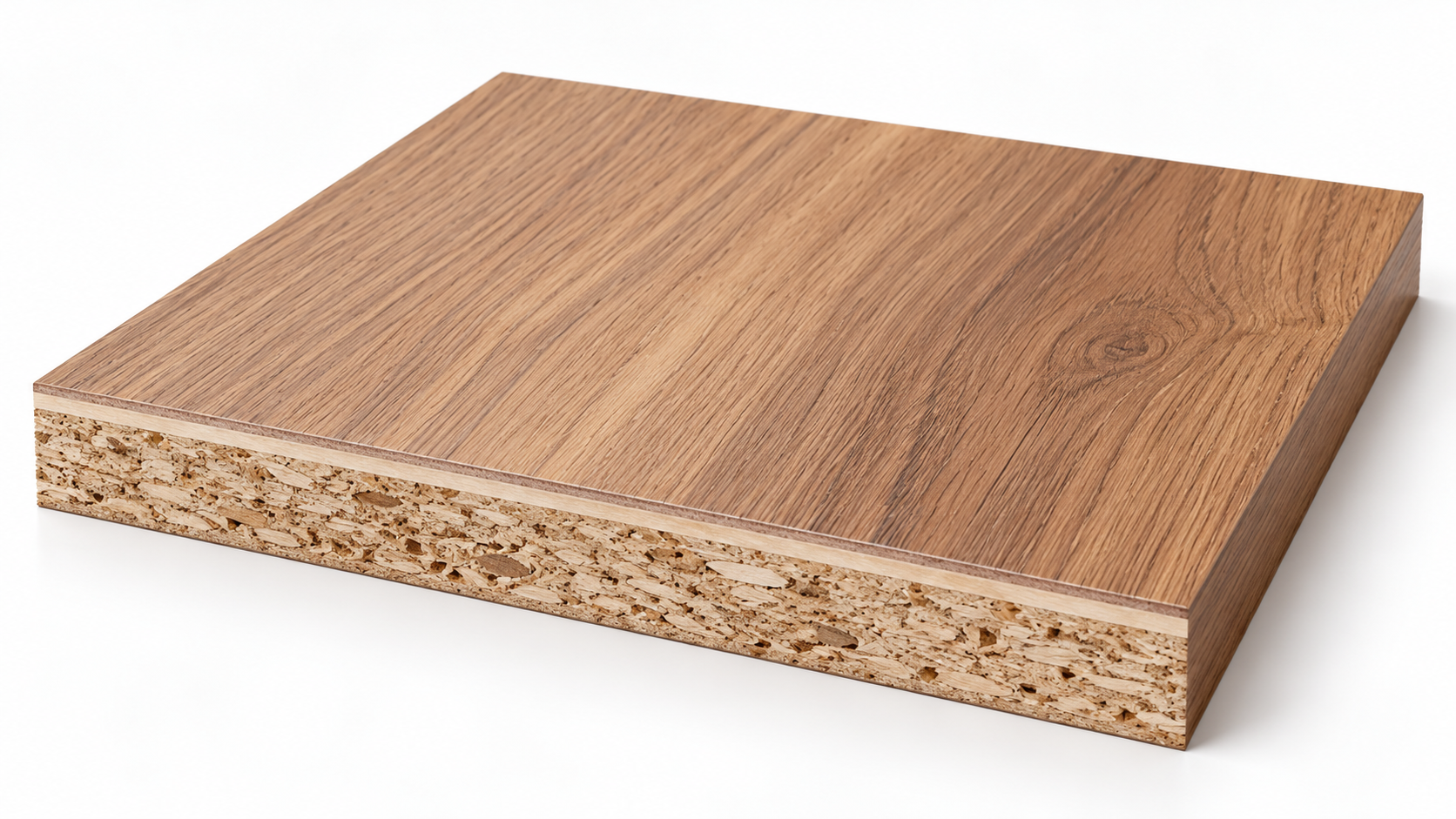
A decorative panel is an assembly. Its substrate, decorative surface, bonding system, coatings, and edge treatments may each influence emissions after the panel has been manufactured.
The direction of that influence is not always obvious. A surface layer may slow emissions from the core, while an adhesive or coating may introduce additional compounds.
Production variables matter too. Changes in curing time, temperature, coating thickness, or adhesive formulation can alter the emissions profile even when the core board remains unchanged.
Storage and timing also affect test results. A recently manufactured panel may emit differently from a conditioned sample that has been stored before testing.
For this reason, a supplier cannot establish finished-panel performance solely by combining separate certificates for the substrate and other components. The completed assembly needs its own relevant evidence.
Which Parts of a Decorative Panel Deserve Extra Attention?
Substrate: Particleboard, MDF, plywood, and other engineered wood products can contain resin systems that release formaldehyde. The substrate report should identify the material, thickness, and applicable classification.
Adhesives: Laminating and assembly adhesives vary in formulation and curing behavior. Request information on the adhesive system and whether the finished assembly was tested after normal production.
Decorative surfaces: Melamine paper, veneer, films, and other facing materials have different compositions. Their effect depends on the complete construction, including how they are bonded.
Coatings: Paints, lacquers, primers, and protective finishes can contribute VOCs. A low-formaldehyde claim for the board does not establish the emissions performance of these finishes.
Edges and cut surfaces: Exposed edges may release substances from the substrate, while edge-banding adhesives and sealants may introduce emissions of their own. Installation details therefore matter.
Installation products: On-site adhesives, sealants, and coatings may affect indoor air independently of the factory-made panel. Evaluate them separately rather than assuming the panel report covers them.
Formaldehyde, TVOC, and Individual VOCs: What Should You Check?
Formaldehyde testing addresses a specific substance. A broader VOC assessment can provide additional information, but the scope of that assessment needs careful review.
TVOC, or total volatile organic compounds, is an aggregate measure defined by the test method. It can be useful for screening, but it does not identify every relevant compound.
Two products with similar TVOC results can have different chemical profiles. Where project specifications require it, ask for individual VOC results as well as any aggregate value.
A report may also cover substances such as acetaldehyde or other aldehydes separately. Check the method and analyte list rather than assuming they are included in TVOC.
Low measured emissions do not mean zero emissions, and a passing laboratory result does not guarantee that every occupant will have the same experience in a completed room.
For sensitive settings, such as schools, healthcare spaces, or occupied homes, align the requested testing with the project specification and applicable local requirements.
How to Read a Finished-Panel Test Report
Start with product identification. The report should make it possible to connect the tested sample to the panel you intend to purchase, including its construction and finish.
Check whether the sample was a finished panel or only a component. Look for details of the substrate, facing, coating, adhesive, thickness, and edge treatment where available.
Review the test standard and its edition, the measured substances, the reported units, and the applicable limits. A pass statement without those details is difficult to evaluate.
Check the sampling and testing dates. An older report may still be informative, but ask whether the formulation, production site, and manufacturing process have changed since testing.
Examine how the sample was obtained. A report on a manufacturer-submitted sample demonstrates the tested sample’s result; it does not necessarily establish independent sampling or ongoing production surveillance.
Confirm the laboratory’s accreditation for the relevant test method and scope. Accreditation supports confidence in the testing process, but it does not replace checking product identity.
Finally, look at conditioning and test duration. Chamber conditions, specimen loading, exposed edges, and sampling time can affect results and should be considered when comparing reports.
Questions to Ask Before Approving a Supplier
A focused document request can reveal whether a low-emission claim applies to the product being offered. Ask the supplier to provide clear, traceable answers to these questions:
- Which standard and edition define the claimed E0 classification, and what limit applies?
- Was the tested sample the complete decorative panel, or only the unfinished substrate?
- Does the report match the proposed substrate, surface, adhesive, coating, thickness, and edge construction?
- Which substances were measured, including formaldehyde, TVOC, and any specified individual VOCs?
- How were specimens prepared, conditioned, and tested, and were edges exposed or sealed?
- Was the laboratory accredited for the relevant method, and who selected the sample?
- Have materials, formulations, production lines, or factories changed since the test?
- What batch identification and quality-control records can be supplied with the order?
If the supplier cannot connect the report to the proposed product, treat the claim as unverified. Request updated evidence or agree on additional testing before purchase.
For large orders, include the approved panel specification and required reports in the purchasing agreement. Define how substitutions will be reviewed and documented.
Where independent verification is important, agree in advance on sampling, laboratory selection, test methods, acceptance criteria, and responsibility for costs and delays.
How Should Buyers Compare Competing Panels?
Compare products against the same project requirements, not simply against marketing labels. Start with the finished construction, intended application, and substances the project needs to control.
Use results generated under comparable methods and conditions wherever possible. A lower number from a different method or sampling time is not automatically evidence of better performance.
Consider both compliance and practical suitability. A panel may have strong emissions documentation but still be unsuitable for the required moisture exposure, durability, or fire performance.
Assess the cost of verification alongside material price. For a large installation, avoiding an undocumented substitution or a failed acceptance test may justify additional testing expense.
Where specifications permit equivalent products, require evidence for the actual alternative. A report for one color, finish, or construction should not automatically cover another.
Keep the approved report, product specification, and delivery records together. This makes it easier to investigate discrepancies and maintain traceability throughout procurement and installation.
Does a Passing Panel Test Guarantee Good Indoor Air?
No. A finished-panel report provides useful product-level evidence, but indoor air quality depends on the combined emissions of materials, furnishings, equipment, and activities within the space.
Room size, panel area, ventilation, temperature, humidity, and time since installation can all affect concentrations. Laboratory test conditions do not reproduce every occupied building.
A material that meets a product limit can still contribute to overall exposure when used extensively, especially alongside other emitting products in a poorly ventilated room.
Specify appropriate ventilation and consider the full material package. Follow manufacturer instructions for curing and installation, and avoid occupying newly finished spaces before project requirements are met.
For projects with strict indoor air targets, consider a broader commissioning plan that includes ventilation checks and, where appropriate, air testing after installation under defined conditions.
Product emissions tests and room air tests answer different questions. The first evaluates a sample under controlled conditions; the second reflects the space at the time measured.
Choosing Decorative Materials With Greater Confidence
Start by defining the application: furniture, wall cladding, cabinetry, and other uses may expose different panel surfaces and involve different installation products or performance requirements.
Then specify the finished construction and request matching evidence. An E0-rated core can be a useful starting point, but the finished panel is the product occupants encounter.
Shenyang Shengshi Meilin Technology Co., Ltd. works across decorative materials and solutions for construction and home furnishing. Buyers can discuss their application and documentation requirements with the supplier.
Before ordering, confirm which products are available, what their test reports cover, and whether additional finished-product testing is needed for the destination market or project specification.
In short, an E0 rating is a formaldehyde-related indicator, not a blanket guarantee of low emissions from a finished decorative panel. Verify the standard, complete assembly, and relevant test results.
Next:No more content
RECOMMEND

Nov 04, 2026
Fire Ratings for Decorative Wall Panels: B1, ASTM E84 Class A and Euroclass Explained
B1, ASTM E84 Class A and Euroclass B come from three different test systems. Which fire document a wall panel project needs depends on where it is built.
Nov 03, 2026
How to Keep Wall Panel Color Consistent Across Batches and Repeat Orders
Color drift between batches is a process problem, not luck. The batch-control workflow buyers should write into the order before a repeat purchase.
Nov 04, 2026
Does an E0 Rating Guarantee Low Emissions From the Finished Panel?
Does an E0 rating guarantee low emissions from the finished panel? Discover what it covers, why VOC testing matters, and how to choose decorative panels with confidence.
Nov 04, 2026
Are Aluminum Honeycomb Panels Worth the Extra Cost for a Hotel Lobby?
Are aluminum honeycomb panels worth the extra cost for a hotel lobby? Compare installed costs, durability and design benefits to make a confident choice.