

Are Composite Panels Worth Choosing Over Gypsum Walls for Boutique Hotels?
For a boutique hotel, switching from traditional gypsum wall systems to composite panel solutions can be worthwhile, but only when the panel system matches the room type, existing structure, fire strategy, and design intent. Composite panels are not automatically a better wall. Their value comes from solving practical problems that gypsum construction can make slower or more difficult: tight renovation schedules, repeated wet-area repairs, inconsistent finish quality, and the need to create a distinctive guest experience without turning every room into a custom site-built project.
The most useful question is not simply whether composite panels are better than gypsum walls. It is: which wall areas are causing cost, maintenance, or design problems in this particular hotel? A hotel lobby, corridor, guestroom headboard wall, bathroom exterior wall, and back-of-house service zone do not need the same material solution.
When composite panels make more sense than gypsum walls
Composite panels are often a strong option when a boutique hotel needs a finished decorative surface with a more controlled installation process. Depending on the product construction, a panel may combine a decorative face, a stable backing, and functional layers intended to improve resistance to moisture, impact, or fire exposure. This can reduce the number of separate on-site trades required to create a finished wall.
That matters most in renovation work. Removing damaged gypsum board, rebuilding framing, taping joints, sanding, painting, and waiting for each stage can disrupt nearby rooms and create dust in an operating property. A well-designed panel system may allow the installer to prepare the substrate, fit the panels, handle trims and joints, and complete the visual finish in a more predictable sequence. The benefit is not that installation becomes effortless; accurate setting-out, substrate preparation, and detailing are still essential. The benefit is that the final surface is less dependent on multiple wet trades and hand-finished joints.
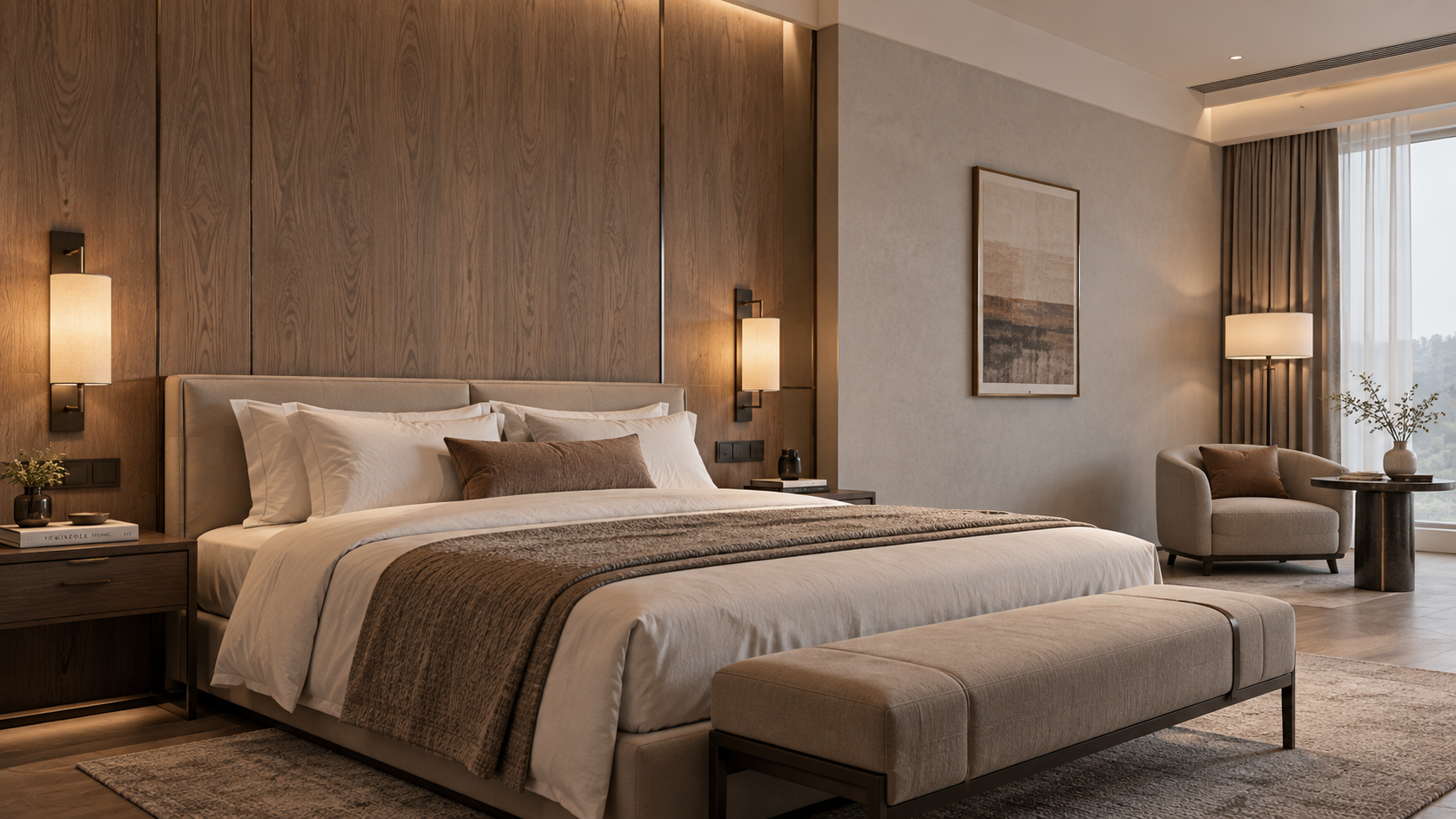
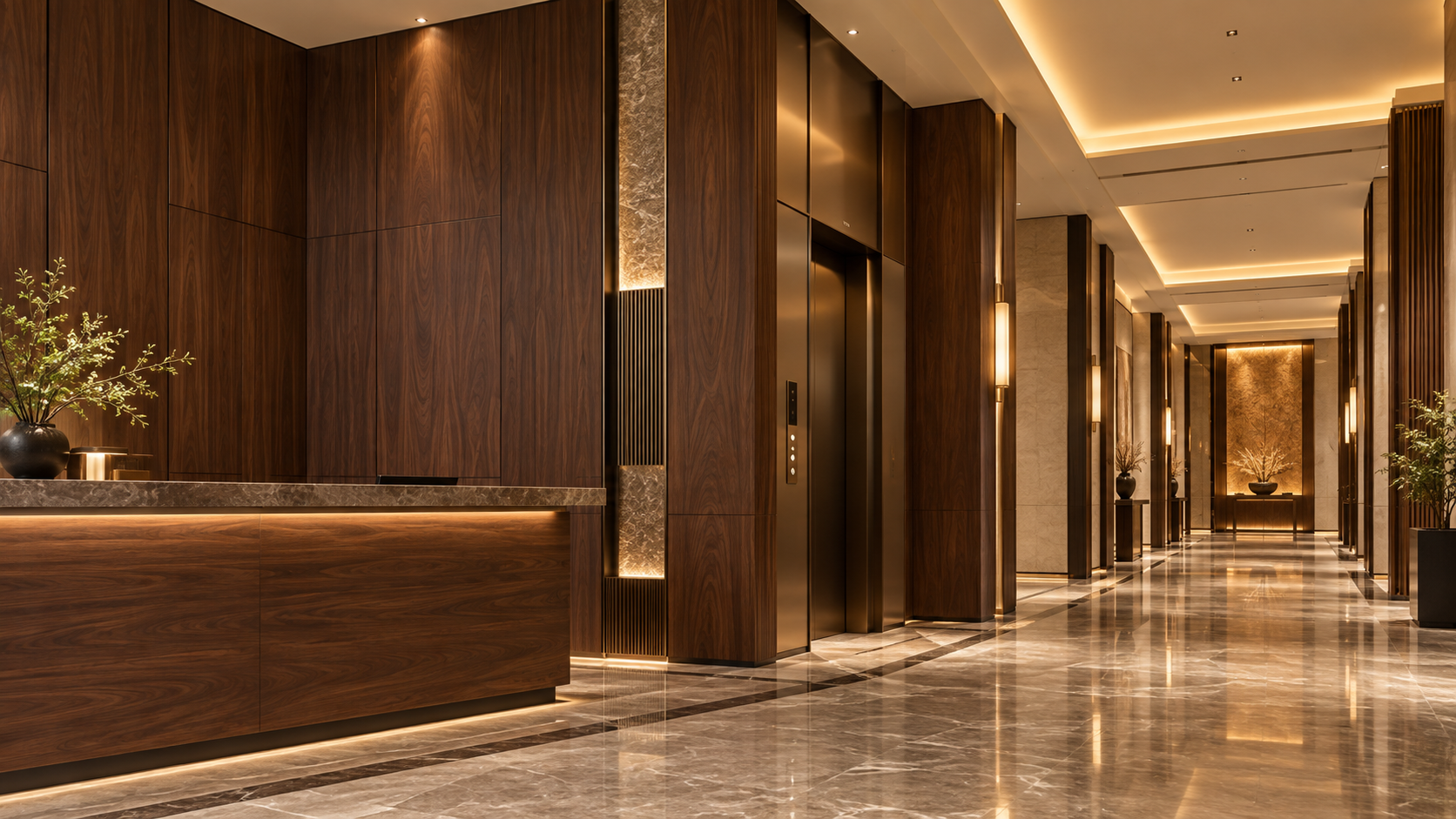
Composite panels also fit boutique hotels where the wall finish is part of the brand experience. Gypsum walls are versatile, but a painted gypsum surface can look generic unless the project adds specialty paint, wallcovering, timber veneer, stone, metalwork, or other decorative layers. Panels can provide a consistent wood-look, stone-look, textile-look, metallic, or other architectural finish across reception areas, corridors, guestroom feature walls, and selected public spaces.
This does not mean every wall should be covered in panels. The strongest projects usually use them selectively: where guests touch, see, photograph, or judge the hotel most closely, and where the operating team benefits from easier cleaning or localized replacement.
Where gypsum walls still have a clear advantage
Traditional gypsum wall systems remain a practical choice for many hotel interiors. They are familiar to most contractors, adaptable around irregular geometry, and useful when a project needs to conceal services, form bulkheads, create curved details, or build a wall assembly around acoustic and fire requirements. A gypsum partition can also be easier to alter later when room layouts, door openings, or electrical locations change.
For large areas that will receive a simple painted finish, gypsum may be the more rational choice. The hotel may not gain enough visual or operational value from a decorative panel to justify using it across every surface. This is especially true in staff-only areas, temporary partitions, or spaces likely to be reconfigured.
Gypsum is also often preferable when the project team has already specified a tested wall assembly that combines framing, insulation, boards, seals, doors, and service penetrations. Replacing one visible board layer with a panel should not casually change the performance of the entire assembly. A wall is more than its face finish.
Fire performance is a system question, not a panel label
Fire-conscious design is one reason hotel owners explore composite panel solutions, but it is also where oversimplified purchasing creates risk. A panel described as fire-resistant or fire-retardant does not automatically make the completed wall suitable for every hotel application. The actual result depends on the panel composition, its backing, adhesive or mechanical fixings, cavity conditions, edge details, insulation, framing, and the treatment of penetrations.
For example, a decorative panel used over an existing wall may perform differently from the same panel installed over battens with a concealed void. A service outlet, access panel, door frame, or joint can become a weak point if it is not detailed as part of the intended wall assembly. Areas close to escape routes, guestroom entries, electrical equipment, and kitchens deserve early coordination rather than a finish-only decision at the end of the project.
The practical procurement approach is to ask suppliers and installers how the proposed construction works as a complete assembly. The project team should compare the exact panel, substrate, fixing method, joint treatment, and sealant system proposed for each area. Fireproof sealing materials are particularly relevant wherever services pass through rated or performance-sensitive wall zones. Decorative decisions and fire-stopping decisions should be coordinated, not managed by separate teams after installation has begun.
Moisture resistance is valuable, but joints decide the outcome
Bathrooms, spa areas, housekeeping rooms, entrance zones, and locations near plumbing are often cited as reasons to move away from standard gypsum board. That logic is understandable, but “moisture-resistant panel” is not enough information on its own. Water usually finds the exposed edge, poorly sealed joint, damaged trim, or unprotected cut-out before it affects the center of an intact panel.
In a guest bathroom, a decorative wall panel may work well outside the direct shower zone, around vanity areas, or on dry-side feature walls. In areas subject to direct and repeated water exposure, the full waterproofing strategy must come first. The surface panel cannot replace the substrate preparation, membrane, drainage design, and sealing details required by the room’s actual use.
Housekeeping practices also matter. Aggressive chemicals, wet mops, steam cleaning, and frequent wiping may affect panel faces, coatings, seals, or decorative films differently. Before specifying a finish across dozens of rooms, assess how the cleaning team will maintain it. A beautiful surface that requires delicate treatment may be appropriate for a quiet lounge wall, but unsuitable for a narrow service corridor where carts repeatedly strike the lower wall.
Acoustics should be planned behind and around the visible surface
Boutique hotels depend on quiet rooms. Guests may forgive a small room; they are much less forgiving of hearing luggage wheels, conversations, plumbing, or television sound through a wall. Neither a standard decorative panel nor a single gypsum board should be treated as an acoustic solution by itself.
Sound performance is influenced by the wall’s mass, cavity design, insulation, framing connections, door seals, service penetrations, and flanking paths around the partition. A rigid panel fixed directly to a wall may change the visual finish without solving the transfer of sound between rooms. In some cases, panels are best used as the exposed finish over a properly designed acoustic partition rather than as a substitute for that partition.
This is particularly important for adjacent guestrooms, suites next to elevators, and rooms that share walls with mechanical or service spaces. If sound privacy is the priority, establish the partition strategy first. Select the decorative face after the acoustic build-up is clear.
The cost comparison should include operations, not only material prices
Comparing the price of a composite panel against a gypsum board sheet produces a misleading answer. Gypsum construction may require framing, boards, joint compound, tape, sanding, primer, paint, wallcovering, protection, and several trade visits. A panel system may have a higher material cost while reducing finishing layers and shortening the period during which a room or corridor is unusable.
At the same time, panels introduce their own costs: substructure or leveling work, trims, corner details, cut-outs, transport protection, specialized installation, and spare material for future repairs. Complex patterns, book-matched decorative surfaces, and custom dimensions can increase both planning and replacement difficulty.
A better comparison separates three questions:
- What does each finished wall cost to install, including labor, trims, substrate work, and finishing?
- How much disruption does each option create during renovation or phased room turnover?
- What is likely to happen after opening: cleaning, scuff repair, moisture exposure, access to services, and finish matching?
A composite panel solution is usually worth the premium when it reduces a meaningful operating problem or creates a guest-facing finish that supports the hotel’s positioning. It is less compelling when it is used only because it appears more modern than painted gypsum.
Use panels where they earn their place
For boutique hotels, a mixed-material strategy is often more effective than a full replacement strategy. Composite panels can be highly effective at the reception desk backdrop, lounge walls, lift lobbies, corridor end walls, guestroom entry zones, bedhead features, wardrobe surrounds, and selected bathroom dry areas. These are locations where durability, visual identity, cleanability, and repeatable detailing often matter.
Gypsum can remain appropriate for ceilings, service partitions, low-visibility walls, complicated shapes, and broad areas that need only a simple paint finish. This approach preserves design impact without forcing a premium finish into places where it brings little benefit.
It also helps to distinguish between a panel that is intended as cladding over an existing stable wall and a panel intended to form part of a new partition. The fixing method, edge treatment, service access, and performance expectations differ. Treating both applications as the same can lead to disappointing results.
Questions to resolve before changing the specification
Before switching to composite panel solutions over traditional gypsum wall systems for boutique hotels, map the proposed walls by use rather than choosing one material for the entire property. Identify guest-facing feature areas, wet or high-cleaning zones, acoustic partitions, fire-sensitive locations, impact-prone corridors, and walls likely to be changed later.
Then review a full-size sample in the intended lighting. Boutique hotel interiors often use warm, low-level, directional lighting, which can reveal panel joints, surface reflections, color variation, or uneven substrate conditions more clearly than a sample viewed in a bright showroom. Inspect corners, end caps, door interfaces, electrical cut-outs, and the transition to flooring and ceilings. Those details determine whether a panel installation looks tailored or improvised.
Keep approved spare panels, trims, and finish records after installation. Local replacement is one of the operational advantages of panel systems, but it only works when the hotel can match the original finish and the installer can remove a damaged section without disturbing adjacent surfaces.
FAQ
Can composite panels be installed over existing gypsum walls?
Often, yes, if the existing gypsum wall is dry, stable, reasonably flat, and able to support the selected fixing method. Loose board, water damage, significant unevenness, or unresolved cracking should be repaired first. Covering a failing substrate only hides the problem temporarily.
Are composite panels suitable for hotel bathrooms?
They can be suitable for dry-side bathroom walls and other controlled-moisture areas when the edges, joints, and cut-outs are correctly detailed. Direct wet zones require a complete waterproofing approach designed for repeated water exposure; the decorative panel is only one part of that construction.
Will decorative panels improve guestroom sound insulation?
Not reliably on their own. Sound privacy depends on the entire wall and adjacent construction. Panels may be added over an acoustic wall assembly for appearance, but they should not replace the acoustic design.
Are panels easier to repair than painted gypsum walls?
They can be, especially when damage is limited to one accessible section and matching replacement material is available. However, repair becomes harder if the panel pattern is discontinued, the fixing system prevents clean removal, or trims were not designed for replacement.
How should a hotel choose a panel supplier?
Look beyond the decorative sample. A capable supplier should help clarify the panel build-up, installation method, trims, joint treatment, maintenance needs, and coordination with fireproof sealing or other wall-system details. Companies such as Shenyang Shengshi Meilin Technology, which works across new materials, decorative applications, and fireproof sealing materials, can be relevant where the project needs those decisions considered together rather than purchased as unrelated items.
Composite panels are worth choosing when they solve a defined hotel problem: creating a distinctive finish, reducing renovation disruption, improving resilience in suitable locations, or making recurring interiors easier to maintain. Keep gypsum where flexibility, established partition construction, or future alteration matters more. The best result usually comes from assigning each material to the walls where it performs a clear job.
RECOMMEND

Sep 23, 2026
What are engineered panel systems?
Learn how engineered panel systems integrate framing, insulation and sheathing for efficient construction. Compare SIPs, metal building panels and engineered wood panels, including structural performance, thermal efficiency, code compliance and selection factors.

Sep 22, 2026
Are Composite Panels Worth Choosing Over Gypsum Walls for Boutique Hotels?
Is it worth switching to composite panel solutions over traditional gypsum wall systems for boutique hotels? Compare design impact, renovation speed, moisture, fire, acoustics, and lifecycle value.
Sep 20, 2026
What Are the Risks of Standard Panels in Premium Commercial Interiors?
What are the key risks of using standard decorative panels in premium commercial interior projects? Explore fire, wear, moisture, and compliance risks.
Sep 11, 2026
How to Manage the Logistics of a Custom Decorative Panel Manufacturing Project with Multiple Suppliers?
Learn how to manage Custom Decorative Panel Manufacturing with multiple suppliers. Discover strategies for supply chain coordination, quality control, and logistics to ensure project success. Streamline your process with expert tips.