

What surface textures are available for custom veneer panels in 2026?
What surface textures are available for custom veneer panels in 2026?
If you’re specifying custom veneer panels for a hospitality lobby, a high-end office reception, or a residential kitchen wall — and you’ve just opened a new sample book from a supplier claiming “2026 textures” — pause before choosing based on gloss level alone. The real question isn’t just *what’s available*, but *what holds up* — under UV exposure, daily cleaning, fire-rated substructures, or the subtle weight of human touch.
At Shenyang Shengshi Meilin Technology Co., Ltd., we don’t launch “new textures” as seasonal trends. We develop them in response to three consistent project realities: architects demanding Class B1 fire performance without sacrificing depth; contractors needing stable adhesion across substrates like MDF, plywood, and metal-backed composites; and end users who notice — and remember — how something feels when brushed with fingertips, not just how it looks in renderings.
Matt wood grain: still the benchmark, but not what it used to be
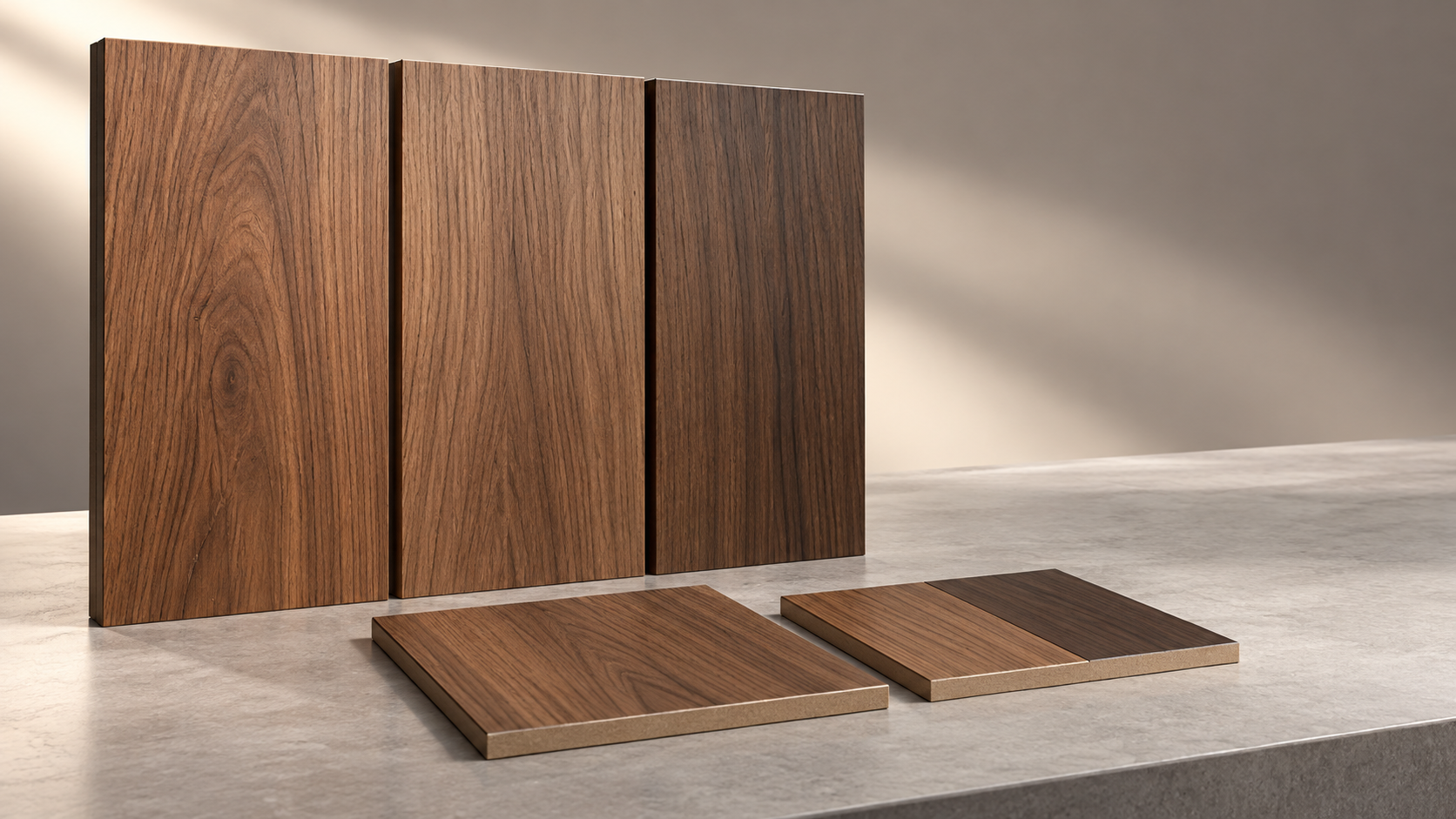
Yes, matte wood grain remains the most requested texture — but today’s version is engineered differently. It’s no longer just a printed film over particleboard. At Shengshi Meilin, our matte wood grain uses a hybrid approach: real thin-cut veneer (0.4–0.6 mm) fused with a nano-matte acrylic topcoat that diffuses light without flattening grain relief. That means you get the warmth and variation of natural wood, but with resistance to fingerprint smudging and solvent-based cleaners — critical for elevator interiors or retail display walls where maintenance crews use alcohol wipes weekly.
One caveat: true matte doesn’t mean zero reflectivity. If your lighting plan includes recessed LED spots at 30° angles, even a matte finish will show directional sheen. We recommend mock-up testing under actual site lighting — not just showroom LEDs — before final sign-off.
Brushed metal: less about shine, more about consistency
Brushed stainless or aluminum finishes used to rely heavily on physical abrasion — which meant batch-to-batch variation, especially on large panels. In 2026, the reliable versions use electrochemical texturing followed by a ceramic-infused clear coat. This gives tighter control over linear grain direction and eliminates the “halo effect” around panel edges where brushing patterns fade.
Important: brushed metal veneers aren’t all equal in thermal expansion. If bonding to aluminum framing or installing in façade applications with wide temperature swings (e.g., northern China winters), verify the coefficient of thermal expansion (CTE) matches your substrate. We typically specify ≤25 × 10⁻⁶ /°C for interior-grade panels — higher values risk edge lifting after 18–24 months.
Embossed concrete: texture with structural honesty
This one gets misused often. Embossed concrete isn’t just a visual pattern — it’s a tactile statement. Our 2026 version uses a dual-layer embossing process: first, a deep-relief base layer cast from real architectural concrete molds; second, a micro-textured top seal that mimics efflorescence and trowel marks without trapping dust. It reads as raw, but cleans with damp microfiber — no abrasive pads needed.
Where it fails? In humid basements or pool-adjacent spaces without proper vapor barriers. Even with our moisture-resistant core, prolonged RH >75% can cause subtle swelling at seams. We flag this early — not in the spec sheet, but in pre-installation briefings.
Soft-touch fabric: not upholstery, but close
Don’t confuse this with laminated textile overlays. What we call “soft-touch fabric” is a thermoplastic polyurethane (TPU) film textured to replicate the nap and compression recovery of bouclé or wool-blend felt — but with inherent flame retardancy (GB 8624–2012 B1 rating) and no fiber shedding. It’s specified for acoustic wall panels, hotel headboards, and library reading nooks where quietness and tactility matter equally.
Real-world note: this texture shows wear differently than others. It doesn’t scratch — it compresses. So high-contact zones (e.g., behind reception desks) need strategic placement: avoid direct elbow height, or specify a 10% thicker build-up in those zones.
UV-gloss: precision, not just shine
Gloss isn’t back — *controlled gloss* is. Our UV-gloss finish uses a two-stage UV-cured acrylic system: first, a low-viscosity primer that penetrates veneer pores; second, a high-build topcoat cured under calibrated UV intensity and dwell time. Result? A mirror-like surface that reflects without amplifying substrate imperfections — unlike older solvent-based lacquers that bridged gaps unevenly.
But here’s what specs rarely mention: UV-gloss requires absolute flatness in the substrate. Even 0.15 mm deviation across a 2.4m panel becomes visible under raking light. We routinely reject panels that pass flatness tolerance on paper but fail under angled inspection — because clients notice it on day one.
What’s *not* widely available — yet
You’ll see “bio-leather,” “recycled ocean plastic grain,” and “ferrofluid metallic” in some trend reports. These exist in lab prototypes or limited-run art installations — not in production-scale, fire-rated, architecturally certified veneer panels. At Shengshi Meilin, we prioritize repeatability over novelty. If a texture can’t be reproduced within ±5% gloss unit, ±0.05 mm emboss depth, and full compliance with GB/T 15104–2017 across 10,000 m² orders — it stays in R&D.
Also absent: fully recyclable mono-material veneers. While we use bio-based resins in several formulations, full material circularity (i.e., separation and reprocessing at end-of-life) remains constrained by current lamination chemistry and recycling infrastructure in most markets.
A practical note on selection
Texture choice shouldn’t happen in isolation. Ask yourself: Is this panel part of a fire-rated assembly? Will it be cleaned with alkaline solutions? Does the lighting design emphasize grazing or diffuse illumination? What’s the expected service life — 5 years (retail fit-out) or 25+ (institutional)?
Shengshi Meilin works with designers to map textures against these parameters — not just aesthetics. Because in practice, the best texture isn’t the most photogenic one. It’s the one that still looks intentional after three years of real use.
RECOMMEND

Oct 27, 2026
Are Aluminum Honeycomb Panels Moisture-Resistant Enough for Bathrooms?
Explore aluminum honeycomb panel moisture resistance for bathrooms. Learn how finishes, sealed edges, and waterproofing help you choose suitable panels for walls, ceilings, and showers.
Oct 27, 2026
How Are Custom Veneer Panels Color-Matched for High-End Interiors?
Explore custom veneer panels color matching for high-end design. Discover how veneer selection, finishes, and lighting create cohesive, luxurious interiors.
Oct 26, 2026
How Do You Choose Fire-Resistant Composite Panels for Commercial Use?
Choose fire resistant composite panels for commercial interior projects. Learn how to verify fire documentation, compare options, and avoid costly specification mistakes.
Oct 26, 2026
Are Meilin Board Custom Panels Suitable for Luxury Hotel Lobbies?
Explore Meilin Board custom decorative panels for luxury hotel lobbies. Discover design considerations and essential fire, emissions, and maintenance checks before specifying your project.