Are Aluminum Honeycomb Panels Moisture-Resistant Enough for Bathrooms?
Yes—aluminum honeycomb panels can be suitable for bathroom walls and ceilings when the complete panel and its installation are designed for the expected moisture exposure. Their aluminum construction avoids the swelling associated with some wood-based boards, but that does not make every panel suitable for shower walls. Adhesives, surface finishes, exposed edges, joints, and fixing details all affect how the assembly performs.
When assessing aluminum honeycomb panel moisture resistance for bathrooms, separate two questions: can the panel tolerate damp conditions, and can the installed wall prevent water from reaching the structure behind it? A panel may perform well under steam and occasional splashes while still needing a separate waterproofing layer or a documented watertight joint system in a shower.
Bathroom humidity and direct shower water demand different things
A ceiling above a ventilated bathroom mainly faces humid air and condensation. A wall beside a basin receives intermittent splashes. A shower enclosure faces repeated direct wetting, including water running across joints and collecting around fittings. These conditions should not be treated as interchangeable.
The following distinctions help narrow the choice before comparing finishes or panel thicknesses:
A specification that says only “suitable for bathrooms” leaves too much unanswered. The intended location matters: approval for decorative bathroom ceilings does not establish suitability inside a shower or steam room.
Why the aluminum core helps—and where its protection ends
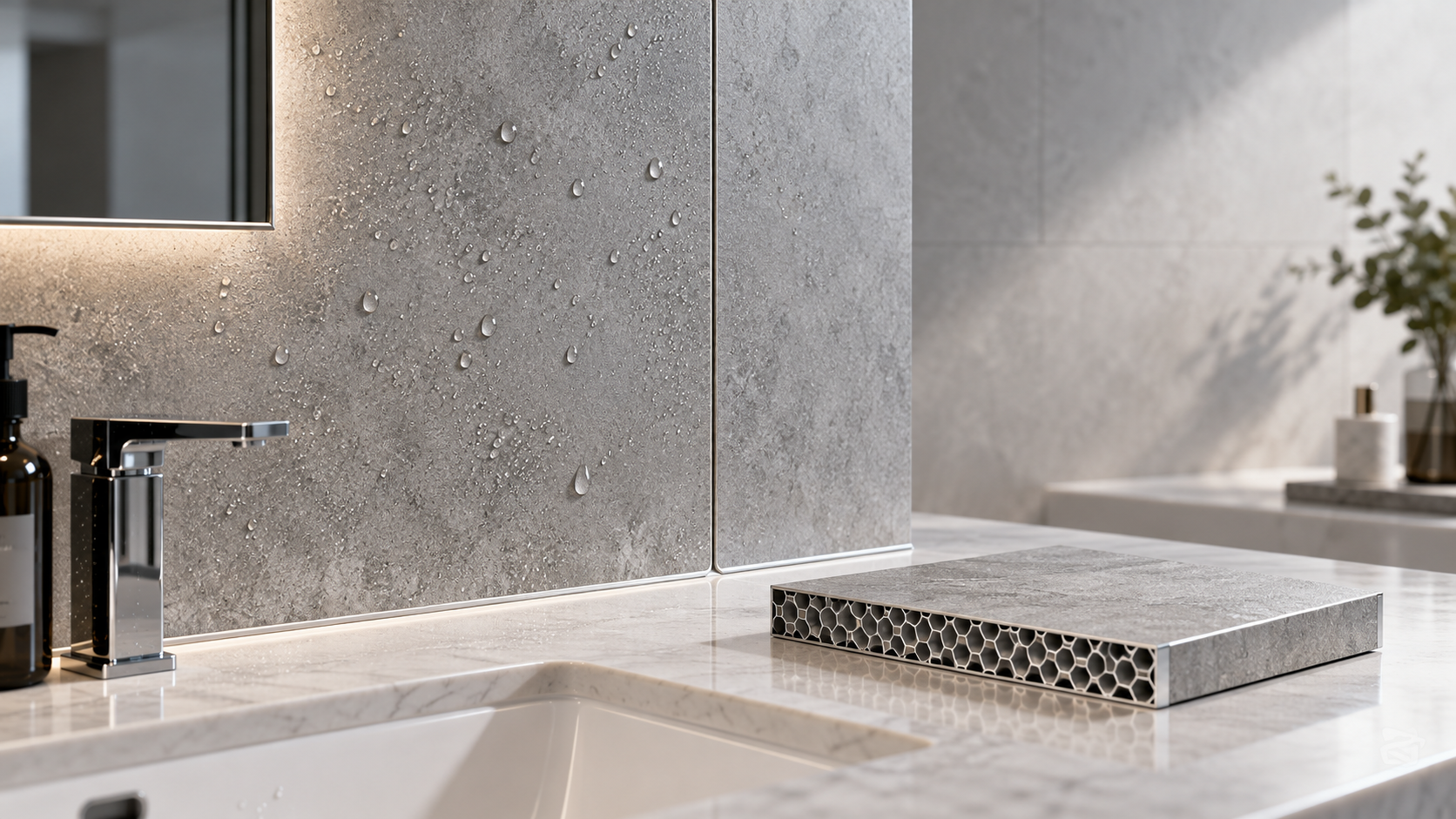
A typical aluminum honeycomb panel has thin face sheets bonded to a cellular core. The separated faces and honeycomb structure provide stiffness without the weight of a solid metal sheet of comparable overall thickness. This can make large decorative panels practical to handle and support.
Aluminum does not absorb water and swell like untreated wood-based materials. That is a useful advantage in humid rooms, particularly where dimensional changes would otherwise strain joints or spoil a flat finish. However, a honeycomb panel is a bonded assembly, so its performance depends on more than the metal.
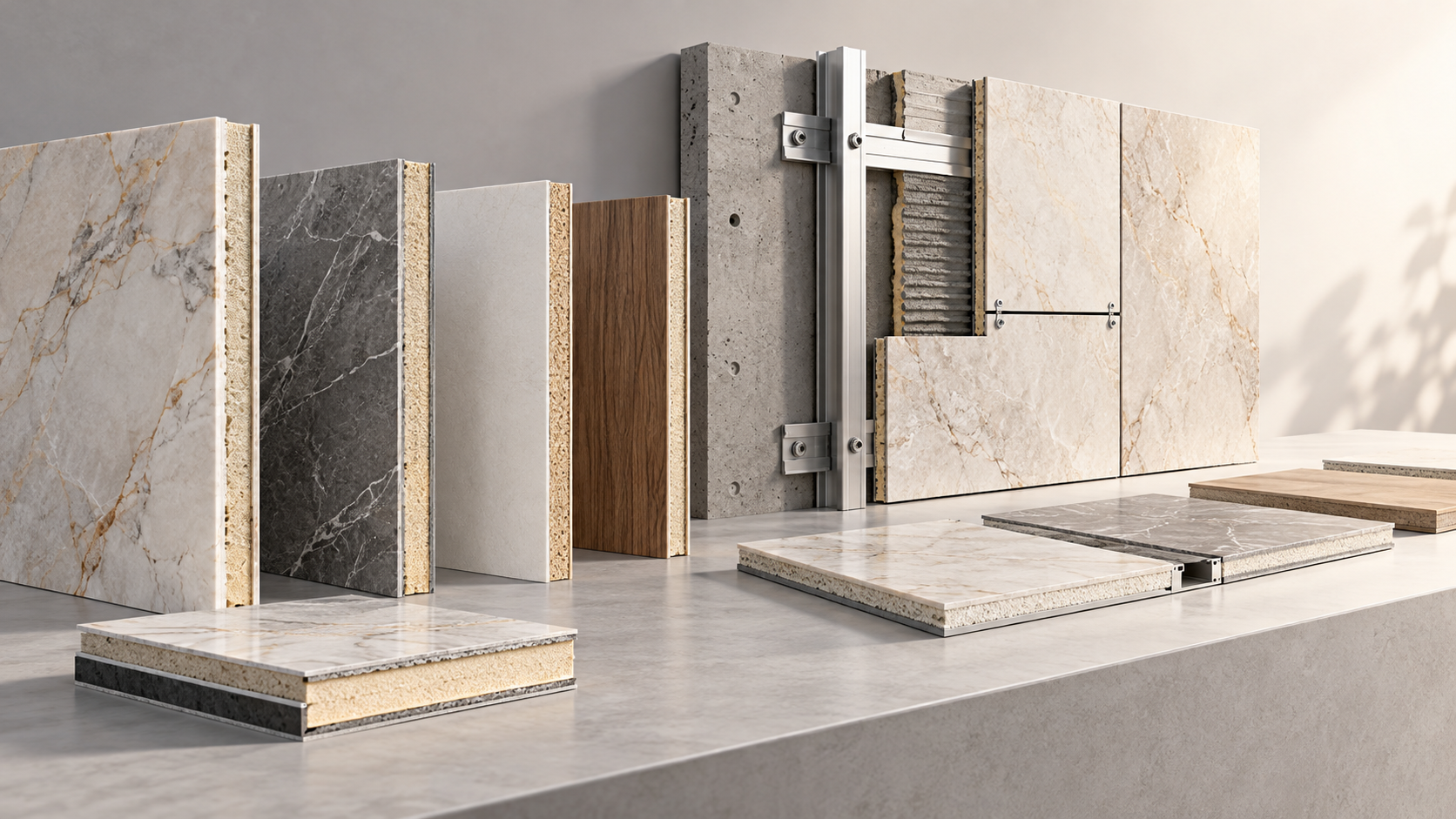
Product names also need careful reading. Some decorative honeycomb panels have aluminum faces, while others combine an aluminum core with stone, laminates, or other surface materials. Each facing brings its own requirements for moisture exposure, cleaning, and edge protection. The core material alone cannot establish the suitability of the finished product.
Aluminum also relies on a protective surface oxide layer and, where specified, additional coatings. Aggressive chemicals or unsuitable contact with other metals can promote corrosion under certain wet conditions. “Will not rust like steel” should never be interpreted as “cannot corrode.”
The details most likely to decide long-term performance
The bond between the layers
The adhesive holds the faces and honeycomb core together so they act as one panel. Repeated moisture exposure and temperature changes can stress this bond. If the bonding system is unsuitable, the result may be blistering, local separation, or a loss of stiffness even while the visible metal surface looks largely intact.
Ask for performance information relevant to the finished panel under humid or wet conditions. A coating description or an aluminum material certificate does not describe the durability of the adhesive bond. Evidence should relate to the proposed construction, including its facings and adhesive system.
Cut edges, holes, and internal cavities
Factory-finished faces are only part of the surface exposed during installation. Cutting a panel for a mixer valve, pipe, socket, or access opening can expose its internal construction. Unprotected openings can give water a route into the core or toward the back of the panel.
Edge protection must therefore cover site modifications as well as factory edges. A decorative trim may hide a cut without sealing it. The detail needs to explain how the trim, sealant, gasket, or closure actually manages water. Depending on the system, incidental moisture may need a planned drainage route; simply sealing every visible gap can obstruct that route.
The decorative finish
Bathroom surfaces encounter soap, cosmetics, limescale removers, and regular wiping. A finish can tolerate water yet be damaged by an incompatible cleaner. Printed patterns, protective films, painted surfaces, and bonded decorative layers may have different cleaning limits.
Choose a finish with care instructions that fit the intended use. A textured surface may disguise fingerprints but take more effort to clean around a shower. A smooth finish can be easier to wipe, although scratches or water marks may be more visible depending on its color and sheen.
Moisture-resistant panels still need a water-management system
A moisture-resistant panel is not automatically a waterproof wall assembly. Water usually finds its way through connections: panel joints, corners, perimeter gaps, pipe penetrations, and the junction with a shower tray or bath.
Some cladding systems use a waterproof substrate or membrane behind the decorative panels. Others form part of a proprietary waterproof wall system with specified joints, seals, and accessories. The correct approach depends on the documented assembly and applicable building requirements. Mixing components from unrelated systems can leave critical connections unresolved.
Consider a shower mixer opening. Sealing the visible trim plate may reduce splashing behind it, but the opening through the wall still needs the waterproofing detail required by the system. The same principle applies to shower-screen fixings and shelves: a screw hole through a protected surface creates another water path unless properly treated.
Movement also matters. Panels, framing, and adjoining materials can expand, contract, or deflect differently. Joints need enough room to accommodate the expected movement, using compatible sealants or gaskets where specified. A rigidly filled joint may look neat at installation and then crack as the assembly moves.
Sealant should have a defined role within that design. Smearing additional sealant over an unclear connection is a poor substitute for a proper joint detail, and it can make later repairs more difficult.
Ceilings and concealed spaces need separate attention
Aluminum honeycomb panels can be attractive for bathroom ceilings because their low weight and stiffness support a clean, flat appearance. Overhead use still requires a fixing arrangement designed for the panel size, supporting structure, and service conditions. Lightweight construction does not justify relying on an unspecified adhesive alone.
Condensation can also develop out of sight. Warm, humid air entering a ceiling void may meet a colder surface and release moisture there. A durable visible panel does not protect nearby insulation, framing, or services from that moisture.
Ventilation, insulation, and air or vapor control should follow the building’s climate and construction design. Avoid adding an improvised impermeable layer without considering how the whole assembly dries. Access panels should also remain usable so leaks and services can be inspected without damaging the decorative ceiling.
What to request before choosing a panel
Start with the exposure conditions, then assess the panel and installation documents together. Comparing samples by appearance alone can hide differences that matter after installation.
- A clear statement of intended use. Establish whether the product is for humid interiors, splash zones, shower walls, or steam enclosures.
- The complete panel construction. Identify both face materials, the core, the decorative finish, and the bonding system.
- Relevant performance evidence. Look for information addressing moisture exposure and bond durability for the proposed panel construction.
- Installation drawings. These should address joints, corners, cut edges, penetrations, supports, and connections to baths or shower trays.
- Compatible accessories. Adhesives, sealants, gaskets, trims, and fasteners need to suit the panel and surrounding materials.
- Maintenance and warranty conditions. Check permitted cleaners, inspection needs, and whether the intended bathroom location falls within the stated use.
A small physical sample helps assess color and surface quality. A joint mock-up is more useful for evaluating how corners, trims, and sealant lines will look together. For a shower installation, request details of the full assembly before ordering panels cut to size.
Shenyang Shengshi Meilin Technology Co., Ltd. works in new material research and applications for construction and home furnishing. When discussing a bathroom application with the company, define the intended location and exposure first, then request the relevant construction and installation information for any proposed material. A broad materials portfolio does not replace a specification for the particular wet-area use.
When another finish may be easier to specify
Aluminum honeycomb panels make sense where large decorative surfaces, low weight, and panel stiffness offer practical value. They become less straightforward when a project has many small recesses, complicated plumbing penetrations, or trades unfamiliar with the required joint system. Large panels reduce the number of field joints, but each remaining connection still needs careful execution.
Ceramic or porcelain tile may be easier to source and repair locally, although tile and grout still depend on an appropriate waterproofing assembly. Purpose-designed bathroom wall panels may provide more coordinated shower details when their documentation includes the necessary joints and accessories. Material labels alone do not settle the comparison.
For steam enclosures, persistent standing-water conditions, or aggressive cleaning routines, general bathroom suitability is insufficient. Those uses place additional demands on the finish, bonding system, seals, and surrounding construction. Choose a system explicitly intended for that exposure rather than extending an ordinary interior panel beyond its documented use.
Keeping the installation serviceable
Routine care should focus on the surface and its connections. Follow the finish supplier’s cleaning instructions, remove residues before they build up, and avoid abrasive tools or chemicals outside the permitted cleaning range. Never mix cleaning products.
Inspect joints around basins, shower trays, corners, and fittings for separation or damage. If a panel develops a bulge, a lifting edge, persistent staining at a joint, or water appearing below it, investigate the moisture source before covering the symptom. Repairing the visible seal alone may leave trapped moisture or a leak behind the panel.
For an ordinary bathroom wall or ceiling, a correctly specified aluminum honeycomb panel can be a practical moisture-resistant finish. For a shower, make the decision from the complete installation detail: a suitable panel, protected openings, compatible joints, and a defined waterproofing approach. Before selecting a color, ask to see how the proposed system handles the wettest connection in the room.
Next:No more content
RECOMMEND

Oct 27, 2026
Are Aluminum Honeycomb Panels Moisture-Resistant Enough for Bathrooms?
Explore aluminum honeycomb panel moisture resistance for bathrooms. Learn how finishes, sealed edges, and waterproofing help you choose suitable panels for walls, ceilings, and showers.
Oct 27, 2026
How Are Custom Veneer Panels Color-Matched for High-End Interiors?
Explore custom veneer panels color matching for high-end design. Discover how veneer selection, finishes, and lighting create cohesive, luxurious interiors.
Oct 26, 2026
How Do You Choose Fire-Resistant Composite Panels for Commercial Use?
Choose fire resistant composite panels for commercial interior projects. Learn how to verify fire documentation, compare options, and avoid costly specification mistakes.
Oct 26, 2026
Are Meilin Board Custom Panels Suitable for Luxury Hotel Lobbies?
Explore Meilin Board custom decorative panels for luxury hotel lobbies. Discover design considerations and essential fire, emissions, and maintenance checks before specifying your project.