How Can Buyers Place Bulk Orders for Meilin Board Aluminum Honeycomb Panels?
Buyers can place a Meilin Board aluminum honeycomb panels bulk order by submitting a detailed request for quotation to Shenyang Shengshi Meilin Technology Co., Ltd., agreeing on the panel specification and commercial terms, approving the required samples or drawings, and issuing a purchase order against the accepted quotation. Production should proceed only after the supplier confirms the order and the agreed payment conditions are met.
The critical point is that a product name alone does not define an orderable panel. Dimensions, aluminum skin thickness, core construction, finish, fabrication, and intended application all affect suitability and price. Supplier-specific minimum quantities, prices, lead times, and payment requirements need to be obtained directly rather than assumed.
How should buyers contact the supplier and establish the correct ordering channel?
Use a company-controlled website or a business channel whose ownership can be independently verified. When contacting Shenyang Shengshi Meilin Technology Co., Ltd., request the legal seller’s name, registered business details, quotation contact, and confirmation that the proposed panels are supplied under the Meilin Board name. Do not rely solely on a marketplace listing, forwarded brochure, or messaging profile.
Before paying, compare the seller named on the quotation, contract, invoice, and bank instructions. A different payment beneficiary requires a documented explanation and independent verification. Changes to bank details should be confirmed through a previously verified contact method, not just by replying to the message announcing the change.
The opening inquiry should describe the application, approximate quantity, required delivery location, and specification status. If drawings are unfinished, identify which dimensions and details remain provisional so that a budget estimate is not mistaken for a production-ready quotation.
What information is needed for an accurate bulk quotation?
A useful quotation request defines both the physical panel and the work expected from the supplier. A price for unfinished sheets cannot be compared directly with a price for numbered, edge-finished panels fabricated to installation drawings.
Attach a panel schedule rather than providing only a total square-meter quantity. Separate repeated standard sizes from unique pieces. Where material selection is incomplete, ask the supplier to identify its proposed construction explicitly and list any deviations from the request.
Which technical details should be settled before comparing prices?
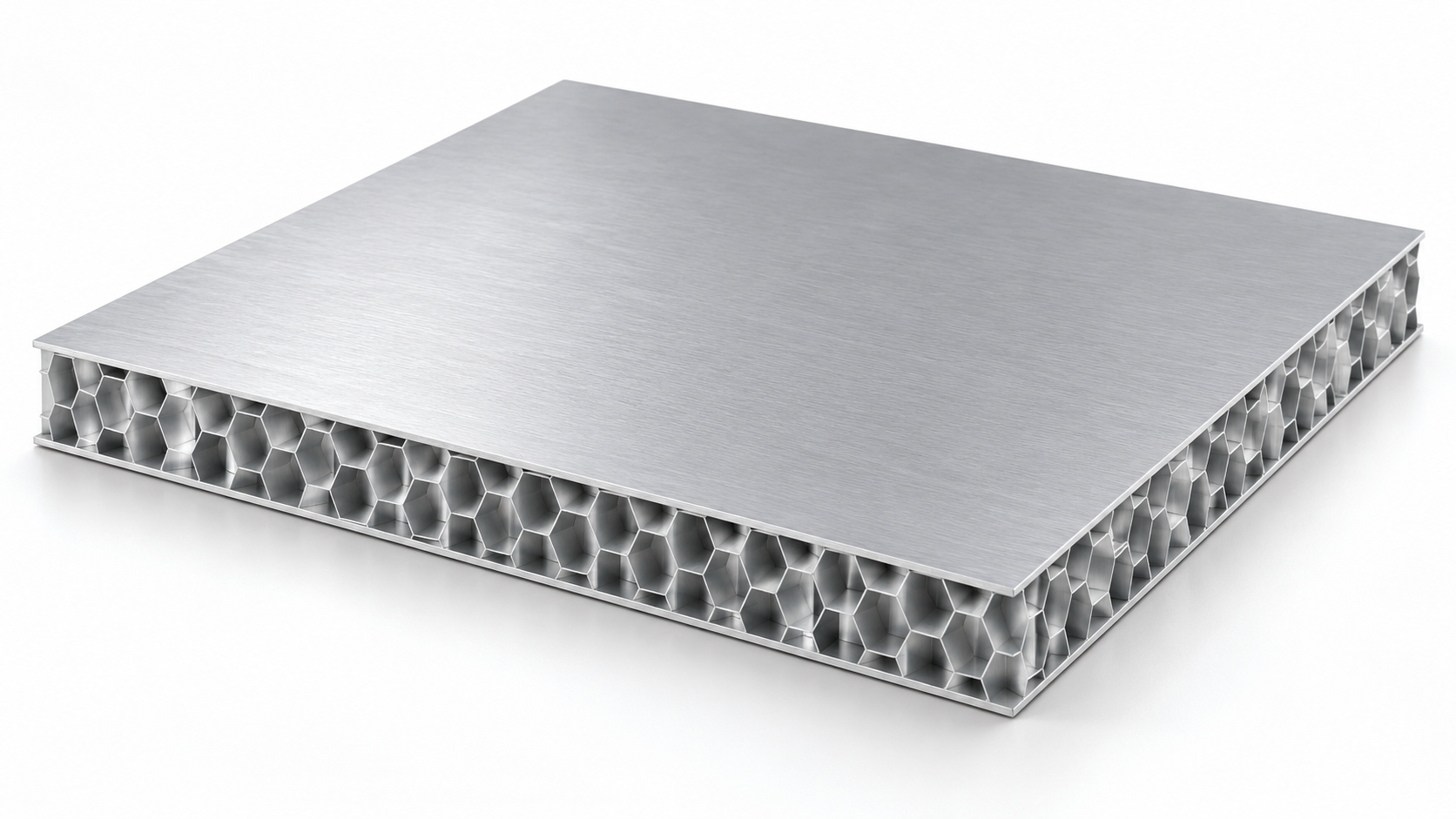
Overall panel thickness is not enough to establish equivalence. Two aluminum honeycomb panels can have the same external dimensions but different skin thicknesses, core geometry, bonding systems, and edge construction. Those differences can affect weight, resistance to local denting, stiffness, and fastening options.
Clarify whether quoted aluminum skin thickness refers to the metal itself or includes a coating. Specify the required front and back skins separately; they need not be identical. Where flatness, dimensional accuracy, or squareness matters, include measurable tolerances and an agreed inspection method.
Installation details also influence what should be purchased. Fasteners, hardware, and concentrated loads need an appropriate load-transfer detail; they should not be assumed to work anywhere on a hollow-core panel. If inserts, reinforced edges, or particular attachment zones are required, show them on approved drawings and allocate responsibility for their design.
Ask the supplier to confirm that its proposed panel construction suits the stated application. That confirmation does not replace project-specific engineering where structural loading, overhead installation, or exterior exposure requires it.
Is there a minimum order quantity, and can different sizes or finishes be combined?
There is no confirmed Meilin Board minimum order quantity in the available product information. Request the minimum separately for standard panels, custom dimensions, special finishes, and fabricated components. A minimum may apply to each finish or production configuration rather than to the shipment as a whole.
Mixed-size orders also need a clear pricing basis. Small finished pieces can create cutting waste and additional handling even when their combined area is modest. Ask whether billing is based on finished area, parent-sheet consumption, a minimum charge per piece, or another stated method.
For repeat purchases, distinguish the immediate release quantity from the projected requirement. A forecast can support production planning, but it should not become a binding purchase commitment unless the contract says so. If material is reserved for future releases, agree on storage charges, ownership, release deadlines, and cancellation liability.
Should samples be approved before the full order?
Sample approval is particularly useful when appearance, edge workmanship, or hardware integration determines acceptance. Request a sample that represents the proposed production construction and finish, not merely a similar panel from an unrelated range.
A small finish sample can establish color, texture, and gloss, but it cannot demonstrate full-size flatness or long-span behavior. A fabricated sample or first article may be needed to assess edge closures, hole positions, inserts, and fit with adjoining components. Confirm the cost and timing of these approvals before placing the production order.
Record the approved sample reference, finish code, drawing revision, and approval date. For directional finishes, specify orientation on each panel. If several shipments will be installed together, agree on batch identification and acceptable visual variation. Photographs can help communication, but lighting, camera settings, and screens make them unreliable as the sole color acceptance reference.
Which quality and compliance documents should be requested?
Request documents tied to the specified product and its destination requirements. Relevant records may include a technical data sheet, construction description, applicable test reports, inspection records, material declarations, and care or installation instructions. The required package depends on the application; a generic company certificate does not establish every performance claim.
An aluminum honeycomb core does not, by itself, establish the fire classification of the finished panel. Adhesives, coatings, decorative layers, and the installed configuration can affect fire performance. Where fire requirements apply, check that the report covers the relevant product construction, thickness range, mounting arrangement, and classification method.
Likewise, claims about emissions, weather resistance, or bond durability need evidence relevant to the material being ordered. Check the tested sample description and report scope, not just the certificate heading. A report for another panel build-up should not be accepted as automatic proof of compliance.
Agree before production which documents will accompany the shipment and which must be reviewed before order release. Missing evidence discovered after manufacture can delay acceptance even when the panels appear satisfactory.
How can buyers compare quotations without overlooking costs?
Normalize quotations to the same specification, quantity schedule, fabrication scope, packaging, and delivery basis. Otherwise, the lowest unit price may simply exclude work or protection included elsewhere.
Ask each quotation to separate panel supply, fabrication, sample or setup charges, packaging, inland transport, export-related charges, and international freight where applicable. Confirm the currency, quotation validity, payment schedule, and treatment of specification changes.
For international shipments, state the Incoterms® rule, named place or port, and edition. “FOB China” is insufficiently precise because it does not identify the shipment port. Incoterms allocate specified delivery obligations, costs, and risks; they do not settle every issue involving payment, ownership, product acceptance, or warranty.
Compare expected landed cost using the destination’s applicable tariff classification, duties, taxes, customs charges, and onward transport. Classification should follow the actual product and destination rules rather than an unsupported assumption based only on the panel’s aluminum content.
How should production timing, packaging, and shipment be agreed?
Ask when the production lead-time clock starts. The trigger may depend on receipt of payment, final drawings, finish approval, or completion of all order details. Separate the production-ready date from dispatch, transit, customs clearance, and final delivery dates.
For phased deliveries, identify the panels needed in each shipment. Shipping the correct total area is not enough if installation depends on particular sizes arriving together. Require package labels to connect each bundle or crate to the panel schedule and drawing references.
Packaging should address the panel’s vulnerabilities: surface scratching, corner damage, edge crushing, and distortion during handling. Agree on protective film, interleaving, corner protection, stack support, and crate or pallet construction. Specify lifting and unloading limitations at the receiving location.
If regulated solid-wood packaging is used internationally, confirm the applicable treatment and marking requirements. Also request guidance on storage conditions and protective-film removal. Transport damage risk and prolonged storage exposure should not be treated as the same issue.
What should the purchase order and inspection agreement contain?
The purchase order should reference the accepted quotation, final panel schedule, approved drawings, sample references, and agreed technical requirements. Identify document revisions and establish which document takes priority if descriptions conflict. “As discussed” leaves too much uncertainty for a custom order.
Include quantities, prices, payment milestones, delivery terms, packaging, required records, and the process for approving changes. Define the treatment of shortages, defective panels, and replacement freight. For custom-cut products, confirm cancellation terms before authorizing material purchase or fabrication.
Inspection should use written acceptance criteria. Relevant checks can include quantities, dimensions, flatness, finish, visible defects, edge workmanship, and fabrication accuracy. If skin thickness or bond-related properties require verification, agree on a suitable method rather than expecting every characteristic to be established through a visual inspection.
Specify whether inspection covers every piece or an agreed sample, who performs it, and whether shipment release depends on acceptance. Destructive testing, where required, needs a separate allowance for test pieces and an agreed method.
What needs to happen after the panels arrive?
Check package condition and shipment counts before discarding protective materials. Record visible damage on delivery documents where appropriate, photograph affected packaging, and retain package labels linking damaged items to the shipment.
Inspect panels within the contractual notification period and distinguish transit damage from manufacturing nonconformity. A useful claim identifies the panel reference, quantity affected, relevant specification, photographs, and supporting measurements. Agree on a remedy before cutting, repairing, or installing disputed material unless immediate action is necessary for safety.
For later replenishment, retain the approved specification, finish references, batch information, and final drawings. Reordering by product name alone may not reproduce the original construction or appearance. A controlled order record gives both parties a clearer basis for supplying matching replacements and resolving any differences.
RECOMMEND

Oct 31, 2026
Which Wall Panel Finish Works Best in a Sales Center?
Which wall panel finish works best in a sales center? Compare wood-look, stone-look and other finishes to create a welcoming, practical space.
Oct 31, 2026
How Much Does an Aluminum Honeycomb Panel Weigh?
Discover aluminum honeycomb panel weight, typical ranges, and easy calculation methods. Find the right panel for your project with practical supplier tips.
Oct 30, 2026
How Can You Assess the Quality of Shengshi Meilin Custom Panels?
Assess Shengshi Meilin custom decorative panels quality with expert tips on samples, construction, test reports, and delivery checks. Discover how to choose panels that meet your project needs.
Oct 30, 2026
Why Do Designers Choose Metal Panels for High-End Exhibition Halls?
Why do designers prefer metal decorative panels for high-end exhibition halls? Discover premium finishes, durability benefits, and specification tips to elevate your next project.