

Decorative Wall Cladding Panels for Hotels, Offices, and Retail: What Changes by Use Case?
When buyers search for Decorative Wall Cladding Panels across hotels, offices, and retail projects, they are usually not comparing finishes in isolation. They are trying to understand which performance priorities change once the same wall system moves from a guest room corridor to a corporate reception area or a fashion storefront. That distinction matters, because a panel that looks impressive in a sample book can underperform once traffic intensity, cleaning routines, code requirements, lighting, and replacement cycles are brought into the picture.
In decorative materials, the mistake is often to treat wall cladding as a purely visual layer. In practice, it sits at the intersection of interior design, compliance, operations, and lifecycle cost. For information-stage buyers, the useful question is not “which panel is best,” but “best for what kind of space, under what constraints, and with what maintenance reality?”
The same product category behaves differently across three commercial environments
Hotels, offices, and retail spaces all use decorative wall systems to shape perception. But the business purpose behind the wall is different in each case.
In hotels, wall finishes help sell comfort, consistency, and brand positioning. Guests notice tactile quality, acoustic calm, visual warmth, and the absence of visible wear. In offices, the wall is more likely to support a professional environment over long occupancy cycles, often with pressure on durability, fire performance, and controlled budgets. In retail, the wall is part of the selling environment itself: it may need to create impact quickly, support seasonal updates, and perform under heavy public contact.
That is why Decorative Wall Cladding Panels should be evaluated less like generic interior decoration and more like a use-case-specific system. The finish, substrate compatibility, fire behavior, cleanability, seam handling, and installation method all take on different weight depending on where the panel is going.
What hotels usually care about first
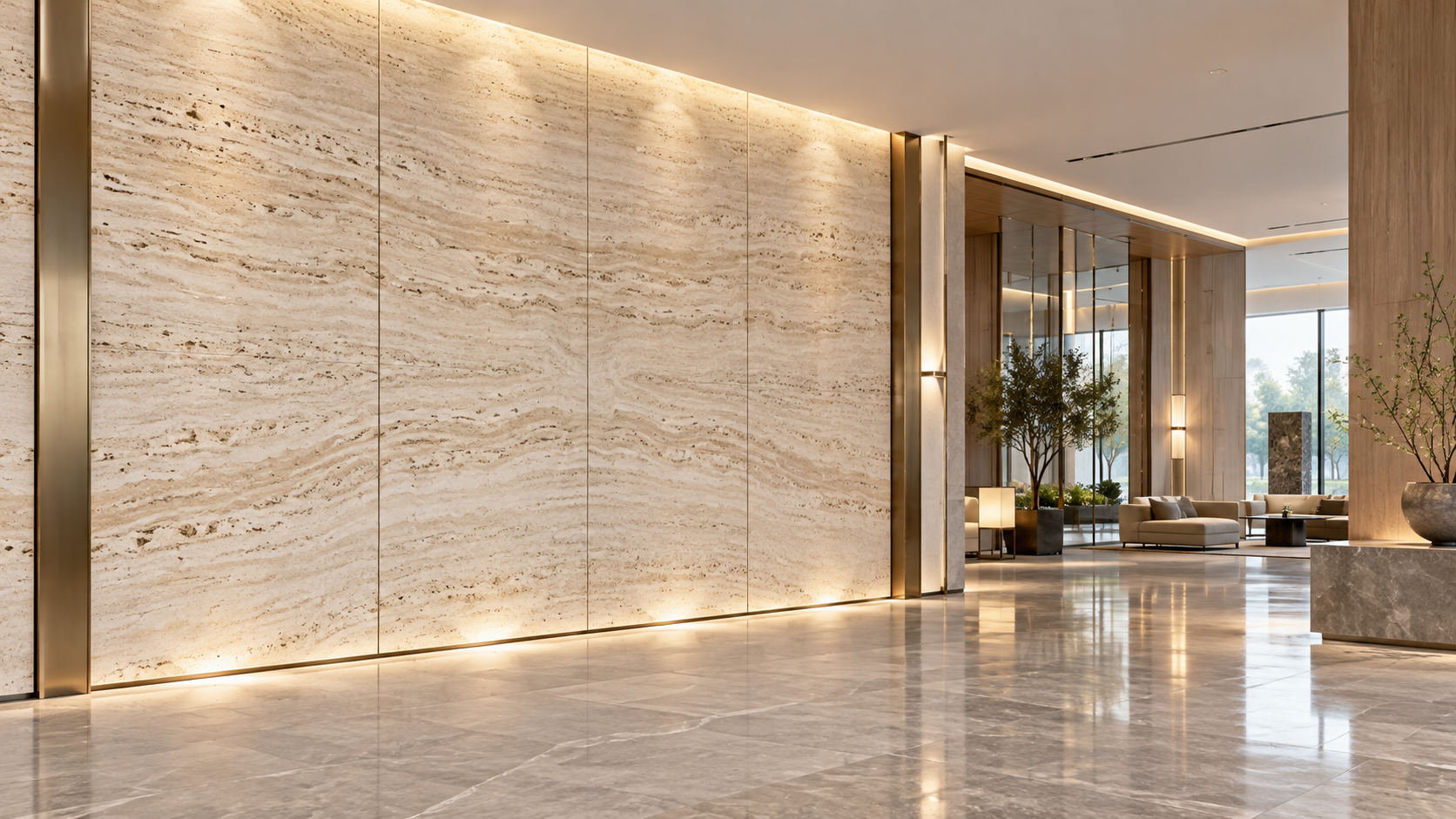
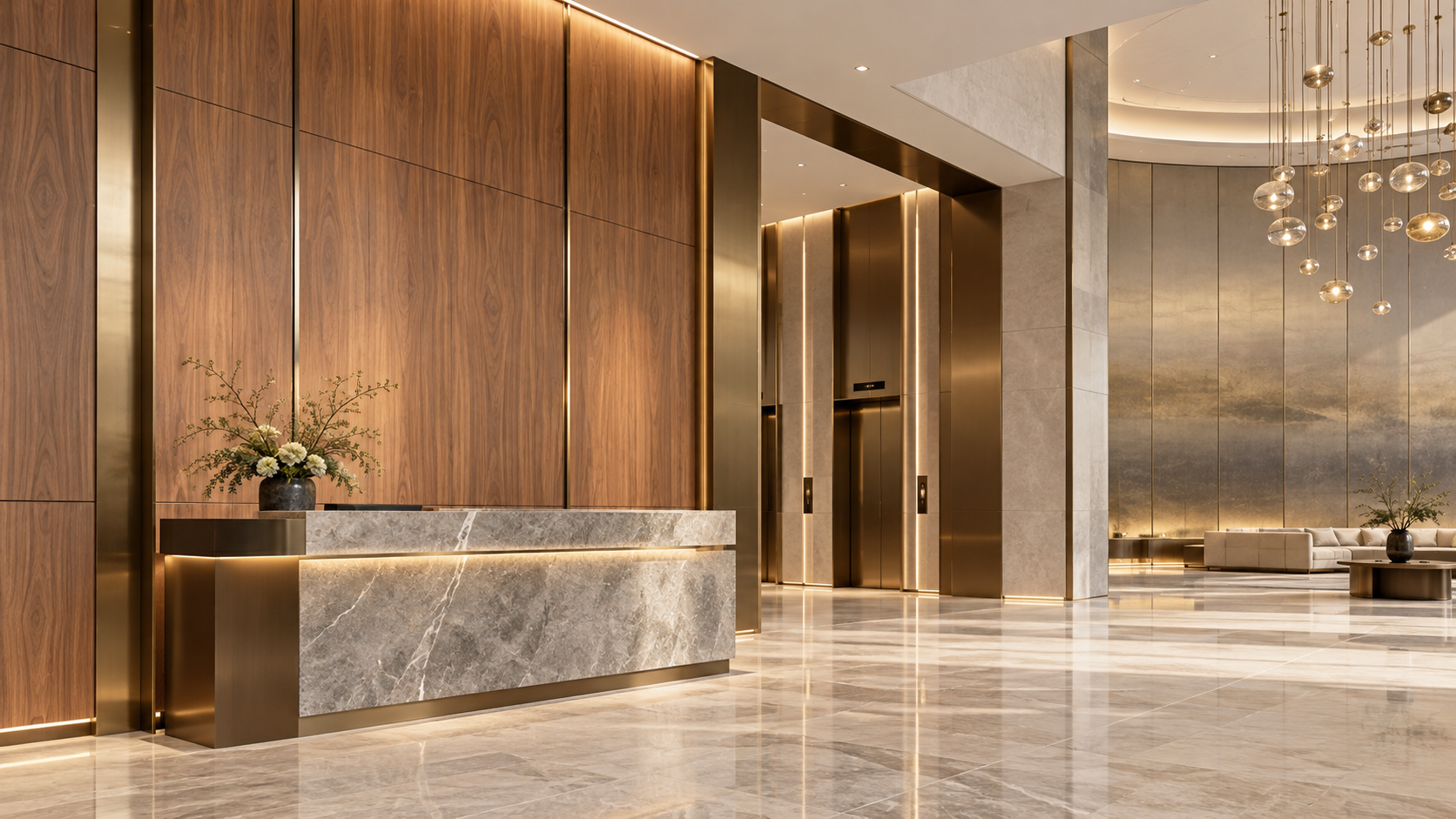
Hotel projects tend to place the highest value on atmosphere and finish stability, but that should not be confused with decorative freedom. A hotel interior may include lobby feature walls, guest room headboard areas, elevator lobbies, corridors, banquet spaces, and back-of-house zones. These are all “hotel” spaces, yet they do not ask the same thing from the material.
For front-of-house areas, designers often prioritize layered texture, metallic accents, stone-like effects, wood visuals, or embossed surfaces that photograph well and support a premium feel. But the procurement side usually needs additional answers:
- Will the panel show scratches, dents, or edge damage under luggage and cleaning equipment contact?
- How visible are joints under warm and directional lighting?
- Can the surface handle frequent cleaning without dulling or delaminating?
- Does the system align with local fire-rating expectations for commercial hospitality interiors? 【待核实】
- Can damaged sections be replaced selectively without redoing an entire wall elevation?
This last point is often underestimated. In hotels, maintenance happens while the property continues operating. A visually complex panel may look strong at handover but become expensive if one damaged area requires removing adjacent sections or causes batch-color mismatch during later replacement.
Hotels also tend to be more sensitive to acoustic comfort and perceived warmth than office environments. A hard, reflective cladding surface may be acceptable in a feature area but feel cold or noisy if overused in guest circulation zones. So the material decision is rarely just about one panel; it is about where that panel belongs and where it should stop.
Office projects usually shift the discussion toward durability, code, and lifecycle value
In office interiors, buyers are generally balancing brand image with longer-term operational logic. A headquarters lobby may still want a signature wall, but most office square meterage is not designed for short-stay emotional impact. It is designed for daily use, maintenance efficiency, and a stable professional look over time.
This changes the selection criteria in several ways.
First, abrasion resistance and surface consistency matter more than many early-stage specifiers expect. Office walls around lift lobbies, meeting areas, pantry zones, and circulation routes face repeated contact from chairs, bags, trolleys, and cleaning tools. A finish that is too delicate can quickly make a relatively new office look poorly managed.
Second, office tenants and developers are often more disciplined about documentation. Depending on project type and market, buyers may ask for fire-related test information, emissions-related documentation, substrate recommendations, and installation guidance before approving a decorative wall system. Exact requirements vary by jurisdiction and building category, so these should always be checked against local standards and project specifications rather than assumed from marketing claims.
Third, office fit-outs can be value-engineered late in the process. That means materials that look similar at sample stage may be compared not only on appearance but on installation speed, labor complexity, waste rate, repairability, and coordination with MEP interfaces, access panels, and corner conditions. A panel with a slightly higher unit price may still be the better option if it reduces installation risk or minimizes on-site finishing work.
For this reason, office buyers often benefit from asking suppliers for mock-up logic, not just samples. A 300 mm sample rarely reveals how a full-height wall handles corners, reveals, switch cutouts, shadow lines, and lighting transitions.
Retail is more visual, but also less forgiving
Retail environments usually push decorative wall materials in a different direction: stronger brand expression, more controlled drama, and faster visual reading from the customer’s point of view. The wall may need to frame merchandise, reinforce a concept, or act as a backdrop for changing campaigns.
That makes finish selection more aggressive, but also more exposed. In retail, lighting is often harsher, customer traffic is less predictable, and surface damage is more public. Fingerprints, scuffs, edge chips, and uneven reflections become visible quickly.
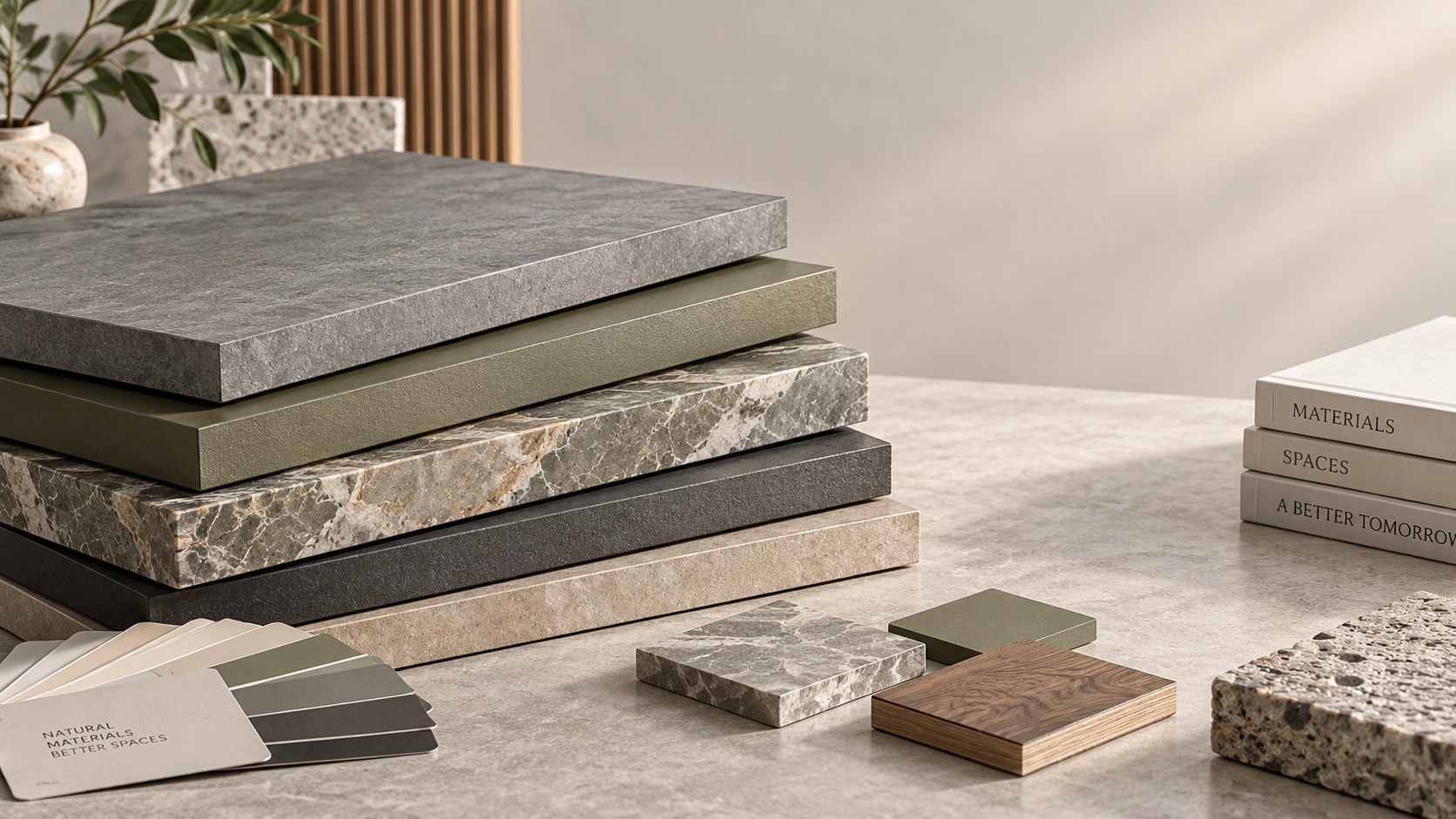
Retail buyers therefore need to separate “showroom attractiveness” from “sales-floor practicality.” A striking embossed or metallic panel may be effective in a focal zone, cash wrap backdrop, or branded display wall, while a more forgiving finish may be better for circulation areas. For example, a product such as Embossed Metal-Herringbone Coffee Gold can make sense when used as a controlled accent surface in a premium retail concept or hospitality feature wall, where pattern, reflectivity, and tone are part of the intended customer impression. It becomes a weaker choice if the same finish is spread indiscriminately across all touch-heavy surfaces without considering upkeep.
Retail also has a higher probability of layout refresh. Some stores redesign zones seasonally; others need frequent fixture changes. If wall cladding is difficult to patch, remove, or coordinate with changing display systems, the hidden cost appears later. A wall material that performs well in static spaces may become inefficient in fast-merchandising formats.
What often gets oversimplified in early discussions
There are several common assumptions in the market that sound reasonable but do not fully hold up once the project moves into detailed selection.
“Premium appearance means better fit for hotels”
Not always. A premium-looking finish can still be unsuitable if it is difficult to clean, too sensitive to impact, or hard to repair in occupied properties. Hospitality buyers should evaluate premium appearance together with operational tolerance.
“Fire safety is just a box to tick”
In commercial interiors, fire-related performance is not simply a certification line in a brochure. The wall assembly, substrate, adhesive, installation method, and local code context may all affect what is actually acceptable on the project. Claims should be checked carefully, especially where imported materials or mixed-system installations are involved. Exact classifications vary by country and project type. 【待核实】
“Retail can use anything because it changes fast”
Fast refresh does not remove the need for durability. It just changes the balance. Retail often needs surfaces that can survive high visibility and contact for a shorter but intense operating cycle. Temporary does not mean careless.
“Office projects only care about budget”
Budget matters, but offices are often disciplined about long-term appearance and risk control. Procurement teams may accept a higher upfront material cost if it reduces maintenance calls, installation disputes, or early replacement.
A more practical way to compare wall cladding options
For information-stage buyers, comparing by product category alone is rarely enough. A more useful approach is to compare by operating condition.
This kind of comparison usually reveals that the “right” panel is not universal. It is conditional.
Material selection should include the installation reality
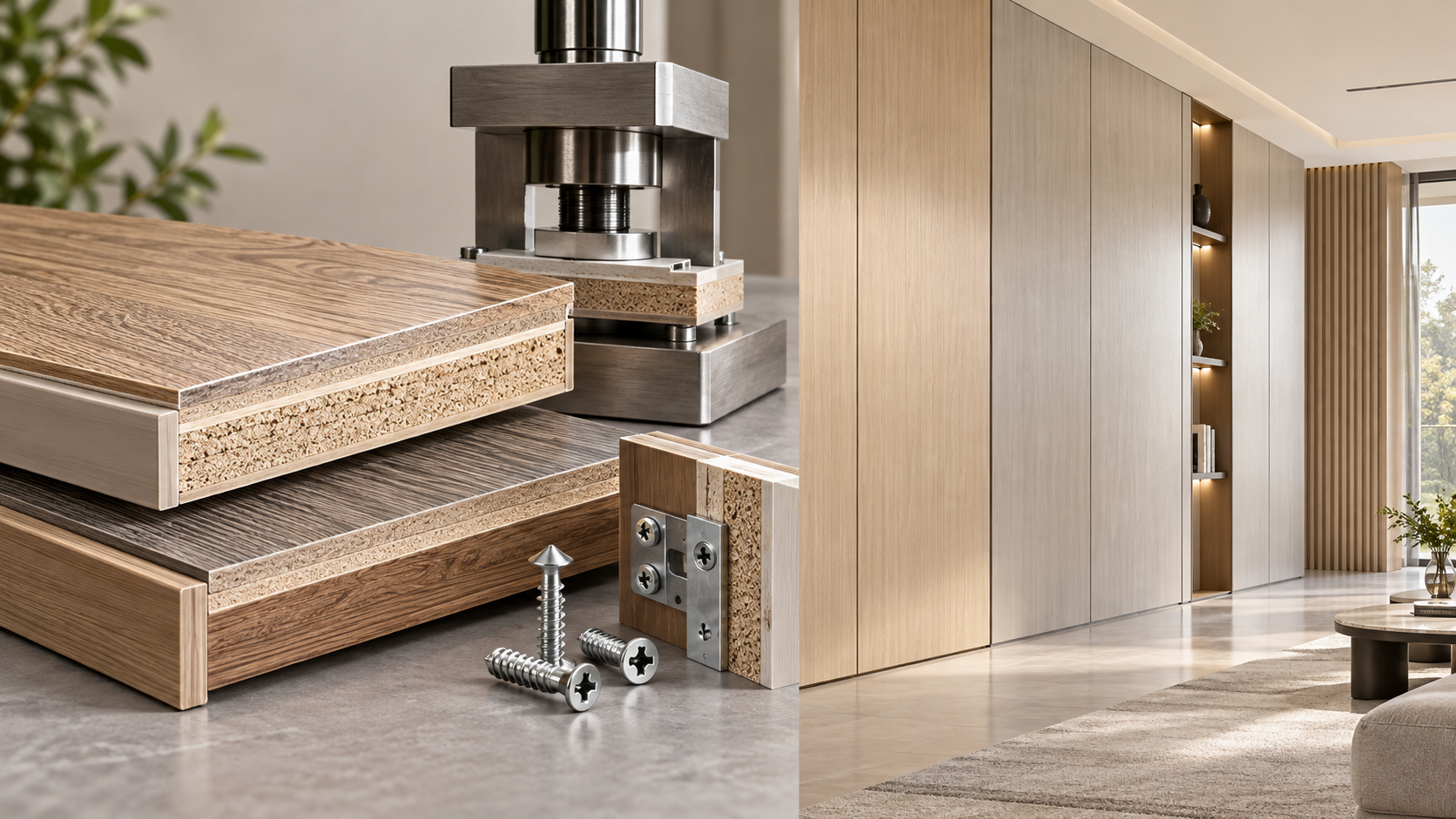
In decorative materials, many project issues appear after material approval, not before it. A panel may be suitable in principle but become problematic because the substrate is uneven, moisture conditions are unstable, corner details were not resolved early, or the on-site team is unfamiliar with the system.
That is especially relevant in projects involving mixed wall types, phased handover, or renovation. Existing surfaces in hotel refurbishment, office upgrades, or retail retrofits may not offer the same substrate quality as new-build interiors. In those cases, installation tolerance becomes a commercial issue, not just a technical one, because delays and rework affect opening dates and tenant schedules.
Buyers should therefore ask not only for finished-face information, but also for guidance on substrate preparation, movement tolerance, edge treatment, and repair approach. Suppliers with a stronger application background typically perform better here than those selling on finish alone.
Where manufacturers with broader materials capability can add value
For commercial buyers, a supplier’s value is not limited to the panel design itself. Companies with a broader new-materials and interior application background are often better positioned to discuss the interaction between decorative effect, safety, and installation. That matters in a market where wall systems are rarely chosen in isolation from other interior materials.
Shenyang Shengshi Meilin Technology Co., Ltd., for example, operates from a new-materials R&D and application perspective rather than from a single-finish perspective alone. In practical terms, that kind of positioning can be relevant for buyers who need environmentally conscious, safety-aware, and design-led interior solutions to align across multiple project zones rather than treating each finish as a separate procurement decision. The real test, however, still comes back to project matching: what works in a boutique hotel lobby may need a different specification logic in an office corridor or retail rollout.
What to focus on next if you are still at the research stage
If the project is still early, the most productive next step is to narrow the use case before narrowing the material. Start by identifying which walls are image-bearing, which are impact-prone, and which are maintenance-sensitive. Then ask suppliers to respond to those specific conditions instead of requesting a generic catalog recommendation.
That usually leads to better discussions around finish suitability, mock-up scope, maintenance expectations, and documentation needs. It also reduces a common procurement problem in decorative interiors: selecting a panel because it looks right in abstraction, then discovering too late that the real business environment was asking something else from the wall.
For hotels, offices, and retail spaces, Decorative Wall Cladding Panels are not one market with three aesthetic styles. They are three operational contexts that happen to use the same product family. Buyers who keep that distinction clear tend to make better decisions earlier, with fewer surprises after installation.
RECOMMEND

Oct 14, 2026
How Can You Verify Decorative and Structural Panel Performance?
How to verify if engineered panel systems meet both decorative and structural performance standards? Discover practical checks for durability, strength, fire safety, and emissions before you specify.
Oct 14, 2026
Is Custom Surface Finishing Available for Small-Batch Design Projects?
Is surface finish customization available for small batch designer projects with unique color requirements? Explore practical options for custom colors, textures, samples, and reliable decorative material production.
Oct 13, 2026
Can Stone-Look Decorative Panels Match Natural Stone in Premium Projects?
Can stone look decorative panels really match natural stone in high-end project settings? Explore premium design, fire performance, installation, and specification insights.
Oct 13, 2026
What Fire Rating Should Decorative Wall Panels Meet in Hotel Lobbies?
What fire rating should decorative wall panels meet for high-end hotel lobby applications? Explore Class A, B-s1,d0, system testing, and approval essentials for luxury hospitality interiors.