Is Custom Surface Finishing Available for Small-Batch Design Projects?
Is Custom Surface Finishing Available for Small-Batch Design Projects?
Is surface finish customization available for small batch designer projects with unique color requirements? In many cases, yes—but “available” and “practical” are not quite the same thing. A finish that can be developed in a sample room may still be difficult to reproduce consistently across a limited production run, especially when the project involves unusual colors, mixed materials, fire-related requirements, or a tight installation schedule.
For architects, interior designers, hospitality studios, and boutique furniture brands, small-batch work is often where the design intent is most specific. The brief may call for a muted mineral grey with a warm undertone, a low-gloss finish that does not show fingerprints, or a decorative surface that feels handmade without creating unpredictable variation. These are not unusual requests. They do, however, require an early conversation about material selection, color control, sampling, and the minimum conditions needed to make the result repeatable.
The short answer is that custom surface finishing can be a realistic option for small projects when the supplier has flexible development capabilities and the specification is clear enough to manufacture. Shenyang Shengshi Meilin Technology Co., Ltd., a high-tech enterprise in Shenyang, Liaoning Province, works in new-material research and application across decorative materials, fireproof sealing materials, furniture, and home furnishing solutions. Its approach is centered on balancing appearance, safety, environmental considerations, and production reliability—an especially relevant balance for custom decorative work.
Why Small-Batch Custom Finishing Is More Complex Than It Looks
A designer may see surface finishing as the final visual layer. From a manufacturing perspective, it is connected to nearly everything underneath: the substrate, primer system, coating or film, texture, curing process, edge treatment, and expected use environment. A pale green applied to a stable panel can look very different from the same color applied to a porous board, a metal component, or a molded profile.
This is why a physical reference matters. A screen image, a paint code, or a mood-board photograph is useful for direction, but it rarely tells a factory enough about gloss, texture, opacity, or undertone. Even a color reference can shift under daylight, warm interior lighting, and showroom spotlights. For a project with custom colors, a retained approval sample is usually more dependable than a digital file alone.
Small quantities also change the economics of the process. Some finishes require setup work, color matching, test panels, special tooling, or a dedicated coating adjustment that does not disappear simply because the order volume is limited. The most suitable solution is not always the most elaborate finish. Often, the better decision is to identify which visual detail is essential to the design and which detail can be simplified without changing the overall effect.
For example, a custom matte tone may be achievable with a standard texture family and a controlled gloss range. That can be more workable than requesting a completely new embossed pattern, a high-variation print, and a custom color all at once. Combining several new variables increases development time and makes approval more difficult. Good suppliers will say this plainly rather than promising that every visual reference can be copied exactly.
What Can Usually Be Customized for a Limited Run?
The degree of customization depends on the decorative material system, but limited-run projects commonly explore color, sheen, tactile feel, pattern direction, and surface performance. The most feasible route is often to adapt an existing material platform rather than build a finish from zero.
Not every feature needs to be custom. That is an important point. A distinctive project can be created through a carefully chosen combination of standard base materials, custom color adjustment, tailored edge details, and thoughtful panel layout. This approach preserves the design character while reducing unnecessary development risk.
Unique Colors Need More Than a Color Name
“Warm white,” “deep olive,” and “smoked blue” sound precise in a concept presentation, but they are not production specifications. Each can contain several possible undertones. A warm white may lean yellow, pink, grey, or cream. An olive can appear sophisticated under soft light and almost brown under cooler lighting. When a project depends on color harmony with stone, timber, fabric, or metal, those differences become obvious.
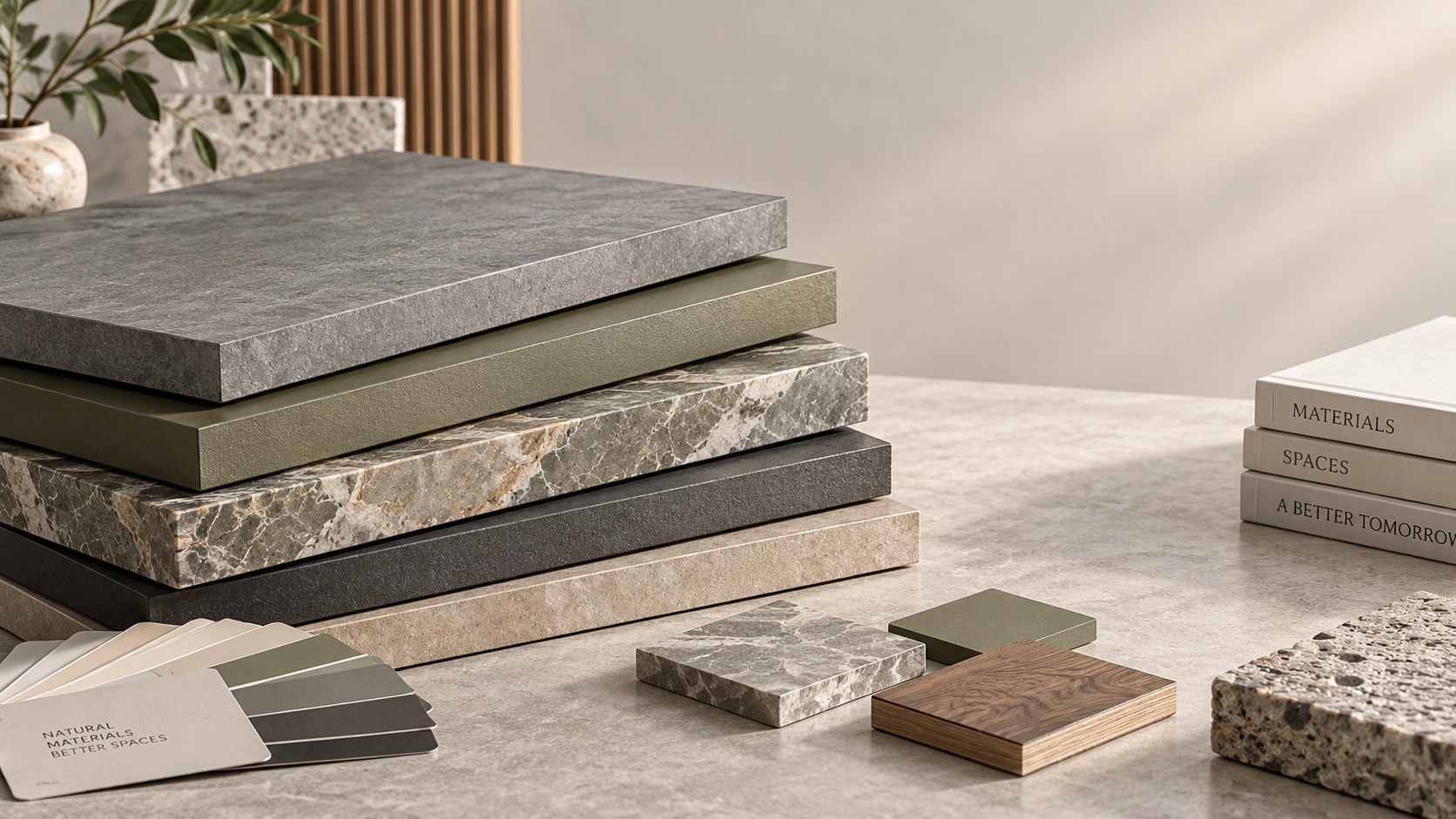
The best practice is to provide a physical benchmark whenever possible. It might be a coated metal sample, a piece of fabric, a stone offcut, or an approved finish panel. The manufacturer can then assess not only the hue but also the surface reflectivity and texture surrounding that hue. A flat color and a textured color may have the same pigment direction yet read differently at a distance.
Design teams should also decide where color variation is acceptable. Natural-looking decorative surfaces may deliberately include slight movement, tonal depth, or grain variation. A reception desk front may benefit from that character. A continuous wall installation with panels meeting edge to edge may require tighter control. Neither preference is wrong, but the requirement should be stated before sampling begins.
It is wise to approve the finish under lighting that resembles the real space. A sample viewed only in a factory or office can lead to disappointment after installation. Where the project uses strong directional lighting, large glazing areas, or warm hospitality lighting, ask to review the sample in comparable conditions if practical.
The Sampling Stage Is Where Most Problems Are Avoided
In custom finishing, sampling is not a ceremonial step. It is the working stage where the supplier and design team discover whether the intended appearance can be achieved consistently on the actual material. A small swatch is useful for color direction, but it may not reveal how a texture repeats, how edges look, or whether the finish behaves differently across a larger surface.
A useful approval sequence often includes an initial color or texture sample, a revised sample where necessary, and a final retained control sample. The retained sample should identify the approved face, substrate, texture, gloss expectation, and any acceptable variation. This may seem detailed for a boutique run, yet it is much cheaper than debating whether installed panels are “close enough” after the material has been cut.
There is another practical question: who has final sign-off? If the architect, interior designer, furniture fabricator, and project owner all comment separately, late-stage changes can become costly. One person or team should consolidate the approval decision. The supplier needs one clear instruction, not four slightly different interpretations of the same beige.
Details that should be agreed before production
- Which substrate will receive the finish, including thickness and edge construction where relevant.
- The approved color reference and whether a slight batch-to-batch variation is acceptable.
- Surface direction, grain orientation, pattern matching, and panel sequencing requirements.
- Expected exposure to abrasion, moisture, cleaning agents, heat, or frequent touch.
- How the material will be packed, transported, stored, and installed on site.
- Whether the project requires material information related to local building, interior, or fire-safety requirements.
The last point deserves attention. Decorative appearance should not be specified separately from use conditions. A finish intended for a quiet residential display cabinet does not face the same demands as one used in a retail fixture, hotel corridor, kitchen-adjacent installation, or public interior. If fireproof sealing materials or related safety considerations are part of the broader assembly, compatibility needs to be assessed with the actual project system rather than assumed from appearance alone.
When a Small-Batch Request May Need to Be Adjusted
A responsible manufacturer will sometimes recommend changing the brief. That is not resistance to customization; it is often a sign that someone is thinking beyond the sample. Requests may need adjustment when the desired finish depends on unavailable raw materials, unusually complex embossing, extremely tight uniformity across mixed substrates, or a delivery date that leaves no room for testing.
Another warning sign is a design that combines a very dark matte finish with high-touch use but gives no guidance on cleaning expectations. Dark matte surfaces can be visually striking, yet oils, dust, and handling marks may be more visible depending on the material system. The right answer may be a different texture, a slightly altered sheen, or a maintenance plan that suits the space. Choosing solely from a tiny visual sample can be misleading.
Similarly, a finish intended to imitate natural stone, timber, or handmade plaster should be discussed in terms of acceptable variation. Trying to eliminate all variation can make a natural-look material feel artificial; allowing too much variation can disrupt a carefully composed interior. The project team should define the visual threshold, especially where multiple panels meet in one field of view.
How to Start a More Productive Custom Finish Conversation
The most efficient inquiry is not necessarily the longest one. It simply provides enough information for the supplier to judge feasibility. Include the intended application, estimated quantity, dimensions, substrate if known, reference images, physical color standard where available, preferred texture, deadline, and any performance concerns. If the final installation conditions are still undecided, say so. Early uncertainty is normal; hidden uncertainty is what causes rework.
For designers working on limited editions, prototype furniture, show flats, branded retail environments, or compact hospitality projects, it is often useful to ask for two routes: a closer visual match with more development work, and a more production-ready alternative based on available materials. This comparison makes the trade-off visible. The first option may protect a very particular concept; the second may offer simpler approval and more predictable timing.
Shengshi Meilin’s work in decorative materials and home furnishing reflects the reality that these decisions are not merely cosmetic. A surface has to look right after it is fabricated, transported, handled, and lived with. The company’s emphasis on innovation, quality, and service is most meaningful when it appears in that process: asking the right technical questions, developing samples carefully, and avoiding promises that the material cannot support.
The Practical Answer
Custom surface finishing is available for many small-batch design projects, including those with distinctive color requirements. The strongest results usually come from adapting an appropriate existing material system, approving a physical sample, and making clear decisions about texture, sheen, application, and allowable variation before production begins.
A small order should not be treated as a miniature version of a mass-production job. It needs its own discipline. When the design team brings a clear reference and remains open to technically sound alternatives, a custom decorative surface can retain the individuality of the original concept without becoming a costly surprise at installation.
RECOMMEND

Oct 14, 2026
How Can You Verify Decorative and Structural Panel Performance?
How to verify if engineered panel systems meet both decorative and structural performance standards? Discover practical checks for durability, strength, fire safety, and emissions before you specify.
Oct 14, 2026
Is Custom Surface Finishing Available for Small-Batch Design Projects?
Is surface finish customization available for small batch designer projects with unique color requirements? Explore practical options for custom colors, textures, samples, and reliable decorative material production.
Oct 13, 2026
Can Stone-Look Decorative Panels Match Natural Stone in Premium Projects?
Can stone look decorative panels really match natural stone in high-end project settings? Explore premium design, fire performance, installation, and specification insights.
Oct 13, 2026
What Fire Rating Should Decorative Wall Panels Meet in Hotel Lobbies?
What fire rating should decorative wall panels meet for high-end hotel lobby applications? Explore Class A, B-s1,d0, system testing, and approval essentials for luxury hospitality interiors.