How Can You Verify Decorative and Structural Panel Performance?
How Can You Verify Decorative and Structural Panel Performance?
How to verify if engineered panel systems meet both decorative and structural performance standards? The answer requires more than checking whether a board looks smooth, feels solid, or carries an attractive product label. In real construction and interior projects, panel systems are expected to do several jobs at once: create a finished visual effect, remain stable through seasonal changes, resist daily wear, support intended loads, and contribute to a safe indoor environment.
That combination is what makes panel selection challenging. A wall panel may look excellent in a showroom but show color variation after installation. A cabinet board may have a convincing woodgrain surface while failing at screw holding near an edge. A fire-rated assembly may be misunderstood as a fire-resistant board, even though its actual performance depends on the complete system: panel, substrate, sealing material, joints, fasteners, and installation method.
Reliable verification begins by separating appearance claims from performance evidence. It then reconnects them through a clear review of test reports, specifications, samples, application conditions, and installation details.
Start With the Panel’s Actual Job, Not Its Product Name
Terms such as decorative panel, engineered board, wall cladding, furniture panel, fireproof board, and structural panel can overlap in the market. They do not automatically describe the same performance level. Before comparing products, define what the panel is expected to do in the finished project.
For example, a decorative facing panel used on a reception wall may primarily need scratch resistance, color consistency, clean joint treatment, low emissions, and suitable fire performance. A panel used for shelving, partitions, cabinetry, doors, or prefabricated components may also need bending strength, internal bond strength, fastening capacity, moisture resistance, and dimensional stability.
The most useful question is not, “Is this a good panel?” It is, “Is this panel appropriate for this location, load condition, exposure level, and finish expectation?”
- Will the panel be visible at close range under strong lighting?
- Is it installed in a dry interior, humid kitchen, bathroom-adjacent area, or semi-exposed space?
- Will it carry shelves, hardware, fixtures, or repeated impact?
- Does it form part of a fire-rated or smoke-control assembly?
- Will cut edges, drilled holes, or joints be exposed after installation?
- Does the project require specific indoor-air or formaldehyde-emission documentation?
A product can perform very well in one role and be unsuitable in another. This is why product brochures alone are not enough for technical approval.
Decorative Performance: What the Eye Sees Over Time
Decorative performance is often dismissed as subjective, but much of it can be evaluated systematically. A panel’s surface must retain its intended appearance after transport, fabrication, installation, cleaning, and normal use. The important point is not simply whether the surface is beautiful on day one, but whether it will remain visually coherent across the whole project.
Surface quality and color consistency
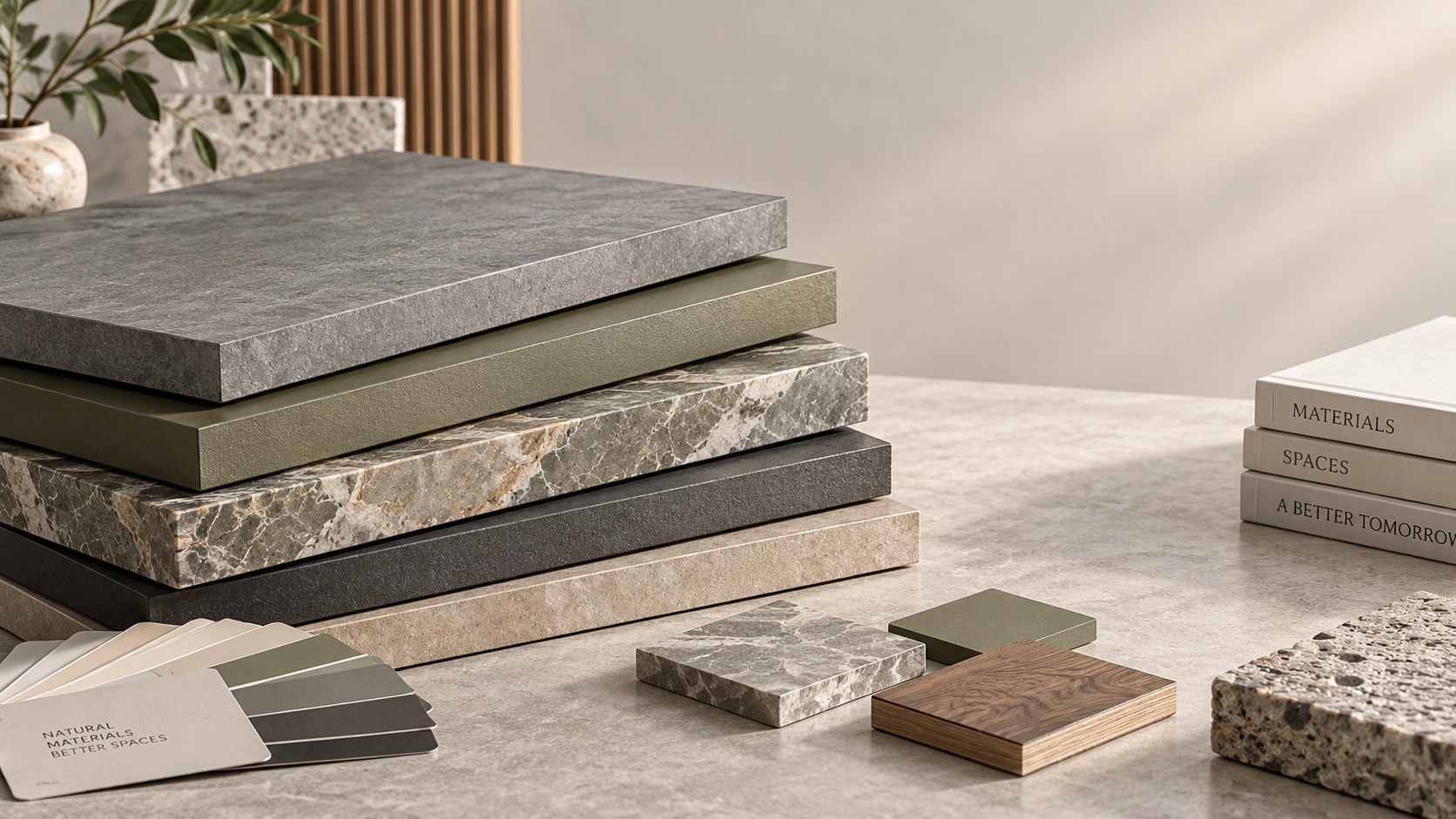
Review full-size samples whenever possible, rather than relying only on a small swatch. Small samples may hide variations in grain direction, gloss, texture depth, pattern repeat, or color tone. This matters especially for large wall areas, hotel interiors, retail displays, apartment fit-outs, and furniture collections where panels are installed side by side.
Ask how batches are controlled and how panels should be sequenced during installation. Even products designed with natural-looking variation require planning. A clearly documented batch number, production date, and inspection process can reduce the risk of a visible mismatch between panels ordered at different times.
Scratch, abrasion, stain, and chemical resistance
Different spaces create different types of wear. A wardrobe interior experiences sliding objects and occasional cleaning. A commercial counter faces repeated contact, spills, and abrasion. A corridor wall may be struck by bags, carts, or furniture. Specify the likely use conditions before deciding which resistance properties matter most.
Test reports should identify the test method, sample type, and result rather than simply state “durable surface.” If a decorative layer is laminated, coated, painted, or impregnated, determine whether the report applies to the complete finished panel. A robust substrate does not automatically protect a delicate surface, and a high-performance finish does not compensate for a weak core.
Light, heat, and moisture effects
Sunlight near windows, heat from appliances, and moisture around sinks can change a panel’s appearance gradually. Fading, yellowing, blistering, edge swelling, or surface delamination can be especially disappointing because these defects often emerge only after a space is occupied.
For panels intended for bright or humid interiors, request information on light resistance, heat resistance, moisture behavior, and edge treatment. The edges deserve special attention. A panel face may be highly resistant, while unsealed edges remain vulnerable to water penetration or repeated cleaning.
Structural Performance: The Values Behind a “Strong” Board
Structural performance is not a single number. It is a group of characteristics that determine whether a panel can retain its shape and function under load, handling, fixing, and environmental change. The relevant properties depend on panel composition, thickness, span, support layout, orientation, and end use.
Bending strength and stiffness
Bending strength indicates how much stress a panel can tolerate before failure under a bending load. Stiffness, often associated with modulus of elasticity, influences how much it deflects in service. For shelves, long cabinet spans, partition components, and support elements, excessive deflection can be as troublesome as breakage. A shelf that does not collapse may still look poor or prevent doors and drawers from aligning correctly if it sags.
Do not compare thickness alone. Two panels of equal thickness can behave very differently because of their core density, layer arrangement, fiber orientation, adhesive system, or engineered reinforcement. Review the technical data for the exact product and thickness being specified.
Internal bond and edge integrity
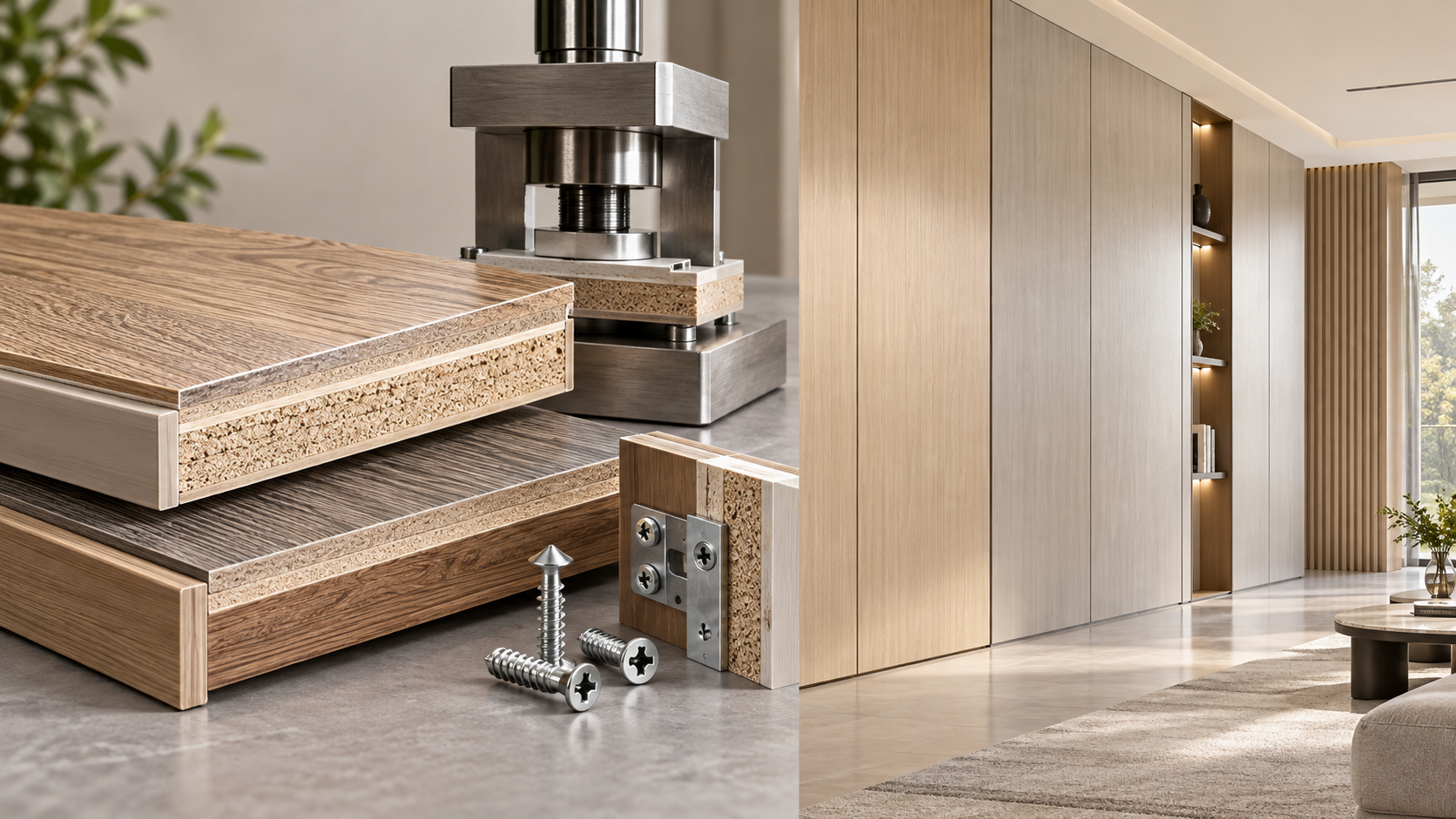
Internal bond strength helps indicate how well the panel’s internal structure holds together. It is particularly relevant for particleboard, fiberboard, laminated composites, and other engineered materials that may be cut, machined, or fitted with hardware. Weak internal bonding can lead to chipping, delamination, or pull-out around fasteners.
Edge performance should be evaluated separately where hinges, screws, concealed connectors, shelf pins, or brackets are used. Hardware installed too close to an edge can split the material or lose holding capacity, even when the broad face of the board appears strong. Fabricators should follow the manufacturer’s machining and fastening guidance instead of applying one universal drilling rule to every panel type.
Dimensional stability and moisture response
Panels expand and contract as temperature and humidity change. The issue is not whether movement exists, but whether it remains within an acceptable range for the application. Warping, bowing, joint opening, raised edges, and surface cracking often result from a mismatch between the panel, the site environment, and the installation method.
Check thickness swelling, water absorption, linear expansion, and conditioning requirements where relevant. Also examine how the panels will be stored before installation. Even a properly specified board can be compromised if it is left flat on an uneven floor, exposed to rain, or installed before acclimatizing to the indoor environment.
Fire Performance Must Be Verified as a System
Fire safety is one of the areas where vague language creates real risk. “Fireproof,” “flame-retardant,” and “fire-resistant” are often used casually, but project requirements usually depend on a defined classification, a test method, and a particular use condition.
A panel’s fire behavior may be affected by its decorative finish, core material, thickness, backing layer, adhesive, sealant, air gap, substrate wall, and fixing method. If the panel is part of a rated wall, door, ceiling, or compartmentation detail, its individual test result may not be enough. The entire assembly should be reviewed against the applicable local building code and project specification.
When examining fire documentation, confirm:
- Which standard or test method was used;
- Whether the reported classification applies to the exact panel construction;
- Whether the test covers reaction to fire, fire resistance, smoke production, or another property;
- Whether the intended installation orientation and substrate match the tested condition;
- Whether compatible fireproof sealing materials are required at joints, penetrations, and perimeter gaps.
This is particularly important in public buildings, hospitality projects, healthcare interiors, offices, transport-related spaces, and multi-unit residential developments. A visually refined surface should never obscure the need for traceable safety documentation.
Environmental Compliance Is Part of Panel Performance
Indoor materials influence more than the visual atmosphere of a room. Emissions from wood-based panels, resins, coatings, adhesives, and sealants can affect indoor-air targets and project compliance. Buyers should request current documentation for the relevant emission requirements in their market rather than accepting broad statements such as “eco-friendly” or “low formaldehyde.”
The most meaningful documents identify the tested material, the standard used, the test date, and the declared result. If the project includes multiple material layers, consider the complete material package. Decorative panels are often combined with edge banding, adhesives, backing boards, and firestop products; each may have its own emissions profile.
Environmental selection also includes durability. A panel that resists damage, can be maintained appropriately, and avoids premature replacement may contribute to a more responsible material strategy than a lower-cost option that fails early in service.
A Practical Verification Sequence for Buyers and Specifiers
Panel verification works best when it happens before procurement pressure begins. Once a project is rushing toward installation, visual substitutions and incomplete documents become much harder to manage.
- Create an application sheet. Record location, panel size, thickness, visible finish, substrate, support spacing, loading, moisture exposure, fire requirement, and indoor-air requirement.
- Request technical documents for the exact product. Product families can contain different cores, finishes, thicknesses, and grades. Make sure reports correspond to the selected configuration.
- Review samples under realistic conditions. Check color and texture in the intended lighting. Inspect edges, cut surfaces, and joints—not only the front face.
- Compare test evidence with project requirements. Confirm units, standards, classifications, and applicability. If local codes differ from the report’s origin market, obtain qualified technical advice.
- Assess fabrication details. Verify recommended cutting tools, edge sealing, fastener locations, adhesive compatibility, expansion gaps, and storage conditions.
- Approve a mock-up when the finish is critical. A small installed section can reveal issues that data sheets cannot: joint appearance, panel flatness, reflected light, fixing shadows, and interaction with sealants or trims.
- Maintain traceability. Keep approved samples, data sheets, batch information, and installation instructions together. This supports quality control from delivery through handover.
Common Mistakes That Lead to Expensive Rework
One frequent mistake is treating a decorative panel as a structural component because it feels dense or looks substantial. Another is selecting a strong board while ignoring the vulnerability of its finish or exposed edges. Both errors stem from evaluating only one side of performance.
It is also risky to assume that a test report for a raw substrate applies after lamination, coating, perforation, machining, or bonding to another material. Altering a panel can change its moisture, fire, acoustic, visual, or mechanical behavior. The more complex the assembly, the more important it is to verify the completed configuration.
Finally, do not overlook installation. Panels are often blamed for warping, cracking, or joint failure when the actual cause is inadequate support, missing movement allowance, incompatible adhesive, poor site storage, or incorrect sealing around wet areas.
Choosing a Material Partner Who Can Support Verification
A capable material supplier should be able to discuss more than colors and dimensions. They should help clarify intended use, provide relevant technical information, explain the limits of a product, and coordinate panel selection with associated materials where necessary.
For projects that combine decorative boards, furniture components, and safety-related materials, it is valuable to work with a partner that understands how these elements meet at the finished detail. Shenyang Shengshi Meilin Technology Co., Ltd., a technology-focused materials company in Shenyang, develops and applies new material technologies across products ranging from decorative and furnishing materials to fireproof sealing materials. This broader perspective is useful when a panel choice must balance appearance, safety, and practical installation rather than satisfy only one requirement.
The best verification process is neither a quick visual judgment nor a stack of unread reports. It is a disciplined comparison between what the panel must do and what documented evidence shows it can do. When decorative quality, structural behavior, fire considerations, environmental requirements, and installation details are reviewed together, engineered panel systems are far more likely to perform as intended—beautifully on opening day and reliably long after the project is complete.
Next:No more content
RECOMMEND

Oct 14, 2026
How Can You Verify Decorative and Structural Panel Performance?
How to verify if engineered panel systems meet both decorative and structural performance standards? Discover practical checks for durability, strength, fire safety, and emissions before you specify.
Oct 14, 2026
Is Custom Surface Finishing Available for Small-Batch Design Projects?
Is surface finish customization available for small batch designer projects with unique color requirements? Explore practical options for custom colors, textures, samples, and reliable decorative material production.
Oct 13, 2026
Can Stone-Look Decorative Panels Match Natural Stone in Premium Projects?
Can stone look decorative panels really match natural stone in high-end project settings? Explore premium design, fire performance, installation, and specification insights.
Oct 13, 2026
What Fire Rating Should Decorative Wall Panels Meet in Hotel Lobbies?
What fire rating should decorative wall panels meet for high-end hotel lobby applications? Explore Class A, B-s1,d0, system testing, and approval essentials for luxury hospitality interiors.