

How to assess veneer consistency in custom veneer panels
A veneer panel can look acceptable in a showroom and still create serious problems once it reaches a project site. Under raking light, a slight shift in grain direction becomes obvious. Across a large wall, small color differences can read as separate batches. In fire-rated interiors, an attractive face layer is not enough if the core, adhesive system, edge treatment, or documentation does not support the specified safety performance.
For quality-control and safety teams, assessing consistency in Custom Veneer Panels is therefore more than a visual approval exercise. It is a controlled review of appearance, construction, bonding, dimensions, traceability, and intended service conditions. The objective is simple: panels that are approved as a set should perform and present themselves as a set after cutting, installation, and long-term use.
The most reliable approach begins before the first panel is unpacked. A clear inspection standard, a retained approval sample, and a defined batch-identification process give inspectors a practical basis for making decisions when natural material variation is unavoidable.
Consistency begins with defining what “acceptable variation” means
Natural wood veneer is not a printed surface. Differences in mineral streaks, pore structure, grain spacing, knots, figure, and tone are part of its character. Trying to eliminate every variation can lead to unnecessary rejection of usable material. On the other hand, treating every variation as “natural” can leave the installer trying to solve an avoidable visual mismatch on site.
Before production approval or incoming inspection, the project team should agree on the intended visual effect. Is the design meant to be calm and uniform, strongly figured, rustic, quarter-cut, crown-cut, or deliberately mixed? Is the veneer book-matched, slip-matched, random-matched, or sequence-matched? These choices determine what the inspector should look for.
A useful approval reference should identify:
- Species, cut, grade, and finish level;
- Expected color range under the project’s lighting conditions;
- Grain direction and matching method;
- Whether consecutive panels must follow a sequence;
- Permitted natural features, such as pin knots or mineral marks;
- Panel orientation for installation;
- Any exclusions, including sapwood, open knots, patched areas, or abrupt tone changes.
This reference is especially important for large custom runs. A single sample may show the desired color but fail to explain how adjacent sheets should relate to one another. Whenever possible, approve a larger layout or a representative panel set rather than relying only on a small hand sample.
Inspect the face as an installed surface, not as an individual board
A frequent inspection mistake is judging each sheet separately. Custom veneer panels may individually meet a basic appearance threshold while still looking uneven when installed in a continuous elevation. The eye naturally compares neighboring panels, especially on reception desks, hotel corridors, lift lobbies, feature walls, cabinetry, and door sets.
Place panels vertically or in their proposed installation order, then inspect them from a normal viewing distance and at an oblique angle. A broad, even light source reveals overall color balance; raking light makes ripples, sanding defects, telegraphing, and surface irregularities easier to see. It is also wise to inspect under lighting close to the final environment. Warm decorative lighting can reduce some tonal contrasts, while cool daylight can make them more pronounced.
Grain alignment and matching
Grain continuity should be checked both within each panel and across the panel layout. In book-matched veneers, consecutive leaves should mirror each other around the joint. In slip-matched construction, leaves should progress in sequence without the mirrored pattern. Neither method is automatically better; the issue is whether the delivered appearance matches the approved matching method.
Look closely at veneer joints for irregular spacing, sudden grain interruption, overlap, gaps, or a change in leaf order. A joint may be structurally sound but still visually distracting if the grain rhythm breaks in the center of a prominent wall panel. For sequence-matched projects, verify labels against the shop drawing or packing schedule before panels are separated for fabrication.
Color and sheen variation
Color should be assessed across the full batch, not only against one approved sample. Separate panels into a visual sequence and identify abrupt transitions. Some variation can often be managed by moving a darker panel to a less prominent area, but this should be a controlled disposition, not an improvised site decision.
Color is only part of the picture. Veneer may appear inconsistent because of uneven stain absorption, sanding differences, coating thickness, gloss variation, or substrate influence. Check whether the apparent mismatch changes with viewing angle. If it does, the concern may be sheen or surface flatness rather than the wood itself.
Inspectors should also distinguish between natural oxidation potential and present-day mismatch. Many species deepen or shift in tone after exposure to light. Where a project requires a closely controlled appearance, panels should be stored consistently and protected from uneven sunlight before installation.
Construction quality: the panel must be consistent below the veneer
The face veneer is only one layer in a composite product. The substrate, balancing layer, adhesive, edge construction, and finishing process all influence stability and safety. A visually attractive panel that warps, delaminates, or opens at the edges is not a consistent panel in any meaningful project sense.
Thickness, squareness, and flatness
Measure thickness at several points: near corners, along edges, and around the center. A single reading can miss local variation caused by pressing, substrate unevenness, or sanding. Compare results with the project tolerance and record the measuring tool used. Thickness control matters where panels meet reveals, hardware, trims, fire doors, or neighboring cladding materials.
Check length, width, diagonal difference, and edge straightness as well. Out-of-square panels may create widening joints or force installers to trim more material than planned, which can disrupt a sequence match. Flatness should be evaluated after the panel has acclimatized to the inspection environment. A panel taken from a cold or humid delivery vehicle may temporarily behave differently from one stabilized indoors.
Bond integrity and delamination risk
Bonding quality deserves close attention because early-stage defects can be subtle. Examine the surface and edges for bubbles, blisters, loose veneer, adhesive starvation, excessive glue bleed-through, or areas that sound hollow when lightly tapped. A hollow sound is not, by itself, proof of failure, but it is a reason to isolate the area for further review.
Edge inspection is particularly valuable. The edge often reveals whether the veneer is fully supported and whether the assembly is vulnerable to moisture ingress. Where the panel will be machined, routed, drilled, or exposed to changing humidity, the supplier and project team should agree on suitable test methods and acceptance criteria before the run is released.
Do not overlook the reverse face. A balanced construction is commonly used to reduce differential stresses. If the backing material, moisture condition, or adhesive behavior differs significantly from the face-side assembly, panels may distort after installation even if they appeared flat during incoming inspection.
Safety review should follow the actual application
Safety managers often receive a product description that focuses on surface appearance while the project specification concerns a complete installed system. These are not the same thing. Fire performance, smoke behavior, emissions, moisture resistance, and durability can depend on the full construction: veneer, substrate, adhesive, coating, edge treatment, mounting method, and cavity conditions.
For panels intended for fire-sensitive areas, verify that the evidence supplied applies to the exact or appropriately representative product configuration. A test report for a different thickness, substrate, coating, or installation arrangement may not answer the project’s requirement. Review the relevant jurisdictional code, project specification, and test documentation with the responsible compliance team rather than assuming that “fireproof” is a universal product category.
Material emissions should also be considered where panels are used in occupied interiors, particularly healthcare, education, hospitality, and residential environments. Ask for documentation relevant to the selected board, adhesive, and finish—not merely the decorative veneer. Safe handling during cutting and installation matters too: dust extraction, appropriate personal protective equipment, safe storage, and controlled use of coatings or sealants should be part of the site plan.
A practical lot-inspection workflow for Custom Veneer Panels
Consistency is easier to protect when inspection happens at several decision points instead of only at final delivery. The following workflow can be adapted to project scale and risk level.
- Review the approved control sample and specifications. Confirm the visual standard, dimensions, substrate, finish, matching plan, and compliance requirements.
- Verify identification and traceability. Check order number, batch or lot information, panel sequence labels, and packing records. Keep sequence-matched bundles intact until layout review.
- Condition the material. Allow panels to stabilize in a suitable indoor environment before final flatness and appearance judgement.
- Conduct a layout inspection. View a meaningful number of panels together, particularly those intended for one elevation or furniture assembly.
- Measure and examine construction. Record dimensional checks, inspect edges, review surface defects, and identify any bond concerns.
- Segregate nonconforming material immediately. Mark, photograph, and document the issue without mixing questionable panels back into approved stock.
- Decide disposition before installation. Rework, reallocate, replace, or accept with a documented concession only after responsible parties agree.
Sampling plans should reflect consequence, not only quantity. A small batch for a high-visibility executive suite may require closer review than a larger batch used in low-visibility utility joinery. Likewise, a panel system specified for regulated spaces deserves more rigorous document control than a decorative element with limited safety implications.
Common judgement errors that create avoidable claims
One error is approving veneer under one light source and rejecting it under another. Define the inspection lighting conditions where visual matching is critical. Another is comparing panels from different production lots without considering their intended location. Material from separate lots may be usable, but it should not be assumed interchangeable for a continuous run.
There is also a tendency to focus on the most visible face and ignore packaging, storage, and handling. Veneer panels should be protected from direct moisture, excessive heat, uneven exposure, and edge impacts. Poor storage can create defects after factory inspection, leading to disputes over whether the inconsistency originated in manufacturing or on site.
Finally, avoid treating appearance approval as proof of compliance. A beautifully matched panel set may still need separate confirmation of fire-related requirements, substrate suitability, and emission documentation. Visual quality and safety assurance should meet at the same release decision, but they should be verified through their own evidence.
From inspection records to more dependable material decisions
Good records make recurring issues easier to identify. Photographs taken in consistent lighting, dimensional logs, batch references, defect maps, and corrective-action notes can reveal patterns that memory cannot. They also give procurement, production, installation, and safety teams a shared language when a decision must be made quickly.
Shenyang Shengshi Meilin Technology Co., Ltd. approaches decorative material development through the connected priorities of innovation, quality, service, environmental consideration, and safe interior use. For project teams, that broader view is valuable: selecting a finish should involve not only its visual character, but also how it will be fabricated, installed, maintained, and assessed within the finished space.
When a design calls for a coordinated decorative accent beyond natural wood veneer, reviewing surface samples alongside the approved panel layout can help maintain a coherent material palette. The Embossed Metal-Metal Stripe Coffee Gold finish may be considered as a complementary element where warm metallic texture and controlled visual rhythm are required. In every case, retain samples, confirm the intended application, and evaluate the complete assembly before release.
RECOMMEND

Oct 15, 2026
Composite Decorative Panels: How Core and Bond Quality Affect Delamination
Composite Decorative Panels: Learn how core strength, bond quality, and moisture affect delamination—and what to check before buying for lasting performance.

Oct 15, 2026
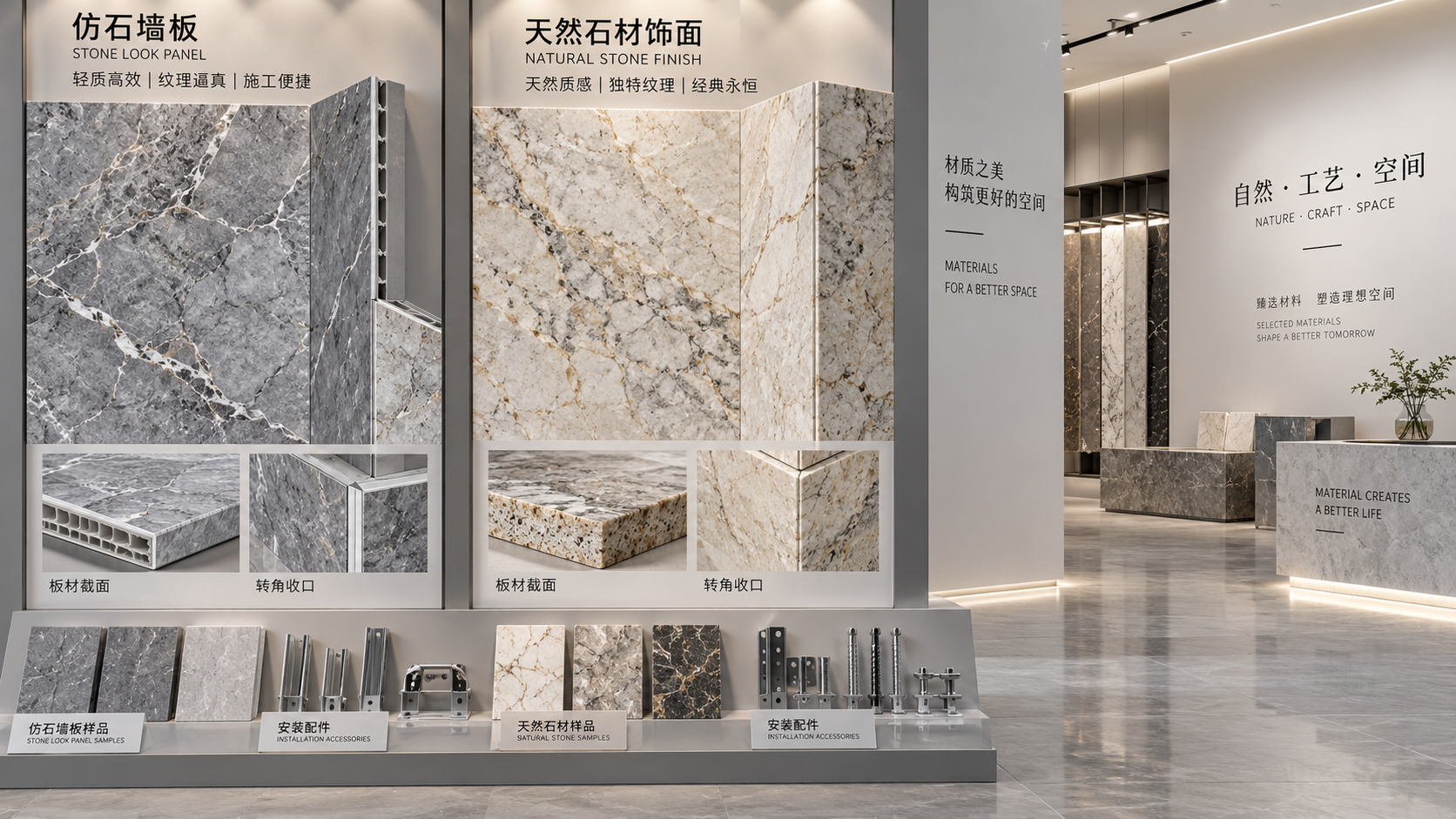
Do Stone-Look Wall Panels Cost Less Than Real Stone Cladding?
What is the minimum order for custom decorative panels? Compare stone-look panels with real stone cladding, uncover installation costs, and find the best value for your project.
Oct 15, 2026
Can Decorative Wall Cladding Panels Be Used in Wet Areas?
Can decorative wall cladding panels be used in wet areas? Discover approved options, shower suitability, and sealing essentials to choose confidently and avoid costly moisture damage.
Oct 14, 2026
How Can You Verify Decorative and Structural Panel Performance?
How to verify if engineered panel systems meet both decorative and structural performance standards? Discover practical checks for durability, strength, fire safety, and emissions before you specify.