Composite Decorative Panels: How Core and Bond Quality Affect Delamination
Delamination in composite decorative panels occurs when a bonded interface separates or the core itself breaks beneath the facing. These failures can look similar, but they require different corrective actions. A stronger adhesive may help with poor adhesion; it will not repair a weak core, prevent excessive moisture movement, or compensate for an unsuitable panel construction.
A smooth, consistent surface therefore provides limited evidence of long-term durability. Reliable assessment depends on three connected questions: where separation occurs, what stresses develop during service, and whether the complete panel retains adequate strength after exposure to those stresses. Core density and initial bond strength matter, but neither should be treated as a standalone measure of delamination resistance.
Start by identifying the failure plane
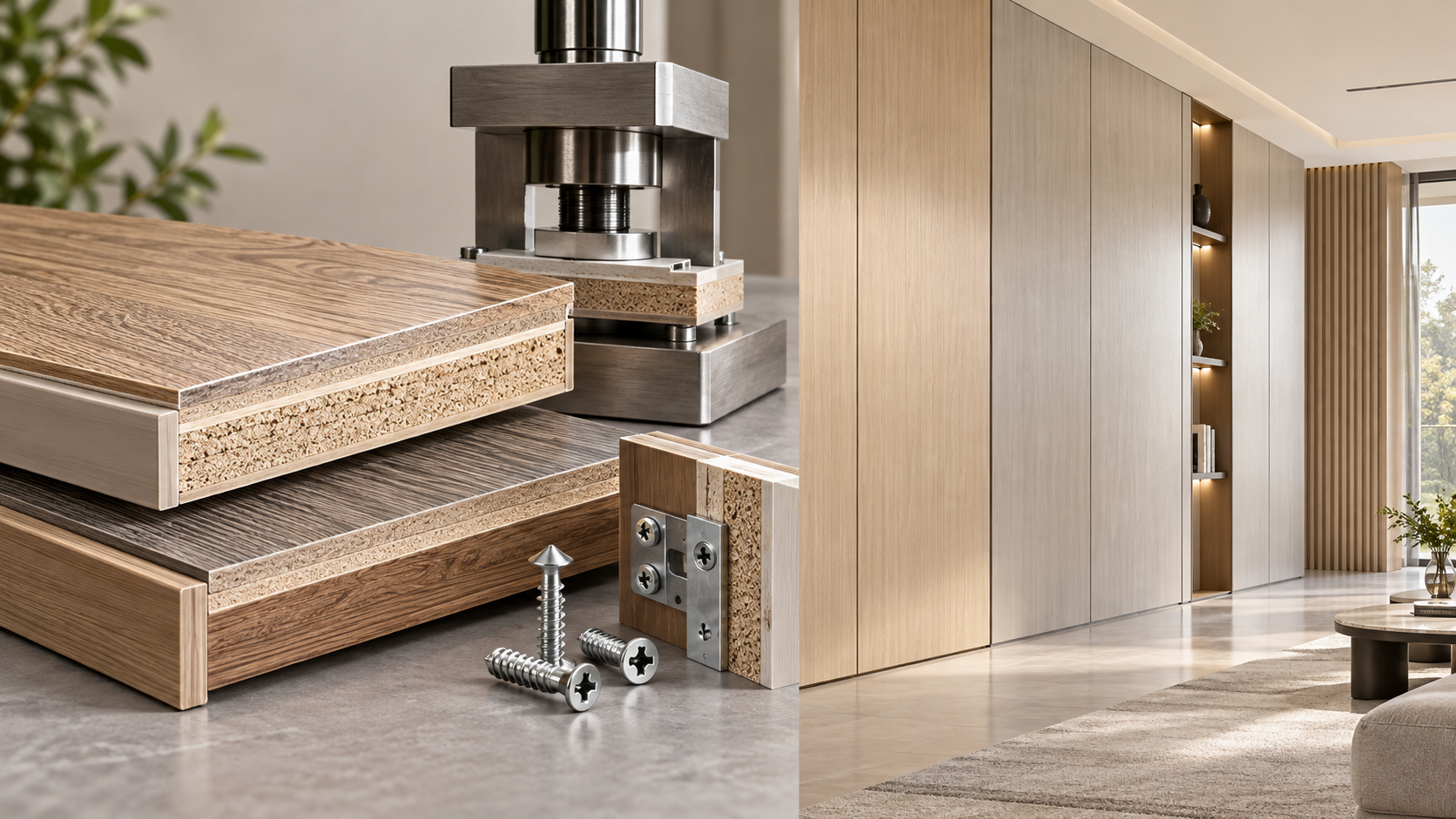
A decorative panel may contain a facing, adhesive, substrate, backing layer, and surface treatments. Separation can occur between any two layers or within one of them. Examining both sides of a failed specimen helps distinguish an adhesion problem from a material-strength problem.
These observations guide investigation; they do not establish the cause by themselves. Thin adhesive residues can be difficult to see, and a specimen may show several failure modes. Record the approximate distribution of each mode alongside the measured strength. A change from core failure before conditioning to clean interface separation afterward can reveal deterioration that a strength value alone does not explain.
Core density matters through structure and consistency
For wood-based cores, average density influences how much solid material supports the bonded surface. However, panels with similar average density can have different surface density, particle distribution, internal bonding, and thickness profiles. A dense surface over a weak inner layer may provide good initial adhesion while allowing separation slightly below the bond line.
Porous surfaces also affect adhesive application. Some penetration helps establish contact with the substrate, but excessive absorption can leave too little adhesive at the interface. Conversely, a compact or poorly wettable surface may prevent adequate contact. The appropriate adhesive spread and application method must match the actual core surface.
Surface strength deserves separate attention. Sanding dust, loose fibers, friable mineral particles, or weak surface skins can become the layer to which the adhesive bonds. The adhesive may adhere successfully to that layer while the layer detaches from the rest of the board. Cleaning helps remove loose contamination, but it cannot restore a substrate whose surface lacks sufficient cohesion.
Density has different implications in other constructions. Foam cores require attention to cell structure, skin condition, and resistance to local crushing. Honeycomb panels depend on bonding at the cell edges and adequate support beneath the facing. Mineral-based cores need assessment of surface friability and moisture response. Comparing these materials using density alone overlooks how each transfers load.
Moisture movement can defeat an initially strong bond
Moisture affects both material strength and dimensional stability. A wood-based core may swell as it absorbs moisture, while a decorative laminate, metal facing, or polymer film responds differently. Because the layers are bonded together, this unequal movement generates stresses at the interface, particularly near edges, corners, openings, and existing defects.
A moisture-resistant adhesive does not make the entire panel moisture-resistant. Water can enter through unsealed edges, drilled holes, joints, or the reverse face. If the core swells or loses cohesion, the facing may separate even when the adhesive retains much of its strength.
The exposure pattern matters as much as the presence of moisture. A panel beside a washbasin may experience repeated edge wetting and drying. A wall panel in a humid room may absorb moisture gradually through its backing. These conditions create different stress distributions, so a single short immersion test may not represent either application well.
Check moisture condition at manufacture as well. Bonding a damp core can interfere with some adhesive systems or trap moisture beneath a relatively impermeable facing. Subsequent drying may cause shrinkage and distortion. Moisture levels should be compatible with the adhesive process and the expected installation environment.
Facing and backing construction also influence panel balance. Layers with substantially different stiffness or moisture response can encourage bowing when environmental conditions change. A suitable balancing layer can reduce distortion, but its effectiveness depends on the complete construction, including layer thicknesses, adhesive, and processing.
Bond quality depends on compatibility and process control
Adhesive selection begins with the materials being joined and the intended exposure. An adhesive that bonds well to a porous wood substrate may perform differently against a coated film, metal sheet, or treated mineral surface. Some facings require a compatible primer or surface treatment to achieve reliable adhesion.
Good wetting means the adhesive makes intimate contact with the bonding surfaces. Dust, oil, release agents, incompatible coatings, and surface treatments can interrupt that contact. Increasing adhesive quantity does not reliably solve contamination or chemical incompatibility.
The cured adhesive must also accommodate the stresses of the construction. A rigid bond may transfer differential movement into a weak core or interface. A more flexible system may accommodate movement but still needs sufficient strength and resistance to creep under sustained loading. “Flexible” and “strong” are useful descriptions only when tied to the application.
Manufacturing conditions determine whether the selected adhesive achieves its intended properties. Mixing ratio, application quantity, open time, assembly time, pressure, temperature, and cure duration can all matter, depending on the chemistry. Pressure must establish contact without excessively squeezing out adhesive or crushing a vulnerable core.
Uneven cure is another source of hidden weakness. In heated pressing, conditions at the bond line can differ from the press settings. Thick panels, variable core moisture, and uneven heat transfer may affect cure across the sheet. Some adhesive systems also require a defined period after pressing before machining or loading.
Process records should therefore connect production settings to finished-panel performance. A nominal adhesive specification offers little assurance if spread, contact, or cure varies between batches.
Choose tests that reveal the relevant weakness
No single bond test fully describes delamination resistance. A useful test program combines mechanical measurements, inspection of the failure surfaces, and environmental conditioning suited to the intended use.
A tensile test perpendicular to the panel surface can reveal weakness through the thickness. Depending on specimen preparation and the test method, it may assess the core’s internal bond or the strength of an attached facing. Those are related but distinct properties. The report should identify which layers were loaded and where failure occurred.
Peel testing is useful when a facing can bend sufficiently to be peeled from the substrate. It concentrates stress near an advancing separation front, making it relevant to edge lifting. However, facing stiffness, thickness, peel angle, and test speed influence the result. Peel values from different constructions or procedures should not be treated as directly equivalent.
Shear testing evaluates resistance to sliding between bonded layers. It can help assess stresses caused by differential movement, although specimen geometry and load application affect interpretation. Where sustained stress is relevant, a short strength test should be supplemented by an assessment of creep or time-dependent deformation.
Repeat appropriate measurements after conditioning. Depending on service conditions, this may include humidity exposure, wetting and drying, thermal cycling, or a combination. Measure visible separation, blistering, thickness change, and warpage as well as retained strength. Allow specimens to recover only as specified by the chosen procedure; drying can change both appearance and measured performance.
Sampling should include sheet edges and central regions, with specimens from more than one production batch where consistency is being assessed. Testing only convenient, defect-free pieces can miss uneven adhesive distribution or localized processing problems.
Read test reports as evidence for a particular construction
A report stating “bond strength passed” is incomplete without the test method, specimen construction, conditioning, loading procedure, acceptance criterion, and failure mode. Results apply to the tested assembly. Changing the core, facing, adhesive, backing, or thickness may change performance even when the decorative appearance remains identical.
Use a recognized method appropriate to the panel type and property being assessed. Tests intended for wood-based boards, sandwich constructions, and flexible laminates may load specimens differently. A numerical result is meaningful only within that method and its stated conditions.
Acceptance criteria should come from the applicable product specification, project requirements, or a documented qualification plan. There is no useful universal delamination threshold for every composite decorative panel. Different applications expose the bond to different combinations of moisture, temperature, movement, and mechanical load.
Other performance claims answer separate questions. Fire classification, emissions testing, and surface abrasion resistance do not establish bond durability under humid or heated conditions. They may all be necessary for a project, but each needs evidence appropriate to the property it describes.
When reviewing a decorative option such as Fabric Grain-MLBW042, assess the proposed finished assembly alongside the visual selection. The finish name does not establish core composition, adhesive chemistry, or delamination resistance. Request construction details and test evidence for the panel configuration intended for supply.
Turn the findings into a purchasing and installation decision
A practical specification should describe the complete panel build and its service environment. “For interior use” is too broad to distinguish a dry furniture application from a humid washroom or a surface exposed to concentrated heat.
Before approving a panel, establish:
- The core type, facing and backing construction, adhesive system, and nominal thickness.
- The expected humidity, wetting, temperature changes, and sustained mechanical stresses.
- The required test procedures, conditioning, acceptance criteria, and reporting of failure modes.
- The edge treatment, machining, storage, acclimatization, and installation requirements.
- The production changes that require renewed assessment.
Installation details belong in this decision because they change exposure and stress. An unprotected cut edge can bypass the protection offered by the facing. Unsupported areas, tightly restrained movement, or unsuitable fixing arrangements can concentrate loads. Evaluate the panel with the joints, cutouts, and attachment method it will actually use.
If separation is already present, preserve both failure surfaces and record its location before cleaning or repair. Edge-originated damage after wetting warrants a different investigation from widespread separation on newly delivered sheets. Compare affected and unaffected areas with the production records and exposure history.
Approve the construction when the core remains sufficiently cohesive, the bond retains adequate performance after relevant conditioning, and installation details control the expected stresses. If testing shows core failure at an unacceptable load, improve the substrate. If it shows interface failure, address compatibility and processing. The corrective action should follow the observed weakness rather than defaulting to a stronger adhesive.
Next:No more content
RECOMMEND

Oct 15, 2026
Composite Decorative Panels: How Core and Bond Quality Affect Delamination
Composite Decorative Panels: Learn how core strength, bond quality, and moisture affect delamination—and what to check before buying for lasting performance.

Oct 15, 2026
Do Stone-Look Wall Panels Cost Less Than Real Stone Cladding?
What is the minimum order for custom decorative panels? Compare stone-look panels with real stone cladding, uncover installation costs, and find the best value for your project.
Oct 15, 2026
Can Decorative Wall Cladding Panels Be Used in Wet Areas?
Can decorative wall cladding panels be used in wet areas? Discover approved options, shower suitability, and sealing essentials to choose confidently and avoid costly moisture damage.
Oct 14, 2026
How Can You Verify Decorative and Structural Panel Performance?
How to verify if engineered panel systems meet both decorative and structural performance standards? Discover practical checks for durability, strength, fire safety, and emissions before you specify.