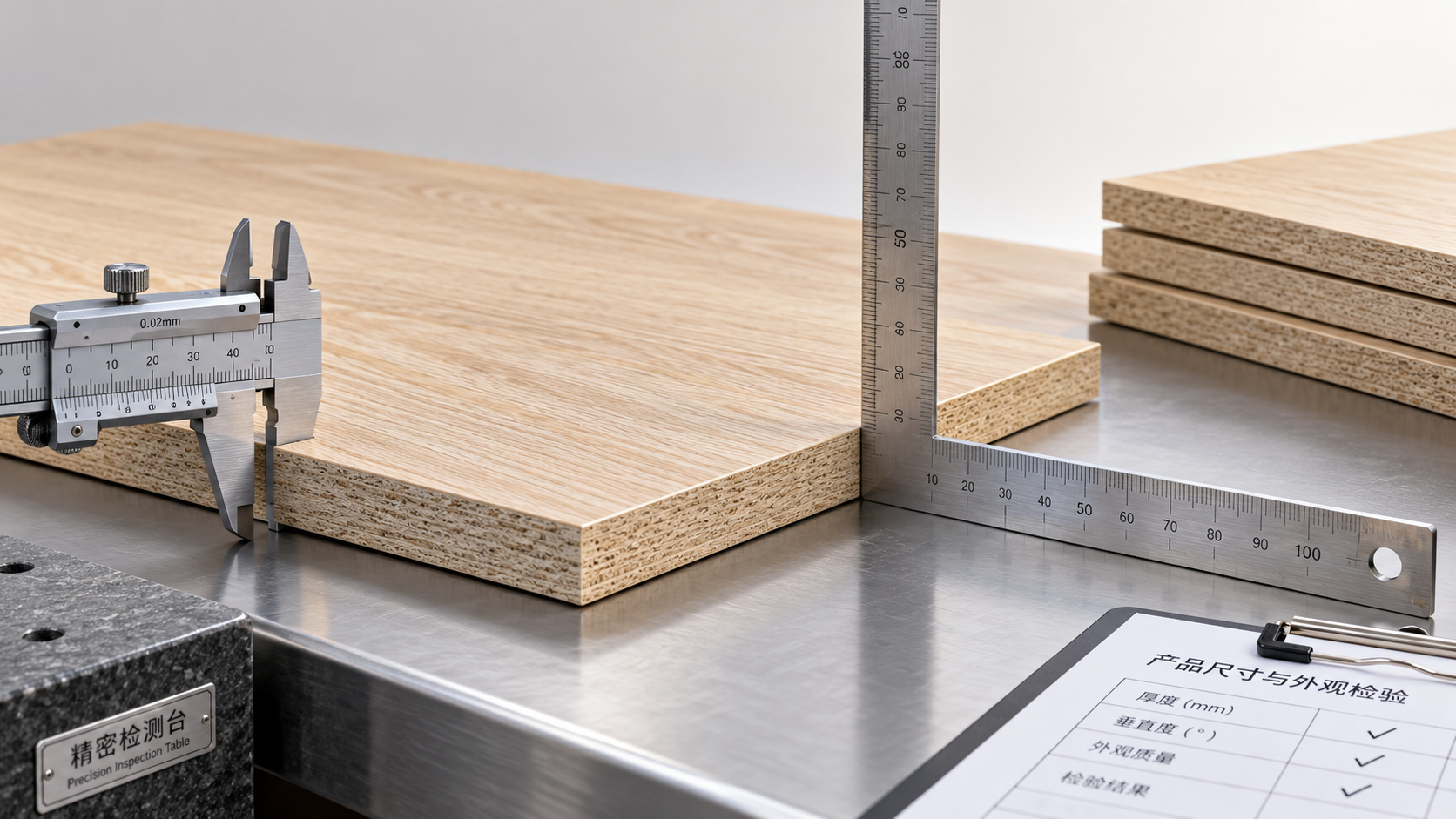
What Tolerances Can Cut-to-Size Panel Processing Achieve?
A decorative wall can look perfectly aligned on a drawing and still develop uneven joints during installation. Sometimes the problem begins with cutting accuracy. In other cases, accurately cut panels change dimension during storage, or the supporting wall is not as straight as expected. Understanding the difference can prevent expensive recutting—and the frustration of discovering that a neat factory finish does not automatically produce a neat installed surface.
So, what tolerances can cut-to-size panel processing achieve? Controlled factory processing can often work within fractions of a millimeter, but the achievable specification depends on the panel material, dimensions, equipment, and inspection method. For buyers also asking “how long do composite wall panels last in humid climates,” the discussion must include moisture resistance and dimensional stability, not just the accuracy of the original cut.
What is a realistic tolerance for cut-to-size decorative panels?
There is no single tolerance that applies to every decorative panel. A compact, rigid board cut under stable factory conditions behaves differently from a long, flexible composite panel with a textured surface or moisture-sensitive core.
For early procurement discussions, the following ranges can help frame the conversation. They are illustrative specification bands, not universal industry standards or verified capabilities of any particular supplier.
A supplier should confirm the actual tolerance against your drawing and material before production. Machine positioning accuracy alone is not proof that finished panels will meet the same tolerance.
For example, a nominal width of 600 mm with a tolerance of ±0.5 mm allows an accepted panel to measure between 599.5 and 600.5 mm. Two accepted panels can therefore differ by 1 mm. Whether that difference matters depends on the joint design and installation method.
Does “cutting tolerance” cover everything that affects fit?
No. Length and width are only part of the picture. A panel can meet both dimensions yet fit poorly because it is out of square, bowed, or damaged along its visible edges.
- Length and width tolerance
- The permitted difference between the specified dimension and the measured finished dimension.
- Squareness
- How closely adjacent edges form a right angle. Poor squareness can create tapered joints even when edge lengths are acceptable.
- Edge straightness
- Whether a cut edge follows a straight line rather than curving or wavering.
- Flatness and bow
- How much the panel departs from a defined plane under specified support conditions.
- Edge quality
- The condition of the cut surface, including chips, burrs, delamination, and damage to decorative coatings.
Thickness variation deserves separate attention. Cut-to-size processing normally changes length and width; it does not automatically correct thickness differences in the original board. On a wall with grazing light, a small face-height difference can be more noticeable than a slightly wider joint.
Specify the characteristics that affect the finished appearance rather than relying on a general request for “high precision.”
Why does panel composition change the achievable accuracy?
The term “composite panel” describes many constructions, not one predictable material. The core, facing, reinforcement, and bonding system all influence cutting behavior.
Wood-based panels can be machined accurately, but moisture absorption may change their dimensions afterward. Exposed edges are especially important where the core is moisture-sensitive. A decorative face does not necessarily make the whole panel water-resistant.
Wood-plastic and other polymer composites may offer useful moisture resistance, depending on formulation. However, thermal expansion, internal stresses, and cutting heat can affect finished size. Some profiles also behave differently along and across their length.
Mineral-filled boards can provide rigidity, but brittle edges may chip without appropriate tooling and support. Their moisture behavior depends on the binder and composition; “mineral” should not be treated as a blanket guarantee of stability.
Laminated or sandwich panels introduce another consideration: the layers may respond differently to heat or humidity. Unbalanced construction can contribute to bowing, while weak bonding can lead to edge separation.
Ask about the exact panel construction and intended application. The relevant question is not simply whether the material can be cut accurately, but whether it will remain suitable between machining, delivery, and installation.
Will CNC cutting always produce tighter tolerances than a panel saw?
Not necessarily. CNC routers are valuable for shaped profiles, openings, repeatable hole positions, and complex machining. A well-maintained panel saw can be highly effective for straight rectangular cuts, particularly when the board is supported and clamped correctly.
Accuracy depends on the full processing setup: tool condition, alignment, feed rate, workpiece restraint, calibration, and operator control. A worn router bit or poorly supported sheet can undermine the benefits of a sophisticated machine.
Thin or flexible panels are particularly sensitive to holding conditions. If a panel bends during processing, its measured shape may change when released. Laminated boards may need scoring or suitable cutting tools to preserve the decorative face.
A useful supplier question is: “Can you demonstrate repeatable finished-panel accuracy on this material at this size?” That is more informative than asking only which machine will be used.
How should tolerances be measured and accepted?
A tolerance is incomplete without a measurement method. Differences in temperature, humidity, panel support, and measuring equipment can create disagreements even when both parties are acting carefully.
Before ordering, agree on the following:
- Measurement stage: immediately after cutting, after finishing, or after a defined conditioning period.
- Reference points: the edges, faces, or datums used to establish dimensions and feature positions.
- Panel support: how the panel rests during checks for size, flatness, and bow.
- Measuring equipment: instruments with suitable accuracy for the specified tolerance.
- Inspection coverage: which characteristics are checked on every piece and which are sampled.
A general-purpose tape measure may be useful for rough installation checks, but it is not an appropriate basis for accepting a ±0.2 mm requirement. Measurement capability should be comfortably better than the tolerance being assessed.
Diagonal measurements can help identify squareness problems, although the permissible diagonal difference should relate to panel size and the agreed specification. For routed openings, define their position from consistent datums rather than chaining measurements from one feature to another.
Can humidity change the dimensions after an accurate factory cut?
Yes. Cutting tolerance describes the panel at an agreed inspection point. It is not a promise that the material will remain dimensionally unchanged in every environment.
Moisture-sensitive cores can swell as they absorb moisture. Uneven exposure between the front and back can contribute to bowing. Polymer-containing panels may also move with temperature, which matters in humid regions where surfaces experience strong sunlight or changing indoor conditions.
This distinction is particularly important when panels leave a controlled factory and arrive at a damp construction site. Wet plaster, recent screeds, open façades, and incomplete ventilation can create conditions unlike those in the finished building.
Follow the product’s storage and conditioning instructions. Protect panels from direct water exposure, use the recommended support arrangement, and avoid installation over unsuitable substrates. Edge protection may reduce moisture entry where applicable, but sealing cannot turn an unsuitable core into a wet-area material.
How long do composite wall panels last in humid climates?
There is no defensible lifespan figure for composite wall panels as a whole. Service life depends on composition, exposure, installation, maintenance, and what counts as failure. A panel may remain attached while developing swollen edges, stained joints, or surface distortion that makes it unacceptable as a decorative finish.
High ambient humidity is also different from repeated splashing, persistent condensation, or a concealed plumbing leak. A product suitable for a humid living room may not be suitable for a shower enclosure.
When evaluating durability, ask for product-specific information on:
- Intended interior or exterior use, including any wet-area limitations.
- Moisture absorption and dimensional-change testing, with the test conditions identified.
- Bond integrity and coating performance under relevant humidity exposure.
- Required edge treatment, adhesives, fixings, and substrate preparation.
- Warranty coverage and exclusions, particularly for condensation and water damage.
Good cutting accuracy supports a clean installation, but it does not establish durability. Equally, a moisture-resistant panel still needs a joint and fixing system that allows any expected movement.
How tight should joints be between accurately cut panels?
Joint width should follow the panel system’s requirements, not just its machining capability. A near-invisible butt joint may look attractive in a sample, yet perform poorly if the installed panels expand against one another.
A useful illustration shows why. If two adjacent panels each have a width tolerance of ±0.5 mm, their combined occupied width can vary by up to ±1 mm from the nominal total. That variation is separate from substrate irregularity, positioning error, and later material movement.
This is not a complete joint calculation. It explains why a very narrow gap cannot be justified by cutting accuracy alone. The design must also consider panel dimensions, fixing locations, perimeter clearance, installation temperature, and material-specific movement guidance.
Reveal trims, cover profiles, and intentionally expressed joints can make modest dimensional variation less visible. They should still be selected as part of the complete system. Tightening manufacturing tolerances cannot compensate for a wall that is out of plane.
What should buyers include in a cut-to-size specification?
A clear specification gives the processor something measurable to deliver and gives installers a reliable starting point. It should include:
- Material identification, thickness, decorative finish, and face orientation.
- Finished length and width, with tolerances for each relevant dimension.
- Squareness, edge straightness, and flatness requirements where necessary.
- Acceptable edge condition, including limits on visible chips or coating damage.
- Details of holes, rebates, grooves, and profiles, referenced to defined datums.
- Whether dimensions apply before or after edge finishing or other treatments.
- Inspection conditions, labeling, packaging, and storage instructions.
For repeated decorative modules, a representative sample or mock-up is often worthwhile before full production. Check it with the actual trim, fixing method, and lighting conditions. A sample should establish an agreed appearance standard, not replace dimensional inspection.
Shenyang Shengshi Meilin Technology Co., Ltd. works across new-material technologies, construction-related materials, and furnishing applications. In discussing a project with the company, buyers should provide the intended environment and installation details alongside the cutting schedule, then request confirmation of material suitability and achievable tolerances for the selected product.
Is paying for the tightest tolerance always worthwhile?
No. Precision is valuable where variation affects visible joints, aligned openings, or assembly. Elsewhere, an unnecessarily tight requirement may increase processing and inspection costs without improving the finished result.
The better target is fit-for-purpose accuracy: tolerances the material can reliably achieve, inspection that can verify them, and an installation design that accommodates realistic movement. For humid-climate projects, that combination matters more than a small number on a quotation.
Before approving production, settle three questions: what dimensional variation is acceptable, under what conditions it will be measured, and how the installed system will handle environmental change. Clear answers make it much easier to turn precisely cut panels into a finish that stays orderly after installation day.
RECOMMEND

Oct 17, 2026
Coordinating Construction and Home Furnishing Solutions for Apartment Fit-Outs
Explore Construction and Home Furnishing Solutions for apartment fit-outs. Coordinate finishes, fireproof sealing, and furniture to reduce costly rework and streamline handover.
Oct 16, 2026
Decorative Wall Panels vs. Paint: Which Suits High-Traffic Hotel Corridors?
Decorative Wall Panels vs. paint for busy hotel corridors: compare durability, cleaning, fire compliance and lifecycle costs to find the best finish for your property.
Oct 15, 2026
Composite Decorative Panels: How Core and Bond Quality Affect Delamination
Composite Decorative Panels: Learn how core strength, bond quality, and moisture affect delamination—and what to check before buying for lasting performance.

Oct 17, 2026
What Tolerances Can Cut-to-Size Panel Processing Achieve?
How long do composite wall panels last in humid climates? Discover cut-to-size tolerances, moisture stability, and buying tips for cleaner joints and durable decorative finishes.